Q.Which of the following compounds are benzylic alcohols? (Two or more options may be correct.)
🔒You're viewing a preview — the full solution, concept, methods & PYQ mapping are locked.
🔒 Start your 14-day free trial to unlock the full solution →Concept understanding — Allylic Alcohol Identification
Allylic Alcohol Identification – From Intuition to Precision
Imagine you have a carbon–carbon double bond, like the one in an alkene. Now picture an –OH group (alcohol) attached to a carbon that is one carbon away from that double bond. That specific arrangement — an alcohol sitting on the carbon next to a double bond — is what we call an allylic alcohol.
The name comes from the allyl group:
CH2=CH−CH2−
If you replace the terminal hydrogen of that group with an –OH, you get allyl alcohol:
CH2=CH−CH2OH
That is the simplest example. But the concept extends to any alcohol where the carbon bearing the –OH is directly adjacent to a C=C double bond.
The Intuition: Why "Allylic" Matters
The carbon next to a double bond (the allylic carbon) is special. The double bond's π electrons can "talk" to that carbon through resonance. When an –OH is on that allylic carbon, the molecule gains unique chemical behaviour:
- The –OH can be oxidised more easily than in a normal alcohol (e.g., to an aldehyde or ketone).
- The C–OH bond can break to form a stable allylic carbocation (resonance-stabilised), making these alcohols reactive in substitution reactions.
- They give characteristic colour tests (like the Lucas test or chromic acid test) that help identify them in the lab.
So the identification is not just about naming — it's about predicting reactivity.
The Precise Definition
An allylic alcohol is any compound in which an –OH group is attached to a sp³-hybridised carbon that is directly bonded to a carbon–carbon double bond (C=C).
In other words:
R−CH=CH−CH2OH or R2C=CR−CH2OH
where the –OH is on a carbon adjacent to the double bond.
How to Identify One – Step by Step
- Find the double bond (C=C) in the structure.
- Look at the carbons directly attached to either end of that double bond.
- Check if any of those adjacent carbons carry an –OH group.
- If yes — that is an allylic alcohol.
A quick mental shortcut: allylic = next to a double bond. If the –OH is on a carbon that is one bond away from a C=C, it's allylic.
Examples and Non-Examples
| Structure | Allylic? | Reason |
|---|---|---|
| CH2=CH−CH2OH | ✓ Yes | –OH on carbon adjacent to C=C |
| CH3−CH=CH−CH2OH | ✓ Yes | –OH on carbon next to C=C |
| CH2=CH−CH(OH)−CH3 | ✓ Yes | –OH on the allylic carbon (the one directly attached to the double bond) |
| CH2=CH−CH2−CH2OH | ✗ No | –OH is two carbons away from C=C (this is a homoallylic alcohol) |
| CH3−CH2−CH2OH | ✗ No | No double bond at all |
A Common Mistake to Avoid
Do not confuse "allylic" with "vinylic".
A vinylic carbon is one of the two carbons in the double bond (sp²).
An allylic carbon is the sp³ carbon next to the double bond.
An –OH on a vinylic carbon (like CH2=CH−OH) is an enol, not an allylic alcohol. Enols are unstable and tautomerise to carbonyl compounds.
--- …
Why this formula?
Allylic Alcohol Identification: Understanding the "Why"
Allylic alcohols are a specific class of organic compounds where a hydroxyl group (−OH) is attached to a carbon atom that is adjacent to a carbon-carbon double bond (C=C). The key to identifying them lies in understanding their unique reactivity — and that reactivity stems from the allylic position.
1. What Makes an Allylic Alcohol Special?
Consider the general structure:
R-CH=CH-CH2-OH
Here, the carbon bearing the −OH is allylic (the carbon next to a double bond). This arrangement creates two important effects:
- Resonance stabilization of any intermediate carbocation formed at the allylic carbon.
- Increased acidity of the allylic C–H bonds (not the O–H bond).
Key idea: The double bond "communicates" with the allylic carbon through resonance, making reactions at that position faster and more selective.
2. The Core Identification Test: Oxidation with PCC or Jones Reagent
Why does this test work?
Reaction:
Allylic alcohols are oxidized to α,β-unsaturated aldehydes or ketones (enals/enones) under mild conditions.
-
PCC (Pyridinium Chlorochromate) in CH2Cl2:
Allylic alcoholPCCα,β-unsaturated carbonyl
-
Jones reagent (CrO3/H2SO4) :
Same product, but harsher — may over-oxidize sensitive substrates.
Why this is diagnostic:
- Simple alcohols (non-allylic) give saturated aldehydes/ketones.
- Allylic alcohols give conjugated carbonyls, which have a distinct UV-Vis absorption (longer wavelength) and can be detected by NMR or chemical tests.
The reasoning behind the selectivity:
The allylic C–H bond is weaker than a typical sp³ C–H bond because the resulting radical or cation is resonance-stabilized:
CHX2=CH−CHX2−OHoxidationCHX2=CH−CH=O+HX2O
The transition state for oxidation is lower in energy for allylic alcohols due to delocalization of electron density into the π system.
3. The "Why" Behind the Key Formula: Oxidation Product
General formula for product:
If the allylic alcohol is:
R−CH=CH−CHX2−OH
Then oxidation gives:
R−CH=CH−CHO(an α,β-unsaturated aldehyde)
If the alcohol is secondary (e.g., R−CH=CH−CH(OH)−RX′), the product is:
R−CH=CH−C(=O)−RX′(an α,β-unsaturated ketone)
Why this formula holds — the mechanism:
- Chromate ester formation: The −OH attacks the chromium reagent, forming a chromate ester.
- Elimination: A base (e.g., pyridine in PCC) abstracts the allylic C–H (not the O–H), breaking the C–H bond and forming a C=O double bond.
- Resonance drives the reaction: The developing positive charge on the allylic carbon is stabilized by the adjacent double bond, making this elimination much faster than for a simple alcohol.
Key takeaway: The formula is not arbitrary — it follows directly from the fact that the allylic C–H is the one removed, and the double bond remains intact, shifting to conjugation with the new carbonyl.
4. Another Key Test: Bromine Water Decolorization
Why does this test work? …
A benzylic alcohol has its -OH on the carbon directly attached to the aromatic ring (the benzylic carbon). Only (b) and (c) have -OH on that carbon. …
A benzylic alcohol is one in which the -OH is bonded to the benzylic carbon, i.e. the sp3 carbon that is itself directly attached to the aromatic ring. Compounds (b) benzyl alcohol and (c) 1-phenylethanol satisfy this; (a) and (d) have the -OH on a carbon that is one atom away from the ring, so they are not benzylic.
Concept
The benzylic carbon is the ring-attached sp3 carbon. If the hydroxyl group is on that carbon, the compound is a benzylic alcohol.
Checking each compound
- (a) C6H5-CH2-CH2OH: the ring-attached carbon is -CH2-, but the -OH is on the NEXT carbon -> not benzylic.
- (b) C6H5-CH2OH: -OH is on the ring-attached -CH2- carbon -> benzylic. Correct. …
Method: Benzylic-Carbon Identification Method
Core Concept
A "benzylic alcohol" requires the -OH group to be bonded DIRECTLY to the benzylic carbon — the sp3 carbon that is itself directly attached to the aromatic ring — not merely present somewhere in a chain that includes an aromatic ring.
Steps
- For each compound, locate the carbon directly bonded to the aromatic ring — this is, by definition, the benzylic carbon.
- Trace the chain outward from the ring one carbon at a time, and identify exactly which carbon carries the -OH group.
- Compare: does -OH sit ON the benzylic carbon itself (the ring-attached carbon), or on a carbon further down the chain?
- If -OH is on the ring-attached (benzylic) carbon -> classify as a benzylic alcohol.
- If -OH is on any carbon other than the ring-attached one (one or more carbons removed from the ring) -> NOT a benzylic alcohol, regardless of how close it appears to the ring. …
- TG EAPCET 2024Set eng-2024-05-10-FN1 markMCQQ.The number of −OH groups present in the structures of bithionol, terpineol and chloroxylenol is respectively (A) 2,1,1 (B) 1,2,1 (C) 1,1,2 (D) 2,2,1
›Reveal solutionSolution
The question asks for the count of -OH groups in bithionol, terpineol, and chloroxylenol. By recalling their structures, we find the counts are 2, 1, and 1 respectively, so the correct option is (A).
Concept & Intuition
This is a test of your memory of common organic compounds used as antiseptics or in fragrances. The key is to know the core skeleton of each molecule and where hydroxyl (-OH) groups attach. Instead of memorizing every atom, focus on the functional groups: bithionol is a bisphenol (two phenol rings, each with an -OH), terpineol is a monoterpenoid alcohol (one -OH on a cyclohexene ring), and chloroxylenol is a chlorinated phenol (one -OH on a benzene ring). Counting -OH groups then becomes straightforward.
Step-by-step reasoning
-
Bithionol
- Bithionol is a disinfectant. Its structure consists of two phenol rings linked by a sulfur atom (or sometimes a methylene bridge, but the common form has a sulfur bridge). Each phenol ring carries one -OH group.
- Therefore, bithionol has 2 hydroxyl groups.
-
Terpineol
- Terpineol is a naturally occurring alcohol with a pine-like odor. It is a monoterpene with a cyclohexene ring and a hydroxyl group attached to a carbon that also bears a methyl group (the typical structure is α-terpineol).
- There is only one -OH group in terpineol.
-
Chloroxylenol
- Chloroxylenol is the active ingredient in Dettol. It is a phenol derivative with one -OH group, one chlorine atom, and two methyl groups on the benzene ring. …
-
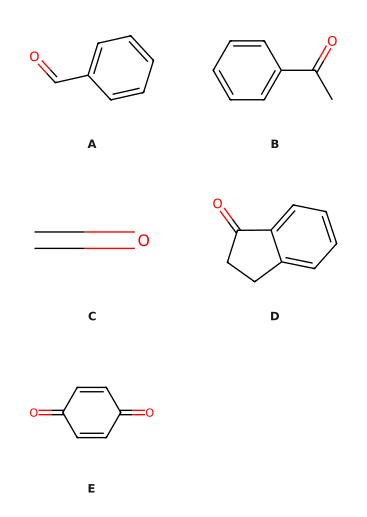
- TG EAPCET 2023Set ap-2023-05-11-AN1 markMCQQ.Compounds that participate in self aldol condensation are (A) A, B, C & E only (B) A, C, D & E only (C) B, D & E only (D) B & D only
›Reveal solutionSolution
Self-aldol condensation requires an α-hydrogen. Only acetophenone (B) and the indanone (D) have one; benzaldehyde, formaldehyde and benzoquinone do not. So the answer is "B & D only" — option (D).
The concept first: no α-H, no enolate, no aldol
Every aldol reaction begins the same way. A base removes a proton from the carbon next to the carbonyl — the α-carbon. It can do so because the resulting negative charge is delocalised onto the electronegative oxygen:
−CαH−C(=O)− OH− [−Cα−−C(=O)−⟷−C=C−O−]
That resonance-stabilised anion is the enolate, and it is the nucleophile that attacks a second molecule of the carbonyl compound. Then dehydration gives the α,β-unsaturated product.
Take away the α-hydrogen and the whole sequence is dead at step one. So the entire question reduces to: which of these five molecules has a hydrogen on a carbon directly attached to a carbonyl carbon? Nothing else matters.
Step-by-step: inspect each compound
- A — Benzaldehyde, C6H5CHO. The carbonyl carbon's neighbours are (i) the aldehydic H and (ii) an aromatic ring carbon, which bears no removable sp3 hydrogen. There is no α-hydrogen. Benzaldehyde therefore cannot self-condense; with concentrated alkali it undergoes the Cannizzaro disproportionation instead. ✗
- B — Acetophenone, C6H5COCH3. The methyl group sits directly on the carbonyl carbon and carries three α-hydrogens. Base removes one, forming the enolate, and self-aldol condensation proceeds (giving dypnone on dehydration). ✓
- C — Formaldehyde, HCHO. Both substituents on the carbonyl carbon are hydrogens — but those are aldehydic hydrogens, not α-hydrogens. There is no α-carbon at all. So no enolate, no self-aldol. (Like benzaldehyde, HCHO undergoes Cannizzaro — and in the crossed Cannizzaro it is always the one that gets oxidised.) ✗ …
🎓Unlock everything free for 14 days
- ✓Full step-by-step solutions
- ✓Concept-first explanations
- ✓Methods, shortcuts & mistakes
- ✓PYQ mapping + timed mock tests
Full access for 14 days. No credit card required.