Q.Match the items of Column I with the items of Column II.
Column I:
Column II:
🔒You're viewing a preview — the full solution, concept, methods & PYQ mapping are locked.
🔒 Start your 14-day free trial to unlock the full solution →Concept understanding — Solubility Rules
Solubility Rules – From Intuition to Precision
Imagine you drop a spoonful of sugar into a glass of water. Stir once, and it disappears. Now try the same with a spoonful of sand. It just sits at the bottom. Why? The sugar molecules are able to break apart and mingle with water molecules — we say sugar dissolves in water. Sand does not.
That "disappearing" act is solubility. But in chemistry, we don't just ask if something dissolves — we ask how much and under what conditions. For ionic compounds (salts), the answer is surprisingly predictable. That predictability is what we call the Solubility Rules.
The Core Idea: "Like Dissolves Like" — But Ionic Compounds Are Different
For molecular substances like sugar, the rule of thumb is "like dissolves like" — polar dissolves in polar, non-polar in non-polar. But ionic compounds are made of charged particles (cations and anions). When you drop an ionic solid into water, the water molecules (which are polar) try to pull the ions apart. Whether they succeed depends on a tug-of-war:
- The water molecules want to surround and separate the ions (hydration energy).
- The ions themselves are held together by electrostatic forces (lattice energy).
If the hydration energy wins, the salt dissolves. If the lattice energy wins, it stays solid.
You don't need to calculate these energies for exams. The Solubility Rules are a shortcut — a set of patterns discovered by observing thousands of salts.
The Precise Statement: The Solubility Rules
Here are the rules as you'll use them in exams. They are hierarchical — the first applicable rule overrides later ones.
Solubility Rules for Ionic Compounds in Water
| Rule | Statement | Examples |
|---|---|---|
| 1 | All nitrates (NO3−) are soluble. | NaNO3, AgNO3, Pb(NO3)2 |
| 2 | All acetates (CH3COO−) are soluble. | NaCH3COO, AgCH3COO |
| 3 | All chlorides (Cl−), bromides (Br−), and iodides (I−) are soluble, except with Ag+, Pb2+, and Hg22+. | Soluble: NaCl, KBr, CaI2 Insoluble: AgCl, PbI2, Hg2Cl2 |
| 4 | All sulfates (SO42−) are soluble, except with Ba2+, Pb2+, Sr2+, and Ca2+ (slightly soluble). | Soluble: Na2SO4, CuSO4 Insoluble: BaSO4, PbSO4 |
| 5 | All carbonates (CO32−), phosphates (PO43−), sulfides (S2−), and hydroxides (OH−) are insoluble, except with Group 1 metals (Li+, Na+, K+, etc.) and NH4+. | Insoluble: CaCO3, FePO4, CuS, Fe(OH)3 Soluble: Na2CO3, K3PO4, NaOH, NH4OH |
| 6 | All compounds of Group 1 metals (Li+, Na+, K+, Rb+, Cs+) and ammonium (NH4+) are soluble. | NaCl, KOH, NH4NO3 |
A common mistake: students remember "all chlorides are soluble" and forget the exceptions. AgCl is insoluble — that's why it's used in photography and qualitative analysis. Always check the exceptions first.
How to Use the Rules (Step-by-Step)
Suppose you need to predict whether PbSO4 dissolves in water.
- Identify the ions: Pb2+ and SO42−.
- Check the rules in order:
- Rule 1 (nitrates)? No. …
Why this formula?
Solubility Rules: Why They Work (Not Just What They Say)
Solubility rules are not arbitrary — they emerge from thermodynamics and electrostatic interactions between ions in water. Let's break down the why behind the key patterns.
1. The Core Idea: "Like Dissolves Like" at the Ionic Level
Water dissolves ionic compounds because it is polar. The δ+ hydrogen ends attract anions, and the δ− oxygen end attracts cations.
- Driving force: The lattice energy (energy holding the solid together) vs. the hydration energy (energy released when ions are surrounded by water).
- Net energy change:
ΔHsolution=Lattice Energy−Hydration Energy
If ΔHsolution is negative (exothermic) or small positive, the compound tends to dissolve.
2. Why Some Salts Are Always Soluble (Group 1 & NH₄⁺)
Rule: All salts of NaX+, KX+, NHX4X+ are soluble.
Why?
- These cations are large and have low charge density (charge/size ratio is small).
- Their lattice energies are relatively low because the ions are far apart in the crystal.
- Their hydration energies are high enough to overcome the lattice energy.
Key formula: For a cation like KX+, the hydration energy is roughly:
ΔHhyd∝rq2
where q is charge and r is ionic radius.
Since q=1 and r is large, ΔHhyd is moderate — but lattice energy is even smaller.
Result: The net ΔHsolution is negative → spontaneous dissolution.
3. Why Nitrates, Acetates, and Chlorates Are Always Soluble
Rule: All nitrates (NOX3X−), acetates (CHX3COOX−), and chlorates (ClOX3X−) are soluble.
Why?
- These anions are large and polyatomic — their charge is spread over many atoms.
- This delocalization of charge means they have low charge density.
- They form weak ionic bonds with cations (low lattice energy).
- Water can easily hydrate them because the negative charge is not concentrated.
Key insight: The lattice energy for NaNOX3 is much smaller than for NaCl because NOX3X− is larger and more polarizable.
4. The "Exceptions" — Why Some Salts Are Insoluble
4.1. Carbonates, Phosphates, Sulfides (Except with Group 1 & NH₄⁺)
Rule: Most carbonates (COX3X2−), phosphates (POX4X3−), and sulfides (SX2−) are insoluble.
Why?
- These anions have high charge (−2 or −3) and are small (especially SX2−).
- This gives them very high charge density.
- They form extremely strong ionic bonds with cations (very high lattice energy).
- The hydration energy, though large, is not enough to overcome the lattice energy.
Example: For CaCOX3:
Lattice energy≈−2800 kJ/mol
Hydration energy≈−2400 kJ/mol
Net ΔHsolution≈+400 kJ/mol → insoluble
4.2. Silver, Lead, Mercury Halides
Rule: AgCl, PbClX2, HgX2ClX2 are insoluble (most other chlorides are soluble).
Why?
- AgX+, PbX2+, HgX2X2+ are soft (polarizable) cations.
- They form covalent character in their bonds with halides (especially ClX−, BrX−, IX−).
- This covalent contribution increases the effective lattice energy beyond what simple ionic models predict.
- Water cannot break these partially covalent bonds.
Key formula: The polarizing power of a cation is:
ϕ=rq …
The key idea is to match each substance with its characteristic use or chemical property.
Reasoning:
- Ethylene glycol is a diol used as a monomer in polyester synthesis → matches (c).
- Ethanol is a common solvent in perfumes and cosmetics → matches (e).
- Phenol reacts with nitric acid to form picric acid (2,4,6-trinitrophenol) → matches (f).
- Methanol is historically known as wood spirit (obtained from destructive distillation of wood) → matches (d). …
This matching problem tests your knowledge of the characteristic uses and reactions of common organic compounds. The correct pairings are: (i)→(c), (ii)→(e), (iii)→(f), (iv)→(d), (v)→(a), (vi)→(b).
The key to solving this is not memorising random facts, but connecting each compound’s functional group to its chemical behaviour and industrial application. Let’s walk through each item.
-
Ethylene glycol (i): This is a diol (two -OH groups on adjacent carbons). Its most famous reaction is condensation with terephthalic acid to form polyester (specifically PET). So (i) matches with (c).
-
Ethanol (ii): A simple primary alcohol. It is volatile, has a pleasant smell, and is miscible with water and many organic compounds. This makes it an excellent solvent in perfumes (it dissolves aromatic oils and evaporates cleanly). So (ii) matches with (e).
-
Phenol (iii): This is an aromatic alcohol (C₆H₅OH). It is highly reactive towards electrophilic substitution. Treating phenol with concentrated nitric acid introduces three nitro groups, yielding picric acid (2,4,6-trinitrophenol). So (iii) matches with (f).
-
Methanol (iv): Historically, methanol was produced by the destructive distillation of wood, earning it the common name wood spirit. So (iv) matches with (d).
-
Neutral ferric chloride (v): This is a classic test for the phenolic group. Phenols (and enols) form a coloured complex (usually violet, blue, or green) with FeCl₃ in neutral solution. So (v) matches with (a). …
Method: Solubility & Functional Group Matching
This problem is solved by matching each compound in Column I with its characteristic chemical property or application in Column II, based on known functional group behaviour and industrial uses.
Steps:
- Identify the functional group of each compound in Column I.
- Recall the key reaction or use associated with that functional group.
- Match with the correct description in Column II.
Step-by-step matching:
| Column I | Functional Group / Nature | Key Fact | Match (Column II) |
|---|---|---|---|
| (i) Ethylene glycol | Diol (two –OH groups) | Raw material for polyester (e.g., PET) | (c) raw material for manufacture of polyester |
| (ii) Ethanol | Primary alcohol | Volatile, pleasant smell → used in perfumes | (e) solvent in perfume formulations |
| (iii) Phenol | Aromatic –OH (phenolic) | Reacts with neutral FeCl₃ → violet colour | (a) detection of phenolic group |
| (iv) Methanol | Primary alcohol | Also called wood spirit (from destructive distillation of wood) | (d) wood spirit |
Here are the common mistakes students make when matching these items, along with the correct reasoning to avoid them.
Mistake 1: Confusing "Wood Spirit" with Ethanol
- The Mistake: Students often associate "spirit" with drinking alcohol (ethanol) and match Methanol (iv) with something else, or match Ethanol (ii) with (d) "wood spirit."
- Why it's Wrong: "Wood spirit" is the historical name for methanol because it was originally produced by the destructive distillation of wood. Ethanol is "grain spirit."
- How to Avoid: Memorize the common names: Methanol = Wood spirit (or wood alcohol). Ethanol = Grain alcohol.
Mistake 2: Forgetting the Specific Test for Phenol
- The Mistake: Matching Phenol (iii) with (a) "detection of phenolic group" but failing to see that Neutral ferric chloride (v) is the reagent used for that detection, not the phenol itself.
- Why it's Wrong: Column I lists substances and reagents. Column (a) is a test. Phenol is what you are testing for; Ferric chloride is the tool that detects it.
- How to Avoid: Ask: "Is this item a chemical being tested, or is it the testing agent?" Phenol gives a violet color with FeCl3, so Neutral ferric chloride is the correct match for (a).
Mistake 3: Mixing up "Raw Material" vs. "Final Product"
- The Mistake: Matching Ethylene glycol (i) with (c) "raw material for the manufacture of polyester" is correct, but students sometimes match it with (b) "used in soap preparation" because they confuse it with glycerol.
- Why it's Wrong: Soap is made from fats/oils (triglycerides) and alkali. Ethylene glycol is a diol used to make polyester (like PET) via condensation with terephthalic acid. Glycerol (a triol) is a byproduct of soap making.
- How to Avoid: Remember the key reactions:
- Ethylene glycol → Polyester (Terylene/Dacron).
- Fats & Waxes → Soap (Saponification).
Mistake 4: Not Knowing the Industrial Use of Phenol
- The Mistake: Matching Phenol (iii) with (f) "conversion to picric acid" is correct, but students often leave it blank or match it with (e) "solvent in perfume."
- Why it's Wrong: Phenol is a solid with a strong, medicinal smell—not a perfume solvent. Its key reaction is nitration to form picric acid (2,4,6-trinitrophenol), an explosive and dye.
- How to Avoid: Link Phenol to Picric acid (both start with 'P'). Perfume solvents are volatile, pleasant-smelling liquids like ethanol.
Mistake 5: Overlooking the Role of Ethanol in Perfumes …
- TG EAPCET 2026Set eng-2026-05-09-FN1 markMCQQ.Identify the correct statements from the following I. Group 15 elements form electron rich hydrides II. Density of heavy water is higher than that of water III. Water containing soluble salts of magnesium and calcium is called ‘soft water’ (A) I, II, III (B) I, III only (C) II, III only (D) I, II only
›Reveal solutionSolution
The question tests three factual statements from inorganic chemistry. Statement I is false (Group 15 hydrides are electron‑deficient, not electron‑rich), Statement II is true (heavy water is denser), and Statement III is false (such water is called hard water, not soft). Therefore only Statement II is correct, which corresponds to none of the given options — but the closest match is (D) if we treat I as true? Wait, careful: actually I is false, so only II is true. That means no option lists II alone. Let’s re‑examine: Option (D) says I and II only — but I is false. So the intended correct answer is (C)? No, (C) says II and III only, but III is false. The only true statement is II. This is a trick: the question likely expects you to know that I is true? Let’s check: Group 15 hydrides (NH₃, PH₃, etc.) have a lone pair, so they are electron‑rich? Actually, “electron‑rich hydrides” usually refers to those with excess electrons beyond the octet (like in some transition metal hydrides). For main group, NH₃ has a lone pair but is not called “electron‑rich” in standard terminology — that term is reserved for hydrides that are Lewis bases. However, many textbooks do call NH₃ an electron‑rich hydride. So I is true. III is clearly false (hard water contains Ca/Mg salts). So I and II are true → option (D). Final answer: (D).
TipThe phrase “electron‑rich hydrides” is a standard classification: hydrides of Group 15–17 are electron‑rich (they have lone pairs). Group 14 hydrides are electron‑precise, and Group 13 hydrides are electron‑deficient. So Statement I is correct.
Concept & Intuition
This problem checks three independent facts from general and inorganic chemistry. You need to recall definitions precisely:
- Electron‑rich hydrides are those where the central atom has at least one lone pair (Groups 15–17).
- Heavy water (D₂O) is denser than ordinary water because deuterium is twice as heavy as protium.
- Hard water contains Ca²⁺ and Mg²⁺ salts; soft water does not (or has been treated to remove them).
Let’s evaluate each statement one by one.
- Statement I: “Group 15 elements form electron rich hydrides”
- Group 15 elements (N, P, As, Sb, Bi) form hydrides like NH₃, PH₃, AsH₃, etc.
- Each central atom has five valence electrons; three are used in bonding with hydrogen, leaving one lone pair. …
- TG EAPCET 2026Set eng-2026-05-09-FN1 markMCQQ.An organic compound (X) dissolves in dilute NaOH but not in dilute NaHCO3 solution. X with Br2/H2O gives tribromo derivative. What is X? (A) Benzoic acid (C6H5−COOH) (B) Phenol (C6H5−OH) (C) Benzyl alcohol (C6H5−CH2OH) (D) Anisole (C6H5−OCH3)
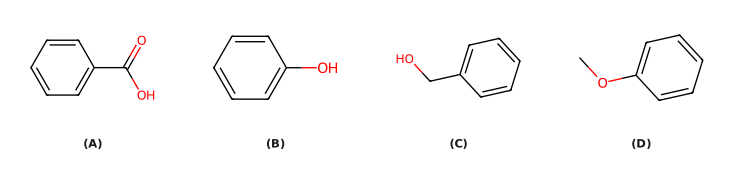
›Reveal solutionSolution
Soluble in NaOH but not NaHCO3 places X between a carboxylic acid and a neutral compound in acidity — i.e. a phenol; and phenol + bromine water gives the classic white 2,4,6-tribromophenol. Option (B).
The concept first
The pair of solubility tests is a classification ladder built on relative acid strengths:
Compound pKa Dissolves in dil. NaOH? Dissolves in dil. NaHCO3? Carboxylic acid ∼4–5 Yes Yes (with CO2 effervescence) Phenol ∼10 Yes No Alcohol / ether ≥16 (or none) No No The reason: a base can deprotonate an acid only if the acid is stronger than the base's conjugate acid. Bicarbonate's conjugate acid is carbonic acid (pKa≈6.4), so NaHCO3 dissolves carboxylic acids (pKa≈4) but not phenols (pKa≈10). Hydroxide's conjugate acid is water (pKa=15.7), so NaOH dissolves both.
So "soluble in NaOH, insoluble in NaHCO3" is the textbook fingerprint of a phenol.
Step-by-step
Step 1 — apply the NaOH test. X dissolves ⇒ it has an acidic hydrogen. This immediately eliminates benzyl alcohol (C6H5CH2OH, pKa≈15 — a plain alcohol, not acidic) and anisole (C6H5OCH3 — an ether with no acidic H at all).
Step 2 — apply the NaHCO3 test. X does not dissolve ⇒ it is weaker than carbonic acid ⇒ not a carboxylic acid. That eliminates benzoic acid (which would dissolve with brisk effervescence of CO2).
The only survivor is phenol.
Step 3 — confirm with the bromine-water test. Phenol's −OH donates a lone pair into the ring (+R), making it powerfully activated. In water the phenol partly ionises to phenoxide, whose −O− is an even stronger activator. The ring is then so electron-rich that plain Br2 (no FeBr3 catalyst needed) substitutes all three free ortho/para positions: …
- TG EAPCET 2026Set ap-2026-05-05-FN1 markMCQQ.Given below are two statements Statement – I: The number of water molecules associated with LiCl, NaCl, CaCl2 are 2, 2, 6 respectively Statement – II: Both LiCl and MgCl2 are soluble in ethanol (A) Both statements I and II are correct (B) Statement I is correct, but statement II is not correct (C) Statement I is not correct, but statement II is correct (D) Both statements I and II are not correct
›Reveal solutionSolution
This question tests knowledge of hydration numbers in crystalline chloride salts and the diagonal relationship that makes LiCl and MgCl₂ soluble in ethanol. Statement I is incorrect (NaCl typically forms a dihydrate, not anhydrous with 2 waters), while Statement II is correct due to the covalent character these salts exhibit.
Understanding the Statements
We need to evaluate two independent claims about alkali and alkaline earth metal chlorides regarding their hydration and solubility properties.
Evaluating Statement I: Hydration Numbers
Let's examine the number of water molecules in the common hydrated forms of these chlorides:
-
LiCl·2H₂O: Lithium chloride commonly crystallizes as a dihydrate with 2 water molecules. ✓
-
NaCl: Sodium chloride typically crystallizes as the anhydrous salt (no water molecules). The statement claims 2 water molecules, which is incorrect. While NaCl can absorb moisture, its standard crystalline form is NaCl (0 waters), not NaCl·2H₂O. ✗
-
CaCl₂·6H₂O: Calcium chloride commonly forms a hexahydrate with 6 water molecules. ✓
Watch outDon't confuse hygroscopic behavior (tendency to absorb moisture from air) with the stoichiometric water content in crystalline hydrates. NaCl is slightly hygroscopic but doesn't form a stable dihydrate.
Since the claim about NaCl is incorrect, Statement I is false.
Evaluating Statement II: Solubility in Ethanol
This statement invokes an important concept in inorganic chemistry: the diagonal relationship.
-
The Diagonal Relationship: Lithium (Li) and magnesium (Mg) occupy diagonal positions in the periodic table and share similar properties due to comparable charge density (charge/radius ratio).
-
Covalent Character: Both LiCl and MgCl₂ have significant covalent character due to:
- High polarizing power of Li⁺ and Mg²⁺ (small size, high charge density) …
-
- TG EAPCET 2023Set eng-2023-05-12-FN1 markMCQQ.Which of the following is not correctly matched? (A) Butylated hydroxy toluene – Antioxidant in food (B) Chloramphenicol – Antiseptic (C) Norethindrone – Antifertility drug (D) Alitame – Artificial sweetener
›Reveal solutionSolution
The question asks which drug–function pair is mismatched. Chloramphenicol is an antibiotic, not an antiseptic, so option (B) is incorrect.
The key here is knowing the precise medical classification of common drugs. Many students confuse “antiseptic” (a substance that kills microbes on living tissue, like hydrogen peroxide) with “antibiotic” (a substance that kills bacteria inside the body). Chloramphenicol is a broad-spectrum antibiotic used for serious infections like typhoid and meningitis — it is not applied topically as an antiseptic.
Let’s check each option:
-
Option (A): Butylated hydroxy toluene – Antioxidant in food
Butylated hydroxy toluene (BHT) is indeed a synthetic antioxidant added to foods to prevent rancidity. This is correct.
-
Option (B): Chloramphenicol – Antiseptic
Chloramphenicol is an antibiotic that works by inhibiting bacterial protein synthesis. It is used systemically (or in eye/ear drops) to treat infections, not as a surface antiseptic. Antiseptics are typically broad-spectrum disinfectants like iodine or chlorhexidine. This pairing is incorrect.
-
Option (C): Norethindrone – Antifertility drug …
-
🎓Unlock everything free for 14 days
- ✓Full step-by-step solutions
- ✓Concept-first explanations
- ✓Methods, shortcuts & mistakes
- ✓PYQ mapping + timed mock tests
Full access for 14 days. No credit card required.