Q.The best reagent for converting 2-phenylpropanamide into 1-phenylethanamine is ____.
🔒You're viewing a preview — the full solution, concept, methods & PYQ mapping are locked.
🔒 Start your 14-day free trial to unlock the full solution →Concept understanding — SN1 Reactivity Order
The Core Intuition: Who Wants to Leave, and Who Can Wait?
Imagine you're at a party where the host (the leaving group) is about to leave. The party (the reaction) happens in two stages. First, the host walks out the door — that's the slow, painful step. Then, a new guest (the nucleophile) rushes in to take the empty spot.
The SN1 reaction works exactly like this: the leaving group leaves first, forming a carbocation intermediate. The nucleophile attacks after the leaving group is gone. This means the rate of the reaction depends only on how easily the leaving group can leave — it does not depend on the nucleophile at all.
So the question becomes: What makes a carbocation form easily? The answer is stability. A carbocation that is more stable will form faster and last longer, making the SN1 reaction faster.
The Precise Statement of SN1 Reactivity Order
SN1 Reactivity Order (for alkyl halides):
Allylic≈Benzyl>3∘>2∘≫1∘≈Methyl
This is the order of how fast the SN1 reaction proceeds. Let's unpack why.
Why This Order? The Stability Ladder
A carbocation is a carbon with only six electrons in its valence shell — it's electron-deficient and positively charged. The more you can spread out (delocalize) that positive charge, the more stable the carbocation becomes.
1. Methyl and 1° Carbocations: The Unstable Ones
A methyl carbocation (CHX3X+) has no alkyl groups attached to the positive carbon. There is zero electron-donating effect to stabilize the charge. It is so unstable that it practically never forms in an SN1 reaction — the reaction simply doesn't happen.
A primary (1°) carbocation has one alkyl group attached. Alkyl groups are weakly electron-donating (through hyperconjugation and inductive effect), so it's slightly more stable than methyl — but still far too unstable to form under normal SN1 conditions.
Never say "SN1 happens on a primary carbon" in an exam. It is essentially impossible under standard conditions because the carbocation is too unstable.
2. Secondary (2°) Carbocations: The Borderline Case
A secondary carbocation has two alkyl groups donating electron density. It is moderately stable — stable enough to form, but only under certain conditions (like a good leaving group and a polar protic solvent). SN1 reactions on secondary carbons are possible, but they are slower than on tertiary carbons.
3. Tertiary (3°) Carbocations: The Sweet Spot
Three alkyl groups donate electron density to the positive carbon. This makes the carbocation very stable. Tertiary alkyl halides undergo SN1 reactions readily — they are the classic example.
4. Allylic and Benzylic: The Champions
These are special cases. In an allylic carbocation, the positive charge is adjacent to a carbon-carbon double bond. The π electrons of the double bond can delocalize the positive charge onto the second carbon:
CHX2=CH−CHX2X+↔+CHX2−CH=CHX2
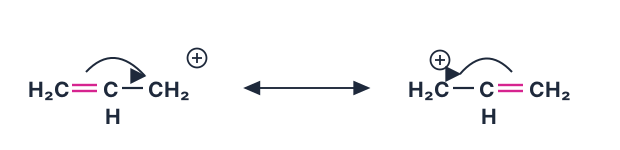
In a benzylic carbocation, the positive charge is adjacent to a benzene ring. The π system of the ring delocalizes the charge across multiple carbons:
CX6HX5−CHX2X+↔(several resonance structures)
Here are those resonance structures — the positive charge cycles from the CH₂ carbon onto the ortho and para positions of the ring:
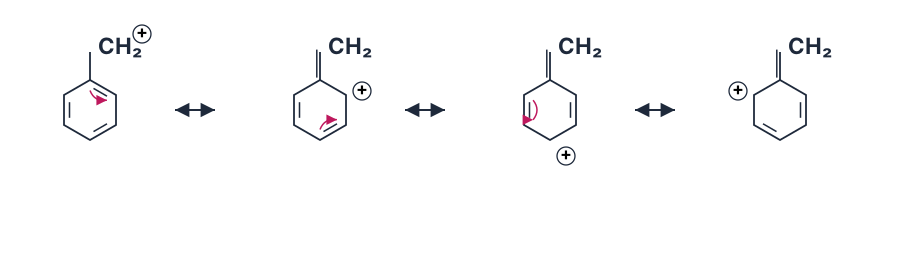
This resonance stabilization makes allylic and benzylic carbocations even more stable than tertiary ones. They form the fastest in SN1 reactions.
The Complete Picture in a Table
| Carbocation Type | Stability | SN1 Reactivity | Example |
|------------------|-----------|----------------|---------| …
Why this formula?
SN1 Reactivity Order: Why It Holds
The SN1 reaction (Substitution Nucleophilic Unimolecular) proceeds via a carbocation intermediate. The reactivity order is determined entirely by the stability of this carbocation — because the rate-determining step is its formation.
The Core Principle
The rate law for SN1 is:
Rate=k[RX]
Only the substrate appears in the rate law — the nucleophile does not participate in the slow step. The slow step is:
RXslowR++X−
Thus, anything that stabilizes the carbocation (R⁺) lowers the activation energy and increases the reaction rate.
The Reactivity Order
For alkyl halides (RX), the SN1 reactivity order is:
Allylic>Benzyllic>Tertiary>Secondary>Primary>Methyl
Let's break down why each step holds.
1. Why Tertiary > Secondary > Primary > Methyl?
This is purely about hyperconjugation and inductive effect.
- Tertiary carbocation: Three alkyl groups donate electron density via hyperconjugation (C–H σ bonds overlap with empty p orbital) and +I effect. This spreads the positive charge over more atoms → most stable.
- Secondary: Two alkyl groups → less stabilization.
- Primary: Only one alkyl group → very little stabilization.
- Methyl: No alkyl groups → least stable (only inductive effect from H atoms, which is negligible).
Key formula: The number of α-hydrogens (H on carbons adjacent to the positive carbon) determines hyperconjugation. More α-H → more resonance structures → more stable.
2. Why Allylic and Benzylic Are Even Faster
These carbocations are resonance-stabilized.
- Allylic carbocation: The positive charge is delocalized over two carbon atoms via π-bond conjugation:
CH2=CH−CH2+⟷CH2+−CH=CH2
- Benzylic carbocation: The positive charge is delocalized into the aromatic ring:
C6H5−CH2+⟷several resonance forms involving the ring
Those resonance forms look like this:
This resonance stabilization is so powerful that even a primary allylic or benzylic carbocation is more stable than a tertiary alkyl carbocation.
3. The Complete Order (with reasoning) …
The target, 1-phenylethanamine (C6H5CH(NH2)CH3), has ONE FEWER carbon than the starting amide, 2-phenylpropanamide (C6H5CH(CH3)CONH2) - that carbon loss is the signature of the Hofmann bromamide degradation, not a simple reduction. Br2 in aqueous NaOH degrades the amide with loss of the carbonyl carbon as CO2, giving exactly the target amine. …
1-Phenylethanamine has one fewer carbon than the starting amide, 2-phenylpropanamide - so this conversion needs the Hofmann bromamide degradation (Br2 in aqueous NaOH), which expels the carbonyl carbon as CO2, not a hydride reduction (which keeps all three carbons). The correct reagent is Br2 in aqueous NaOH, option (ii).
Compare the starting material and the target carbon-by-carbon. 2-Phenylpropanamide is C6H5-CH(CH3)-CONH2: a three-carbon amide chain (the carbonyl carbon, the CH bearing the phenyl group, and the terminal methyl). The target, 1-phenylethanamine, is C6H5-CH(NH2)-CH3: only two carbons remain, with the amino group on the carbon that used to bear the phenyl substituent - the carbonyl carbon is gone entirely.
Losing a carbon while converting the amide group to an amine is exactly what the Hofmann bromamide degradation does: treating a primary amide with Br2 in aqueous/alcoholic NaOH forms an N-bromoamide, which rearranges (via an isocyanate intermediate) with loss of the carbonyl carbon as CO2, leaving the remaining group bonded directly to NH2. Applied here, 2-phenylpropanamide converts straight to 1-phenylethanamine.
Now check the other options:
- (i) excess H2/Pt does not reduce an amide carbonyl under ordinary catalytic hydrogenation conditions.
- (iii) NaBH4/methanol is too mild to reduce an amide. …
Concept: Hofmann Rearrangement (Hofmann Degradation)
This reaction converts a primary amide into a primary amine with one fewer carbon atom in the chain. The reagent used is bromine in aqueous sodium hydroxide (Br2/NaOH).
Method: Hofmann Rearrangement
Step 1 — Identify the starting material and target
- Starting amide: 2-phenylpropanamide Structure: C6H5−CH(CH3)−CONH2
- Target amine: 1-phenylethanamine Structure: C6H5−CH(CH3)−NH2
Notice: The carbon chain length decreases by one (the carbonyl carbon is lost as CO2).
Step 2 — Apply the reagent logic
- Hofmann rearrangement uses Br2/NaOH to convert R−CONH2 → R−NH2
- The alkyl group (R) attached to the carbonyl remains attached to the nitrogen in the product.
- Here, R=C6H5−CH(CH3)−, which directly gives the target amine.
Step 3 — Eliminate other options …
Common Mistakes & How to Avoid Them
Concept: Hofmann Rearrangement vs. Reduction of Amides
The reaction converts an amide (2-phenylpropanamide) into a primary amine (1-phenylethanamine). The key observation: the carbon chain loses one carbon atom — the amide carbon is lost as CO2.
✗ Mistake 1: Choosing LiAlH4 (Option D) or NaBH4 (Option C)
Why students do this:
They see "amide → amine" and immediately think of reduction. LiAlH4 is a strong reducing agent that converts amides to amines.
Why it's wrong here:
LiAlH4 reduces amides to amines without changing the carbon skeleton.
- 2-phenylpropanamide (C6H5CH(CH3)CONH2) would give 2-phenylpropanamine (C6H5CH(CH3)CH2NH2).
- But the product asked is 1-phenylethanamine (C6H5CH(NH2)CH3) — one carbon fewer.
NaBH4 is even weaker and does not reduce amides at all under normal conditions.
How to avoid:
Always count the carbons in the reactant and product. If the chain shortens, reduction is not the answer — look for a rearrangement or degradation reaction.
✗ Mistake 2: Choosing H2/Pt (Option A)
Why students do this:
They think "hydrogenation" or "catalytic reduction" will convert the amide to an amine.
Why it's wrong:
H2/Pt reduces alkenes, alkynes, nitro groups, and nitriles — but not amides. Amides are very stable toward catalytic hydrogenation.
How to avoid:
Memorise the functional groups that H2/catalyst reduces:
- C=C, C≡C, −NO2, −CN, −CHO, −CO− (ketones/aldehydes)
- Not −CONH2, −COOH, −COOR
✓ Correct Answer: NaOH/Br2 (Option B) — Hofmann Rearrangement
Why it works:
This is the Hofmann bromamide rearrangement.
- The amide reacts with Br2 in NaOH to form an isocyanate intermediate.
- The isocyanate loses CO2 (hence the loss of one carbon).
- The product is a primary amine with one fewer carbon in the chain.
Reaction summary: …
- TG EAPCET 2026Set eng-2026-05-11-AN1 markMCQQ.An alkene, C4H8 (X) on reaction with HBr gives a compound Y. Hydrolysis of Y follows SN1 mechanism. The ozonolysis products of X are (A) CH3CH2CHO, CH2O (B) CH3CHO, CH3CHO (C) CH3CH2OH, CH3CHO (D) CH3COCH3, CH2O
›Reveal solutionSolution
The alkene X must be 2-methylpropene because its addition of HBr gives a tertiary bromide that hydrolyzes via SN1; ozonolysis of that alkene yields acetone and formaldehyde, matching option (D).
Concept & Intuition
The key is to work backwards from the SN1 hydrolysis condition. SN1 reactions favor tertiary or secondary carbocations. The compound Y is an alkyl bromide formed by adding HBr to the alkene X. If Y hydrolyzes via SN1, then Y must be a tertiary (or possibly secondary) bromide. That tells us the alkene X must be one that, upon HBr addition, gives a tertiary (or stable secondary) carbocation intermediate. Among the four C4H8 isomers, only 2-methylpropene (isobutylene) yields a tertiary carbocation. Once we identify X, ozonolysis tells us the carbonyl fragments.
Step-by-step reasoning
-
Identify possible alkene isomers of C4H8
The four structural isomers are:
- But-1-ene: CH2=CH–CH2–CH3
- But-2-ene: CH3–CH=CH–CH3 (cis/trans)
- 2-Methylpropene: (CH3)2C=CH2
- Cyclobutane (not an alkene, ignore) and methylcyclopropane (also not an alkene here).
-
Determine which alkene gives a tertiary bromide with HBr
Addition of HBr follows Markovnikov’s rule: the H adds to the less substituted carbon, Br to the more substituted carbon.
- But-1-ene → secondary carbocation → 2-bromobutane (secondary).
- But-2-ene → secondary carbocation → 2-bromobutane (secondary).
- 2-Methylpropene → tertiary carbocation → 2-bromo-2-methylpropane (tertiary). Only the tertiary bromide undergoes SN1 hydrolysis readily. So X must be 2-methylpropene.
-
Confirm SN1 hydrolysis of Y
Y = (CH3)3C–Br. In water or aqueous conditions, it forms a tertiary carbocation, then reacts with water to give (CH3)3C–OH (tert-butyl alcohol). This is a classic SN1 reaction.
-
Ozonolysis of X (2-methylpropene)
Ozonolysis cleaves the C=C double bond, replacing each carbon with a carbonyl group.
For (CH3)2C=CH2: …
-
- TG EAPCET 2025Set ap-2025-04-29-AN1 markMCQQ.Observe the following set of reactions Y HBr 2-Methylpropene HBr X Correct statement regarding X and Y is Options : (A) Both X and Y undergo nucleophilic substitution by SN1 mechanism (B) Both X and Y undergo nucleophilic substitution by SN2 mechanism (C) X undergoes nucleophilic substitution by SN1 and Y by SN2 mechanism (D) X undergoes nucleophilic substitution by SN2 and Y by SN1 mechanism
›Reveal solutionSolution
X = tertiary tert-butyl bromide (SN1); Y = primary isobutyl bromide (SN2).
The central compound is 2-methylpropene, (CH3)2C=CH2.
Formation of X: 2-methylpropene + HBr adds by Markovnikov's rule; H goes to the terminal CH2 and Br to the more substituted carbon, giving 2-bromo-2-methylpropane (tert-butyl bromide). This is a tertiary halide, which ionises easily to a stable 3-degree carbocation, so it undergoes nucleophilic substitution by the SN1 mechanism. …
- TG EAPCET 2023Set ap-2023-05-10-FN1 markMCQQ.The artificial sweetener that contain chlorine is X and that contain sulphur is Y. X and Y respectively are (A) Aspartame, Saccharin (B) Sucralose, Alitame (C) Alitame, Sucralose (D) Saccharin, Aspartame
›Reveal solutionSolution
The question asks which artificial sweetener contains chlorine and which contains sulphur. Sucralose is a chlorinated derivative of sucrose (contains chlorine), and Alitame contains sulphur in its structure. Therefore, X = Sucralose and Y = Alitame, which corresponds to option (B).
The key to this question is knowing the chemical structures of common artificial sweeteners. Many students memorize names but forget the functional groups or elements present. Let’s break it down.
-
Identify the sweetener that contains chlorine.
Sucralose is made by chlorinating sucrose — three hydroxyl groups are replaced by chlorine atoms. Its chemical name is 1,6-dichloro-1,6-dideoxy-β-D-fructofuranosyl-4-chloro-4-deoxy-α-D-galactopyranoside. The presence of chlorine is a defining feature. No other common sweetener has chlorine as a structural element.
-
Identify the sweetener that contains sulphur.
Alitame is a dipeptide sweetener (L-aspartic acid and D-alanine) with a terminal amide that includes a sulphur-containing group — specifically, a tetramethylthietanyl moiety. Sulphur is present in its structure. Among the options, only Alitame fits this description.
-
Check the other sweeteners for clarity.
- Aspartame: a methyl ester of a dipeptide (aspartic acid + phenylalanine). Contains no chlorine or sulphur. …
-
- TG EAPCET 2023Set eng-2023-05-14-AN1 markMCQQ.Which of the following acts as antihistamine? (A) Heroin (B) Dimetapp (C) Nardil (D) Veronal
›Reveal solutionSolution
Antihistamines block histamine receptors to relieve allergy symptoms; among the options, only Dimetapp is a common antihistamine formulation, so the correct answer is (B).
The key concept here is drug classification by mechanism of action. An antihistamine works by blocking histamine receptors (usually H₁ receptors) to reduce allergic reactions like sneezing, itching, and runny nose. The question tests whether you can distinguish between drugs used for allergies, pain, depression, or sleep — each belongs to a different pharmacological family.
Let’s examine each option:
-
Heroin (A) — This is an opioid, a powerful analgesic and recreational drug. It acts on mu-opioid receptors in the brain, not on histamine receptors. It has no antihistamine effect; in fact, opioids can sometimes release histamine, causing itching. So this is not an antihistamine.
-
Dimetapp (B) — This is a brand name for a combination cold and allergy medication. Its active ingredients typically include an antihistamine (like brompheniramine or diphenhydramine) and a decongestant. It is explicitly used to relieve allergy symptoms. Therefore, this is an antihistamine.
-
Nardil (C) — This is a brand name for phenelzine, a monoamine oxidase inhibitor (MAOI) used as an antidepressant. It affects neurotransmitter levels (serotonin, norepinephrine), not histamine. So it is not an antihistamine. …
-
- TG EAPCET 2022Set ap-2022-07-31-FN1 markMCQQ.The metallic fluoride that can be used for the preparation of alkyl fluorides from alkyl chlorides is (A) NaF (B) LiF (C) BF3 (D) Hg2F2
›Reveal solutionSolution
The key is that the reagent must be a source of fluoride ion that is soluble in organic solvents and can undergo a halogen-exchange reaction (Finkelstein-type) with alkyl chlorides. The correct choice is Hg2F2 because it is covalent and soluble in organic media, unlike ionic fluorides like NaF or LiF.
The question asks which metallic fluoride can convert an alkyl chloride into an alkyl fluoride. This is a classic example of a halogen-exchange reaction, specifically the Finkelstein reaction (or a variant). The challenge is that fluoride ion (F−) is very small, highly electronegative, and strongly solvated in polar protic solvents, making it a poor nucleophile in such environments. Therefore, we need a fluoride source that is soluble in organic solvents and provides a "naked" or weakly solvated fluoride ion.
Let’s evaluate each option:
-
NaF and LiF — These are ionic salts with high lattice energies. They are insoluble in most organic solvents (like acetone, ether, or chloroform) and dissolve only in water or highly polar solvents. In water, the fluoride ion is heavily hydrated and loses its nucleophilicity. Thus, they are ineffective for converting alkyl chlorides to alkyl fluorides in organic media.
-
BF3 — This is a Lewis acid, not a source of fluoride ions. It actually accepts fluoride ions to form BF4−. It would not donate fluoride to an alkyl chloride; instead, it might catalyze other reactions (like Friedel-Crafts) but not a simple substitution.
-
Hg2F2 (mercurous fluoride) — This is a covalent compound, soluble in organic solvents. It can undergo a metathesis reaction with alkyl chlorides:
-
- TG EAPCET 2022Set eng-2022-07-18-AN1 markMCQQ.The order of reactivity of the following compounds towards dilute aqueous KOH in SN1 reaction is CH3CH2CH2CH2Br \hspace{1cm} H3CCH2CHBrCH3 \hspace{1cm} (CH3)CHCH2Br \hspace{1cm} (CH3)3CBr I \hspace{2cm} II \hspace{2cm} III \hspace{2cm} IV Options : (A) I < IV < III < II (B) IV < II < III < I (C) III < II < I < IV (D) I < III < II < IV
›Reveal solutionSolution
In an SN1 reaction, the rate depends only on the stability of the carbocation intermediate. The more stable the carbocation, the faster the reaction. The order of reactivity is I < III < II < IV, which corresponds to option (D).
The key to this question is understanding what controls the rate of an SN1 reaction. Unlike SN2, where the nucleophile attacks the carbon bearing the leaving group in a single step, SN1 proceeds in two steps. First, the leaving group departs on its own, forming a carbocation. Then the nucleophile attacks that carbocation. The slow, rate-determining step is the first step — the formation of the carbocation.
That means the rate depends entirely on how easily the C–Br bond breaks, which in turn depends on how stable the resulting carbocation is. A more stable carbocation forms faster. So the problem reduces to ranking the stability of the carbocations that would form from each alkyl bromide.
Let’s look at each compound.
-
Compound I: CH3CH2CH2CH2Br (1-bromobutane)
This is a primary alkyl halide. If the Br leaves, the carbocation formed is a primary carbocation — CH3CH2CH2CH2+. Primary carbocations are very unstable because there is only one alkyl group donating electron density to the positive carbon. They are so unstable that SN1 reactions on primary halides are practically never observed under normal conditions. So this will be the slowest.
-
Compound III: (CH3)2CHCH2Br (1-bromo-2-methylpropane, isobutyl bromide)
This looks like a primary halide at first glance — the Br is on a primary carbon. But look at the carbocation that forms: (CH3)2CHCH2+. That is still a primary carbocation. However, there is a subtlety: this primary carbocation is adjacent to a tertiary carbon (the isopropyl group). It can undergo a 1,2-hydride shift to form a much more stable tertiary carbocation: (CH3)3C+. In an SN1 reaction, such rearrangements are common and fast. So although the initial carbocation is primary, the actual intermediate that reacts is the tertiary one. This makes compound III react faster than a simple primary halide like I, but still slower than a halide that directly gives a secondary or tertiary carbocation because the rearrangement step adds a small energy barrier.
-
Compound II: H3CCH2CHBrCH3 (2-bromobutane) …
-
- TG EAPCET 2022Set eng-2022-07-19-FN1 markMCQQ.The correct order of rate of acid mediated dehydration reaction of the following compounds is (A) II > III > IV > I (B) IV > III > I > II (C) III > II > IV > I (D) III > IV > II > I
›Reveal solutionSolution
The rate of acid-catalysed dehydration of alcohols depends on carbocation stability. The compound that forms the most stable carbocation reacts fastest. The correct order is III > II > IV > I, which corresponds to option (C).
The key concept here is that acid-mediated dehydration of alcohols proceeds via formation of a carbocation intermediate. The alcohol is protonated by the acid, water leaves, and a carbocation is formed. The rate-determining step is the formation of this carbocation. So, the more stable the carbocation that can be formed, the faster the reaction.
We need to compare the carbocation stability for each compound. The compounds are alcohols, and we must consider the structure of the carbocation that would result after loss of water. The stability order for carbocations is: tertiary > secondary > primary > methyl. Also, resonance stabilisation (allylic or benzylic) can make a carbocation even more stable than a simple tertiary one.
Let’s examine each compound:
-
Compound I: This is a primary alcohol. The carbon bearing the –OH group is attached to only one other carbon. After protonation and loss of water, it would form a primary carbocation. Primary carbocations are very unstable and difficult to form. This compound will have the slowest rate of dehydration.
-
Compound II: This is a secondary alcohol. The –OH carbon is attached to two other carbons. Loss of water gives a secondary carbocation. Secondary carbocations are more stable than primary but less stable than tertiary. So, this will be faster than I but slower than a tertiary alcohol.
-
Compound III: This is a tertiary alcohol. The –OH carbon is attached to three other carbons. Loss of water gives a tertiary carbocation. Tertiary carbocations are the most stable among simple alkyl carbocations due to hyperconjugation and inductive effects. This will be very fast.
-
Compound IV: This is also a secondary alcohol, but with a twist. The –OH carbon is attached to a carbon that is part of a benzene ring (benzylic position). Loss of water here gives a secondary carbocation that is benzylic. A benzylic carbocation is stabilised by resonance with the aromatic ring — the positive charge can be delocalised into the ring. This makes it even more stable than a simple tertiary carbocation. In fact, a benzylic carbocation is often comparable in stability to a tertiary carbocation, and in many cases more stable. So, compound IV will form a carbocation that is more stable than that from compound III.
Watch outA common mistake is to think that all secondary alcohols are slower than all tertiary alcohols. But resonance stabilisation (like in a benzylic or allylic position) can override the simple tertiary > secondary order. Here, the benzylic carbocation from IV is more stable than the tertiary carbocation from III.
So, the order of carbocation stability (and hence rate of dehydration) is: IV (benzylic secondary) > III (tertiary) > II (simple secondary) > I (primary).
Thus, the correct order is IV > III > II > I. But wait — look at the options. Option (B) says IV > III > I > II, which is wrong because II (secondary) is faster than I (primary). Option (D) says III > IV > II > I, which puts III before IV, which is incorrect. Option (A) says II > III > IV > I, which is completely reversed. None of these match IV > III > II > I exactly.
Let’s re-check the options carefully:
- (A) II > III > IV > I
- (B) IV > III > I > II
- (C) III > II > IV > I
- (D) III > IV > II > I …
-
- TG EAPCET 2022Set eng-2022-07-20-FN1 markMCQQ.Assertion (A): Tertiary alcohols produce turbidity immediately with Lucas reagent. Reason (R): Lucas reagent is a 1 : 1 mixture of conc. HNO3 and anhydrous ZnCl2. The correct option among the following is (A) is true, (R) is true and (R) is the correct explanation for (A) (B) (A) is true, (R) is true but (R) is not the correct explanation for (A) (C) (A) is true but (R) is false (D) (A) is false but (R) is true
›Reveal solutionSolution
Tertiary alcohols react immediately with Lucas reagent to form an insoluble alkyl halide, causing turbidity, because they form stable carbocations. However, Lucas reagent is a mixture of concentrated HCl and anhydrous ZnCl2, not HNO3. Therefore, Assertion (A) is true, but Reason (R) is false. The correct option is (C).
Concept and Intuition
The Lucas test is a classic method in organic chemistry used to distinguish between primary, secondary, and tertiary alcohols. The test relies on the difference in reactivity of these alcohols with a specific reagent, known as Lucas reagent.
Lucas reagent is a solution of concentrated hydrochloric acid (HCl) and anhydrous zinc chloride (ZnCl2). The reaction involves the substitution of the hydroxyl group (−OH) of the alcohol with a chloride ion (−Cl) to form an alkyl chloride (R-Cl).
R-OH+HClAnhydrous ZnCl2R-Cl+H2O
The key to the test is that alkyl chlorides are generally insoluble in the aqueous Lucas reagent, causing the solution to turn cloudy or turbid. The rate at which this turbidity appears indicates the type of alcohol:
- Tertiary alcohols react immediately, producing immediate turbidity.
- Secondary alcohols react within 5-10 minutes, producing turbidity after a short delay.
- Primary alcohols do not react significantly at room temperature, and no turbidity is observed.
This difference in reactivity is due to the mechanism of the reaction, which is primarily an SN1 (Substitution Nucleophilic Unimolecular) pathway, especially for tertiary and secondary alcohols. The rate-determining step in an SN1 reaction is the formation of a carbocation intermediate.
R-OH+H+⇌R-OH2+
R-OH2+slowR++H2O(Carbocation formation)
R++Cl−fastR-Cl
The stability of carbocations follows the order: tertiary (3∘) > secondary (2∘) > primary (1∘). Since tertiary carbocations are the most stable, they form most readily, leading to the fastest reaction rate for tertiary alcohols. Anhydrous ZnCl2 acts as a Lewis acid, coordinating with the oxygen of the alcohol and making the −OH group a better leaving group (H2O).
Step-by-step Evaluation
- Evaluate Assertion (A): Tertiary alcohols produce turbidity immediately with Lucas reagent.
- As explained above, tertiary alcohols form the most stable carbocations, leading to a very fast SN1 reaction with Lucas reagent. …
- TG EAPCET 2022Set ap-2022-07-31-AN1 markMCQQ.Which one of the following is more reactive towards SN1 reaction? (A) C6H5CH2Br (B) C6H5CH(CH3)Br (C) C6H5CH(C6H5)Br (D) C6H5C(CH3)(C6H5)Br
›Reveal solutionSolution
The key idea is that SN1 reactivity depends on carbocation stability. The most stable carbocation forms from the compound that best delocalises the positive charge, making (D) the most reactive.
The SN1 reaction proceeds through a two-step mechanism: first, the leaving group (bromide) departs, generating a carbocation intermediate; then the nucleophile attacks this carbocation. The rate-determining step is the formation of the carbocation, so anything that stabilises the carbocation speeds up the reaction. More stable carbocation → faster SN1 reaction.
The question gives four benzylic bromides. Each can lose Br− to form a carbocation where the positive charge is on the carbon that was attached to bromine. The stability of that carbocation depends on how many aryl (phenyl) groups and alkyl groups are attached to the positively charged carbon — because these groups can delocalise or donate electron density to stabilise the charge.
Let’s examine each option.
-
Option (A): C6H5CH2Br
Loss of Br− gives C6H5CH2+, a primary benzylic carbocation. The positive charge is stabilised by resonance with the phenyl ring, but there is only one phenyl group and no alkyl substituent on the carbocation carbon. This is the least stabilised among the four.
-
Option (B): C6H5CH(CH3)Br
The carbocation formed is C6H5CH+(CH3), a secondary benzylic carbocation. Here, the positive carbon has one phenyl group (resonance stabilisation) and one methyl group (inductive + hyperconjugative stabilisation). This is more stable than (A).
-
Option (C): C6H5CH(C6H5)Br
This gives C6H5CH+(C6H5), a secondary benzylic carbocation with two phenyl groups attached. Two phenyl rings can delocalise the positive charge through resonance, making this carbocation significantly more stable than (B). The extra phenyl group adds a second resonance pathway.
-
Option (D): C6H5C(CH3)(C6H5)Br …
-
- TG EAPCET 2021Set ap-2021-08-10-AN1 markMCQQ.Among the following ethers, which one will produce methyl alcohol on treatment with one equivalent of hot concentrated HI (A) CH3CH2CH2OCH3 (B) CH3CH2OCH2CH3 (C) CH3CH3∣CH3C−OCH3CH3∣CH3 (D) CH3CH(CH3)CH2OCH3
›Reveal solutionSolution
The key idea is that hot concentrated HI cleaves ethers via an SN2 mechanism, so the alcohol formed comes from the smaller alkyl group when one equivalent of HI is used. The ether that yields methyl alcohol is the one where the methoxy group is attached to a less hindered carbon, making methyl iodide the leaving group and leaving methanol. The correct option is (C).
Concept and Intuition
Ether cleavage with hot concentrated HI is a classic reaction. The mechanism is typically SN2: the iodide ion attacks the less hindered carbon of the protonated ether, breaking the C–O bond. With one equivalent of HI, only one C–O bond is cleaved, producing one alcohol and one alkyl iodide. Which alcohol forms depends on which alkyl group becomes the iodide (the better leaving group in SN2) and which becomes the alcohol. Since methyl groups are small and unhindered, they are excellent SN2 targets — but if the methyl group is the one attacked, it becomes methyl iodide, not methanol. To get methanol, the methyl group must remain as the alcohol, meaning the other alkyl group must be the one attacked by iodide. So we need an ether where the methyl group is attached to oxygen but the other alkyl group is more hindered or bulky, so that iodide attacks the other carbon, leaving the methyl group as methanol.
Step-by-step reasoning
-
General reaction: For an ether R–O–R' + HI (1 equiv, hot conc.), the mechanism is:
- Protonation of oxygen.
- SN2 attack by I⁻ on the less hindered carbon.
- Products: R–I + R'–OH (or vice versa, depending on which carbon is attacked). The alcohol is the one whose alkyl group was not attacked.
-
Option (A): CH3CH2CH2OCH3
- Two alkyl groups: propyl (primary, straight chain) and methyl.
- The methyl carbon is less hindered than the propyl carbon. I⁻ attacks the methyl carbon → forms CH3I and CH3CH2CH2OH (propanol).
- Methyl alcohol is NOT produced.
-
Option (B): CH3CH2OCH2CH3 (diethyl ether)
- Both groups are ethyl (primary, identical).
- I⁻ can attack either ethyl carbon; both give ethyl iodide and ethanol.
- No methyl alcohol produced.
-
Option (C): (CH3)3C−OCH3 (tert-butyl methyl ether)
- Groups: tert-butyl (highly hindered, tertiary) and methyl.
- The methyl carbon is much less hindered than the tert-butyl carbon. However, note: SN2 attack on a tertiary carbon is impossible (steric hindrance). So the only feasible attack is on the methyl carbon.
- Attack on methyl → CH3I and (CH3)3COH (tert-butyl alcohol).
- Wait — that gives tert-butyl alcohol, not methanol. But the question asks which produces methyl alcohol. Let’s re-evaluate: With one equivalent of HI, the reaction stops after one cleavage. If we attack the methyl, we get methyl iodide. But can we attack the tert-butyl? No, because SN2 at a tertiary carbon is extremely slow. So the only product is tert-butyl alcohol + methyl iodide. …
-
- TG EAPCET 2021Set ap-2021-08-10-FN1 markMCQQ.Among the following ethers, which one will produce methyl alcohol on treatment with one equivalent of hot concentrated HI (A) CH3CH2CH2CH2−O−CH3 (B) CH3−CH2−CH−O−CH3CH3CH3 (C) CH3−C−O−CH3CH3CH3 (D) CH3−CH(CH3)−CH2−O−CH3
›Reveal solutionSolution
The key idea is that hot concentrated HI cleaves ethers via an SN1 or SN2 mechanism, and the alcohol formed comes from the less hindered alkyl group when one equivalent of HI is used. The correct option is (C), because the tertiary alkyl group forms an iodide, leaving methanol.
The relevant concept is the cleavage of ethers by hydrogen iodide. Hot concentrated HI is a strong acid and a good nucleophile. The reaction proceeds by protonation of the ether oxygen, followed by nucleophilic attack by iodide ion. The mechanism can be SN1 or SN2 depending on the alkyl groups. With one equivalent of HI, only one C–O bond is broken, and the alcohol produced corresponds to the alkyl group that does not become an alkyl iodide. The key rule: the more stable carbocation (or the less hindered site for SN2) determines which bond breaks. For methyl ethers, the methyl group is small and can undergo SN2, but if the other group is tertiary, it will form a tertiary carbocation (SN1) and then an iodide, leaving the methyl group to form methanol.
Let’s analyze each option step by step.
-
Option (A): CH3CH2CH2CH2−O−CH3
This is a primary methyl ether. Both alkyl groups are primary (methyl and n-butyl). With HI, the mechanism is typically SN2. Iodide attacks the less hindered carbon. Methyl is less hindered than n-butyl, so attack occurs at the methyl carbon, giving methyl iodide and n-butanol. Thus, methanol is not produced; n-butanol is.
-
Option (B): CH3CH2CH(CH3)−O−CH3
This is a secondary methyl ether (the larger group is sec-butyl). Again, the methyl group is less hindered, so SN2 attack at methyl is favored, yielding methyl iodide and sec-butanol. No methanol.
-
Option (C): CH3C(CH3)2−O−CH3 …
-
🎓Unlock everything free for 14 days
- ✓Full step-by-step solutions
- ✓Concept-first explanations
- ✓Methods, shortcuts & mistakes
- ✓PYQ mapping + timed mock tests
Full access for 14 days. No credit card required.