Q.Give plausible explanation for each of the following:
🔒You're viewing a preview — the full solution, concept, methods & PYQ mapping are locked.
🔒 Start your 14-day free trial to unlock the full solution →Concept understanding — Basicity Order Amines
Basicity of Amines: From Intuition to Precision
Imagine you have a nitrogen atom with a lone pair of electrons — that pair is like a key that can grab a proton (H+). The more willing the nitrogen is to share that pair, the stronger the base. That's the core idea.
The Intuition: What Makes a Nitrogen "Want" a Proton?
Amines are organic derivatives of ammonia (NH3), where one or more hydrogen atoms are replaced by alkyl groups (R). Alkyl groups are electron-donating — they push electron density toward the nitrogen. More alkyl groups = more electron density on nitrogen = stronger base.
So you'd expect: tertiary > secondary > primary > ammonia. That's the inductive effect argument.
But reality is more interesting. In water (the usual solvent for basicity measurements), the order is:
Secondary > Primary > Tertiary > Ammonia
Why the reversal for tertiary amines? Because basicity isn't just about the free amine — it's about the stability of the conjugate acid (the ammonium ion RNH3+) once the proton is grabbed.
The Precise Explanation: Three Factors at Play
1. Inductive Effect (pushes electron density)
Alkyl groups donate electrons through sigma bonds. More alkyl groups = more electron density on N = stronger base. This favours: tertiary > secondary > primary > ammonia.
2. Solvation Effect (stabilises the conjugate acid)
Once the amine grabs a proton, the resulting ammonium ion is positively charged. Water molecules surround it, stabilising the charge through hydrogen bonding. The more hydrogens on the nitrogen, the more H-bonds can form.
Primary ammonium (RNH3+) has 3 H's → best solvation.
Secondary (R2NH2+) has 2 H's → good solvation.
Tertiary (R3NH+) has 1 H → poor solvation.
This favours: primary > secondary > tertiary.
3. Steric Hindrance (blocks solvation)
Bulkier alkyl groups physically block water molecules from approaching the charged nitrogen. This further reduces solvation in tertiary amines.
The Net Result: The Actual Order in Water
| Amine Type | Inductive Effect | Solvation | Steric Hindrance | Net Basicity (pKb) |
|---|---|---|---|---|
| Ammonia (NH3) | Weakest | Best (3 H's) | None | 4.75 |
| Primary (RNH2) | Moderate | Good (2 H's) | Minimal | ~3.4 |
| Secondary (R2NH) | Strong | Moderate (1 H) | Some | ~3.2 |
| Tertiary (R3N) | Strongest | Poor (0 H's) | Significant | ~4.2 |
pKb is the negative log of the base dissociation constant. Lower pKb = stronger base. So secondary (pKb ≈ 3.2) is the strongest, then primary (≈3.4), then tertiary (≈4.2), then ammonia (4.75).
The Final Answer
The basicity order of amines in aqueous solution is:
Secondary > Primary > Tertiary > Ammonia
This is the standard order for simple alkyl amines (methyl, ethyl, etc.). The inductive effect dominates from ammonia to secondary, but the loss of solvation and steric hindrance in tertiary amines drops them below primary.
A Quick Check: Why Not Tertiary? …
Why this formula?
Basicity Order of Amines: Why It Holds
Let's build this from first principles — understanding why amines have different basicities is essential for exams and for deeper chemistry.
1. What Does "Basicity" Mean Here?
Basicity of an amine is its ability to accept a proton (H+).
The stronger the base, the more readily it grabs H+.
The equilibrium is:
R3N+H2O⇌R3NH++OH−
The base dissociation constant Kb measures this:
Kb=[R3N][R3NH+][OH−]
A larger Kb means a stronger base.
2. The Key Factor: Electron Density on Nitrogen
The lone pair on nitrogen is what accepts H+.
More electron density on nitrogen → stronger base.
Why? Because a proton (H+) is attracted to negative charge. If the nitrogen's lone pair is more "available" (less tightly held), it binds H+ more easily.
3. The Two Competing Effects
✓ Inductive Effect (Electron-Donating)
Alkyl groups (−CH3, −C2H5, etc.) are electron-donating via the inductive effect.
They push electron density toward nitrogen.
- More alkyl groups → more electron density on N → stronger base.
This suggests:
3∘>2∘>1∘>NH3
✗ Solvation Effect (Hydration of the Conjugate Acid)
When the amine accepts H+, it forms R3NH+ (a positively charged ion).
This ion is stabilized by water molecules (hydration).
- More H atoms on the NH+ group → more hydrogen bonding with water → better stabilization of the conjugate acid.
- Better stabilization of R3NH+ → stronger base (because the equilibrium shifts toward protonation).
This suggests:
1∘>2∘>3∘ (since 1∘ has 3 H's, 2∘ has 2, 3∘ has 1)
4. The Actual Order (Aqueous Solution)
In water, the observed order for aliphatic amines is:
2° > 1° > 3° > NH3
Wait — that's not simply "more alkyl = stronger". Why?
The Reasoning (Step by Step)
-
From NH3 to 1∘: Adding one alkyl group increases electron density (inductive effect) → stronger base.
So 1∘>NH3.
-
From 1∘ to 2∘: Adding a second alkyl group further increases electron density → even stronger base.
So 2∘>1∘.
-
From 2∘ to 3∘: Here, the solvation effect becomes dominant.
The 3∘ amine has only one H on the NH+ group → poor hydration of the conjugate acid.
The inductive effect is still present, but the loss of solvation outweighs the gain in electron density.
So 3∘ is weaker than 2∘.
Thus, the net order is:
2° > 1° > 3° > NH3
5. The Key Formula(e) to Remember
For gas phase (no solvent):
Only inductive effect matters:
3° > 2° > 1° > NH3
For aqueous solution (common in exams): …
- Concept: Acidity depends on the stability of the conjugate base after losing a proton. In alcohols, the conjugate base is an alkoxide ion (RO−), where the negative charge is localised on a highly electronegative oxygen. In amines, the conjugate base is an amide ion (R2N−), where nitrogen is less electronegative than oxygen and holds the negative charge less effectively. The alkoxide ion is therefore more stable than the amide ion, making alcohols more willing to lose a proton — i.e., more acidic. Amines are weaker acids.
- Concept: Boiling point depends on the strength of intermolecular hydrogen bonding. Primary amines (RNH2) have two N–H bonds, allowing them to form extensive intermolecular hydrogen bonds. Tertiary amines (R3N) have no N–H bond, so they cannot hydrogen-bond with each other — only weak dipole-dipole and van der Waals forces operate. Stronger hydrogen bonding in primary amines requires more energy to overcome, giving them higher boiling points.
- Concept: Base strength depends on the availability of the lone pair on nitrogen. …
Amines are less acidic than alcohols because the conjugate base of an amine (amide ion) is less stable than an alkoxide ion; primary amines boil higher than tertiary amines due to stronger intermolecular hydrogen bonding; aliphatic amines are stronger bases than aromatic amines because the lone pair on nitrogen in aromatic amines is delocalised into the benzene ring, making it less available for protonation.
(i) Why are amines less acidic than alcohols of comparable molecular masses?
Concept first: Acidity is about how easily a compound gives up a proton (H+). When an acid loses H+, it forms a conjugate base. The more stable that conjugate base, the stronger the acid. So to compare acidity of amines (R−NH2) and alcohols (R−OH), we compare the stability of their conjugate bases: the amide ion (R−NH−) and the alkoxide ion (R−O−).
-
Electronegativity of the atom holding the negative charge.
Oxygen is more electronegative than nitrogen (3.44 vs 3.04 on Pauling scale). In the alkoxide ion, the negative charge is held by a more electronegative atom, which stabilises the charge better. The amide ion has the negative charge on a less electronegative nitrogen, so it is less stable.
-
Resonance stabilisation (or lack thereof).
In an alkoxide ion, the negative charge on oxygen can be delocalised into the alkyl group only through inductive effects — no resonance. In an amide ion, there is also no significant resonance stabilisation. So the key difference remains the electronegativity factor.
-
Inductive effect of the alkyl group.
Alkyl groups are electron-donating (+I effect). They push electron density toward the negatively charged atom, which destabilises the conjugate base. This effect is similar for both amines and alcohols of comparable molecular mass, so it doesn't tip the scale.
A common mistake is to think that because nitrogen is less electronegative than oxygen, amines should be more acidic. Actually, the opposite is true: the more electronegative atom better accommodates the negative charge, making the conjugate base more stable and the parent compound more acidic.
Conclusion: The alkoxide ion is more stable than the amide ion because oxygen holds negative charge better. Hence alcohols are stronger acids than amines of comparable molecular mass.
(ii) Why do primary amines have higher boiling point than tertiary amines?
Concept first: Boiling point depends on the strength of intermolecular forces. For amines, the key forces are hydrogen bonding (between N–H of one molecule and lone pair of another) and van der Waals forces (which increase with molecular size and surface area).
-
Hydrogen bonding capability.
A primary amine (R−NH2) has two N–H bonds, so it can form two hydrogen bonds per molecule (as donor). A tertiary amine (R3N) has no N–H bond — it can only act as an acceptor (via the lone pair on nitrogen), not as a donor. So primary amines form extensive intermolecular hydrogen bonding networks; tertiary amines cannot.
-
Effect on boiling point.
Breaking hydrogen bonds requires extra energy. Primary amines thus have significantly higher boiling points than tertiary amines of comparable molecular mass. For example, n-propylamine (b.p. 49°C) vs. trimethylamine (b.p. 3°C) — both have molecular mass ~59 g/mol.
-
What about secondary amines?
Secondary amines (R2NH) have one N–H bond, so they fall in between: higher boiling than tertiary, but lower than primary (because they form fewer hydrogen bonds per molecule).
A quick memory aid: More N–H bonds → more hydrogen bonding → higher boiling point. Primary > Secondary > Tertiary (for comparable molecular masses).
Conclusion: Primary amines have higher boiling points than tertiary amines because they can form intermolecular hydrogen bonds (as donors), while tertiary amines cannot.
(iii) Why are aliphatic amines stronger bases than aromatic amines?
Concept first: Basicity is about the availability of the lone pair on nitrogen to accept a proton (H+). The more available (electron-rich) the lone pair, the stronger the base. Anything that delocalises or withdraws electron density from the nitrogen lone pair reduces basicity.
- Resonance in aromatic amines. In aniline (C6H5NH2), the lone pair on nitrogen is in conjugation with the π-electrons of the benzene ring. This delocalises the lone pair into the ring, making it less available for protonation. The resonance structures show the lone pair being shared with the ortho and para positions of the ring. …
Here is a clear, concept-first solution for each part of your question.
Method: Inductive Effect & Solvation Analysis
This method explains basicity and acidity by analyzing how electron density is distributed around the reactive site (N or O) and how the resulting ion is stabilized.
(i) Why are amines less acidic than alcohols of comparable molecular masses?
Step 1: Identify the acidic proton.
- In an alcohol (R−OH), the acidic proton is on the oxygen.
- In an amine (R−NH2), the acidic proton is on the nitrogen.
Step 2: Compare the stability of the conjugate base.
- When an alcohol loses H+, it forms an alkoxide ion (R−O−).
- When an amine loses H+, it forms an amide ion (R−NH−).
Step 3: Apply the concept of electronegativity.
- Oxygen is more electronegative than Nitrogen.
- A more electronegative atom can better stabilize a negative charge by pulling the electron density towards itself.
- Therefore, the alkoxide ion (R−O−) is more stable than the amide ion (R−NH−).
Step 4: Conclude the acidity order.
- A stronger acid has a more stable conjugate base.
- Since R−O− is more stable, R−OH (alcohol) is a stronger acid.
- Since R−NH− is less stable, R−NH2 (amine) is a weaker acid.
Final Answer: Amines are less acidic than alcohols because oxygen is more electronegative than nitrogen, allowing the alkoxide conjugate base to stabilize the negative charge better than the amide ion.
(ii) Why do primary amines have higher boiling points than tertiary amines?
Step 1: Identify the key intermolecular force.
- Boiling point depends on the strength of intermolecular forces. For amines, the most important force is hydrogen bonding.
Step 2: Count the available hydrogen atoms for bonding.
- A primary amine (RNH2) has two N-H bonds. This allows it to form two hydrogen bonds with neighboring molecules (as a donor).
- A tertiary amine (R3N) has no N-H bonds. It can only accept hydrogen bonds (via the lone pair on N) but cannot donate them.
Step 3: Compare the extent of hydrogen bonding.
- Primary amines can form an extensive network of hydrogen bonds (both donating and accepting).
- Tertiary amines can only form weak dipole-dipole interactions and act as acceptors, resulting in significantly weaker overall intermolecular attraction.
Step 4: Conclude the boiling point order.
- Stronger intermolecular forces require more energy to overcome, leading to a higher boiling point.
Final Answer: Primary amines have higher boiling points than tertiary amines because primary amines have N-H bonds that allow them to form strong intermolecular hydrogen bonds, while tertiary amines lack N-H bonds and can only form weaker dipole-dipole interactions.
(iii) Why are aliphatic amines stronger bases than aromatic amines?
Step 1: Identify the basic site.
- Basicity depends on the availability of the lone pair of electrons on the nitrogen atom to accept a proton (H+). …
Here is a breakdown of the common mistakes students make on this exact question, along with the correct conceptual reasoning required for Indian exams (JEE, NEET, Class 12).
(i) Why are amines less acidic than alcohols of comparable molecular masses?
The Concept (The "Why")
Acidity is the ability to donate a proton (H+). To compare acidity, we compare the stability of the conjugate base formed after losing H+.
- Alcohol loses H+ to give Alkoxide ion (R−O−).
- Amine loses H+ to give Amide ion (R−NH−).
Common Mistake #1: Comparing the wrong atom.
- The Error: Students compare the electronegativity of N vs O in the original molecule (amine vs alcohol).
- The Fix: You must compare the stability of the conjugate base (the anion). Oxygen is more electronegative than Nitrogen. Therefore, the negative charge is better stabilized on Oxygen (RO−) than on Nitrogen (RNH−). A more stable conjugate base means a stronger acid.
- Result: RO− is more stable than RNH−. Therefore, Alcohols are stronger acids than amines.
Common Mistake #2: Confusing Basicity with Acidity.
- The Error: Students think "Amines are basic, so they must be more acidic." This is backwards.
- The Fix: Basicity is the ability to accept a proton. Acidity is the ability to donate a proton. They are opposite properties. Amines are good bases (they want to grab H+), so they are poor acids (they don't want to give H+ away).
How to avoid: Always draw the conjugate base. The atom holding the negative charge determines stability. O > N in electronegativity, so RO− > RNH− in stability.
(ii) Why do primary amines have higher boiling point than tertiary amines?
The Concept (The "Why")
Boiling point depends on the strength of intermolecular forces. The key force here is Hydrogen bonding.
Common Mistake #1: Forgetting the number of H-atoms on Nitrogen.
- The Error: Students say "Primary amines have more H-bonding because they have more H atoms." This is partially correct but incomplete.
- The Fix: For a molecule to form a strong H-bond, it needs a H atom attached to N (donor) and a lone pair on N (acceptor).
- Primary (1∘): Has two H atoms on N. Can form extensive H-bonds (donor and acceptor).
- Tertiary (3∘): Has zero H atoms on N. It can only accept H-bonds (using its lone pair), but cannot donate them. This makes its intermolecular attraction much weaker.
- Result: 1∘ amines have strong intermolecular H-bonding, requiring more energy to boil. 3∘ amines have only weak dipole-dipole and van der Waals forces.
Common Mistake #2: Ignoring molecular mass/surface area.
- The Error: Students think tertiary amines (which are more branched) have higher boiling points because they have more carbon atoms.
- The Fix: For comparable molecular masses, branching decreases surface area and decreases van der Waals forces. So, even if 3∘ amines had H-bonding (which they don't), their shape would lower the boiling point. The dominant factor here is the absence of H-bond donation in 3∘ amines.
How to avoid: Count the number of N−H bonds. More N−H bonds = stronger H-bonding = higher boiling point. 1∘>2∘>3∘.
(iii) Why are aliphatic amines stronger bases than aromatic amines?
The Concept (The "Why")
Basicity depends on the availability of the lone pair on Nitrogen to accept a proton (H+).
Common Mistake #1: Only thinking about Inductive Effect (+I) of alkyl groups.
- The Error: Students correctly say alkyl groups are electron-donating (+I), which increases electron density on N, making aliphatic amines stronger bases. But they stop there.
- The Fix: This is only half the story. The real killer is the Resonance Effect in aromatic amines (e.g., Aniline).
Common Mistake #2: Forgetting the Resonance in Aniline.
- The Error: Students don't draw the resonance structures of aniline. …
Showing the 12 most recent of 27 on this concept.
- TG EAPCET 2026Set ap-2026-05-04-AN1 markMCQQ.What is the amino acid which does not contain −NH2 group in its structure? (A) Tyrosine (B) Alanine (C) Proline (D) Methionine
›Reveal solutionSolution
The key idea is that proline is an imino acid, not a standard amino acid — its side chain loops back to form a secondary amine, so it lacks a free −NH2 group. The correct option is (C).
Amino acids are the building blocks of proteins. The standard structure of an α-amino acid has a central carbon (α-carbon) bonded to four groups: an amino group (−NH2), a carboxyl group (−COOH), a hydrogen atom, and a variable side chain (R). That −NH2 group is what makes it an "amino" acid.
But not every molecule classified as an amino acid follows this exact pattern. Proline is the classic exception. Its side chain is not a simple alkyl group — instead, it forms a five-membered ring that connects back to the nitrogen of the amino group. This turns the primary amine (−NH2) into a secondary amine (>NH), which is part of a ring. Because of this, proline is technically an imino acid, not a true amino acid. It still has a carboxyl group and an α-carbon, but the free −NH2 group is absent.
Let's check each option:
-
Tyrosine — has a standard −NH2 group attached to the α-carbon. Its side chain is a phenolic ring. No structural modification to the amino group. So it contains −NH2.
-
Alanine — the simplest of the four here, with a methyl group as the side chain. The α-carbon carries a normal −NH2 group. So it contains −NH2.
-
Proline — as described, the side chain is a three-carbon chain that loops back and bonds to the nitrogen atom, forming a pyrrolidine ring. The nitrogen now has only one hydrogen (instead of two), and is part of the ring. There is no free −NH2 group. This is the correct answer. …
-
- TG EAPCET 2025Set eng-2025-05-02-FN1 markMCQQ.Which of the following compounds will be suitable for estimation of nitrogen by Kjeldahl’s method? (A) I & V only (B) I, II, III only (C) II & V only (D) III & IV only
›Reveal solutionSolution
Kjeldahl's method estimates nitrogen by converting it to ammonium sulfate, then ammonia. It is suitable for nitrogen in amines, amides, and amino acids, but not for nitrogen in nitro, azo, or heterocyclic ring compounds. Based on common examples, compounds like aniline (an amine) and urea (an amide) are suitable.
Concept and Intuition
Kjeldahl's method is a quantitative analytical technique used to determine the nitrogen content in organic compounds. The core idea is to convert all the nitrogen present in the sample into a measurable form, specifically ammonia, which can then be quantified.
The method relies on a crucial chemical transformation:
- Digestion: The organic compound is heated with concentrated sulfuric acid in the presence of a catalyst (like CuSO4) and potassium sulfate (K2SO4). This process oxidizes the organic matter and converts the nitrogen present into ammonium sulfate, (NH4)2SO4.
Organic N-compound+conc. H2SO4catalyst, heat(NH4)2SO4+CO2+H2O
- Distillation: The ammonium sulfate solution is then treated with an excess of a strong base, typically sodium hydroxide (NaOH). This liberates ammonia gas (NH3).
(NH4)2SO4+2NaOH⟶Na2SO4+2NH3+2H2O
- Titration: The liberated ammonia gas is absorbed in a known excess volume of a standard acid (e.g., H2SO4 or HCl). The unreacted acid is then back-titrated with a standard base to determine the amount of ammonia absorbed, and consequently, the amount of nitrogen in the original sample.
The critical limitation of Kjeldahl's method is that not all forms of nitrogen can be quantitatively converted to ammonium sulfate under the digestion conditions. For the method to be effective, the nitrogen must be in a reduced state or a state that can be easily reduced to ammonia.
ImportantCompounds suitable for Kjeldahl's method:
- Amines (primary, secondary, tertiary)
- Amides
- Amino acids and proteins
- Ammonium salts
Compounds NOT suitable for Kjeldahl's method:
- Nitro compounds (e.g., nitrobenzene, −NO2)
- Azo compounds (e.g., azobenzene, −N=N−)
- Nitrogen in heterocyclic rings (e.g., pyridine, quinoline)
- Diazo compounds
- Nitriles (some sources list them as unsuitable, or requiring modified conditions)
The reason these unsuitable compounds cannot be estimated is that their nitrogen atoms are either in a highly oxidized state (like nitro compounds) or are part of very stable structures (like heterocyclic rings or azo groups) that do not readily convert to ammonium sulfate under the standard Kjeldahl digestion conditions.
Let's analyze the given compounds based on these principles. Since the specific structures for I, II, III, IV, V are not provided, we will consider common examples that represent the types of compounds typically tested in such questions.
Step-by-step Analysis
We will assume the compounds are:
- I: Aniline (C6H5NH2)
- II: Nitrobenzene (C6H5NO2)
- III: Pyridine (C5H5N)
- IV: Azobenzene (C6H5−N=N−C6H5)
- V: Urea (H2N−CO−NH2)
-
Compound I: Aniline
- Aniline is a primary aromatic amine. The nitrogen atom is directly bonded to a carbon atom and two hydrogen atoms.
- This type of nitrogen is readily converted to ammonium sulfate upon digestion with concentrated sulfuric acid.
- Therefore, aniline is suitable for Kjeldahl's method.
-
Compound II: Nitrobenzene …
- TG EAPCET 2024Set ap-2024-05-08-FN1 markMCQQ.The atomic numbers of elements A, B, D, E respectively are 7, 17, 13, 11. The element which forms basic oxide among them is (A) E (B) B (C) D (D) A
›Reveal solutionSolution
The basic character of an oxide depends on the metallic character of the element. Among the given elements, sodium (atomic number 11) is the most metallic and forms a strongly basic oxide. The correct option is (A) E.
The key idea here is that oxides of metals are generally basic, while oxides of non-metals are acidic. So to find which element forms a basic oxide, we need to identify which one is a metal — and more specifically, which one is the most metallic.
Let’s decode the atomic numbers given:
- A: atomic number 7 → Nitrogen (N) — a non-metal
- B: atomic number 17 → Chlorine (Cl) — a non-metal
- D: atomic number 13 → Aluminium (Al) — a metal, but with some amphoteric character
- E: atomic number 11 → Sodium (Na) — a highly reactive metal
Now, let’s work through the reasoning step by step.
-
Metallic character and basicity of oxides
Metallic elements tend to lose electrons and form positive ions. Their oxides react with water to give hydroxides, which release OH⁻ ions — that’s what makes them basic. Non-metals, on the other hand, form covalent oxides that are typically acidic (they release H⁺ in water).
-
Identify the metals among the given elements
From the atomic numbers:
- 11 (Na) and 13 (Al) are metals.
- 7 (N) and 17 (Cl) are non-metals. So only D and E are candidates for forming basic oxides.
-
Compare the basic nature of Na₂O and Al₂O₃ …
- TG EAPCET 2024Set ap-2024-05-08-FN1 markMCQQ.Identify the correct statements from the following I. Conjugate base of chloric acid is ClO− II. AlCl3 is a Lewis acid III. Conjugate base of NH3 is NH2− (A) I, II, III (B) I, II only (C) II, III only (D) I, III only
›Reveal solutionSolution
Conjugate acid-base pairs differ by one proton; Lewis acids accept electron pairs. Chloric acid is HClOX3, so its conjugate base is ClOX3X−, not ClOX−. AlClX3 is electron-deficient and accepts a lone pair, making it a Lewis acid. NHX3 loses a proton to give NHX2X−, so that pair is correct. Only statements II and III are true.
The core of this question is understanding two distinct definitions: the Brønsted-Lowry concept of conjugate acid-base pairs (where a conjugate base is what remains after the acid donates a proton), and the Lewis concept of acids (electron-pair acceptors). Each statement must be tested against these definitions.
-
Statement I: Conjugate base of chloric acid is ClOX−
Chloric acid is HClOX3. When it donates a proton (HX+), it loses one hydrogen atom and the charge adjusts. The species left is ClOX3X− (the chlorate ion). The ion ClOX− is the conjugate base of hypochlorous acid (HClO), not chloric acid. So statement I is false.
-
Statement II: AlClX3 is a Lewis acid
A Lewis acid is any species that can accept an electron pair. AlClX3 has an aluminum atom with only six electrons in its valence shell (three bonds to chlorine, no lone pairs). This electron deficiency means it readily accepts a lone pair from a donor (like ClX− in the classic dimerization to AlX2ClX6). Therefore, AlClX3 is indeed a Lewis acid. Statement II is true.
-
Statement III: Conjugate base of NHX3 is NHX2X− …
-
- TG EAPCET 2024Set eng-2024-05-09-AN1 markMCQQ.Arrange the following in the correct order of their boiling points (C2H5)2O \hspace{1cm} CH3(CH2)3OH \hspace{1cm} CH3CH2CH(OH)CH3 \hspace{1cm} CH3–(CH2)3–CH3 I \hspace{2.5cm} II \hspace{2.5cm} III \hspace{2.5cm} IV (A) I > III > II > IV (B) II > I > III > IV (C) III > II > I > IV (D) II > III > IV > I
›Reveal solutionSolution
Hydrogen bonding (alcohols II, III) dominates; among molecules of similar mass the longer-chain alkane IV slightly outboils the weakly polar ether I, and straight-chain 1-butanol (II) beats branched 2-butanol (III). Order: II > III > IV > I — option (D).
Concept & Intuition
Boiling point tracks the strength of intermolecular forces: hydrogen bonding > dipole-dipole > London dispersion. Identify each species:
- I: (C2H5)2O — diethyl ether (polar, no O–H).
- II: CH3(CH2)3OH — 1-butanol (straight-chain primary alcohol).
- III: CH3CH2CH(OH)CH3 — 2-butanol (branched secondary alcohol).
- IV: CH3(CH2)3CH3 — n-pentane (nonpolar alkane).
All have similar molar mass (~72–74 g/mol), so hydrogen bonding is the deciding factor.
Step-by-step reasoning.
-
Alcohols come first. II and III both have –OH and hydrogen-bond, so they boil highest (1-butanol ~117 °C, 2-butanol ~99 °C).
-
Straight vs branched alcohol. Branching lowers surface area and weakens dispersion, so straight-chain II boils higher than III.
-
Ether vs alkane. Diethyl ether (I, ~35 °C) is only weakly polar; n-pentane (IV, ~36 °C) is nonpolar but has a slightly longer carbon chain and marginally stronger dispersion, so IV boils just above I.
-
Full order:
- TG EAPCET 2024Set eng-2024-05-10-FN1 markMCQQ.Identify the set of molecules which are not in the correct order of their dipole moments (A) HF>HCl>HBr (B) H2O>H2S>CO2 (C) H2S>HCl>HF (D) NH3>NF3>BF3
›Reveal solutionSolution
Dipole moment depends on both bond polarity and molecular geometry. Checking each option against known values shows that (A), (B), and (D) all list the correct order, but (C) reverses the true order — the actual order is HF > HCl > H₂S, not H₂S > HCl > HF. So the set that is not in the correct order is (C).
Concept & Intuition
A common trap is to assume greater electronegativity difference always means a larger dipole moment — but bond length and molecular geometry matter too. Even though HF has the largest electronegativity difference among the hydrogen halides, its dipole moment still comes out largest once you compare actual measured values, and H₂S (despite having two polar S–H bonds) has a smaller net dipole than either HCl or HF.
Step-by-step reasoning
-
Option (A): HF > HCl > HBr
Measured dipole moments: HF ≈ 1.91 D, HCl ≈ 1.08 D, HBr ≈ 0.82 D.
→ Order HF > HCl > HBr is correct.
-
Option (B): H₂O > H₂S > CO₂
H₂O is bent (~104.5°) with a large dipole (≈1.85 D) because oxygen is highly electronegative. H₂S is also bent but sulfur is less electronegative, giving a smaller dipole (≈0.97 D). CO₂ is linear and symmetric, so its two C=O bond dipoles cancel exactly, giving zero net dipole.
→ Order H₂O > H₂S > CO₂ is correct.
-
Option (C): H₂S > HCl > HF
Using the same measured values as above: H₂S ≈ 0.97 D, HCl ≈ 1.08 D, HF ≈ 1.91 D. The actual order is HF > HCl > H₂S — the complete reverse of what this option claims.
→ This order is incorrect.
-
Option (D): NH₃ > NF₃ > BF₃ …
-
- TG EAPCET 2024Set eng-2024-05-10-FN1 markMCQQ.Observe the following species(i) NH3(ii) AlCl3(iii) SnCl4(iv) CO2(v) Ag+(vi) HSO4− How many of the above species act as Lewis acids? (A) 5 (B) 3 (C) 4 (D) 2
›Reveal solutionSolution
A Lewis acid is an electron-pair acceptor. Checking each species: AlCl₃, SnCl₄, CO₂, and Ag⁺ can all accept an electron pair, while NH₃ (a lone-pair donor) and HSO₄⁻ (a Brønsted acid/base with no accessible empty orbital) cannot. That gives 4 Lewis acids, so the correct option is (C).
Concept & Intuition
A Lewis acid is any species that can accept a pair of electrons — typically because it has an incomplete octet, a vacant low-energy orbital, or an electron-deficient centre that can coordinate a lone pair. Go through each species and ask: can it accept an electron pair?
Step-by-step reasoning
-
NH₃ — Nitrogen has a lone pair and a complete octet; it donates electrons rather than accepting them.
→ Not a Lewis acid (it is a Lewis base).
-
AlCl₃ — Aluminium has only six electrons around it (an incomplete octet) and readily accepts a lone pair (e.g., from Cl⁻ to form AlCl₄⁻).
→ Lewis acid.
-
SnCl₄ — Tin can expand its octet using empty d-orbitals and accepts a lone pair to form species like SnCl₆²⁻.
→ Lewis acid.
-
CO₂ — The carbon in CO₂ is strongly electron-deficient (δ⁺) and readily accepts a lone pair from a nucleophile, as in its reaction with OH⁻/H₂O to form HCO₃⁻/H₂CO₃. This is a standard textbook example of a Lewis acid, alongside BF₃, SO₂, and SO₃.
→ Lewis acid.
-
Ag⁺ — A silver cation has vacant orbitals and readily accepts lone pairs from ligands (e.g., NH₃, forming [Ag(NH₃)₂]⁺).
→ Lewis acid. …
-
- TG EAPCET 2024Set eng-2024-05-10-FN1 markMCQQ.In the given reaction sequence, Z is
[!FORMULA] C6H5CO2H(1) NH3(2) ΔXBr2 /NaOHYCHCl3 /KOHZ
(A) C6H5−Cl (B) C6H5−OH (C) C6H5−NC (D) C6H5−CN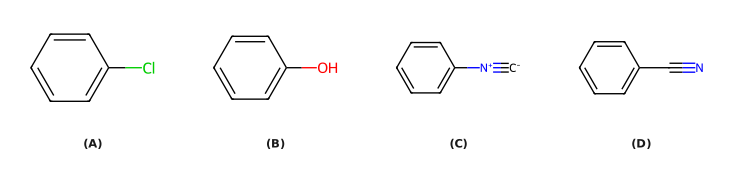
›Reveal solutionSolution
Benzoic acid → benzamide → (Hofmann) aniline → (carbylamine reaction) phenyl isocyanide CX6HX5NC — option (C).
The concept first. Three named reactions, each with a give-away signature:
- Acid + ammonia + heat: forms the ammonium salt, which on heating dehydrates to the amide. (Acid → amide is the standard way in.)
- Hofmann bromamide degradation (BrX2/NaOH): converts an amide RCONHX2 into a primary amine RNHX2 with the loss of one carbon. The mechanism goes through an N-bromoamide, then a nitrene-like migration of R from carbon to nitrogen, giving an isocyanate that is hydrolysed.
- Carbylamine (isocyanide) test (CHClX3+KOH, heat): the diagnostic test for primary amines. KOH deprotonates chloroform to give dichlorocarbene :CClX2, which the amine attacks; loss of 2HCl gives the isocyanide R−N≡C, recognisable by its very unpleasant smell.
Step 1 — X.
CX6HX5COOH+NHX3CX6HX5COOX− NHX4X+Δ,−HX2OCX6HX5CONHX2
X = benzamide.
Step 2 — Y.
CX6HX5CONHX2BrX2/NaOHCX6HX5NHX2+NaX2COX3+NaBr …
- TG EAPCET 2024Set eng-2024-05-11-FN1 markMCQQ.Consider the following carbocations
[!FORMULA] CX6HX5CHX2X+ICHX2=CHX+IICHX3−CX+−H∣CHX3IIICHX3−CHX2X+IVHC ≡CX+V
Arrange the above carbocations in the order of decreasing stability (A) I > III > IV > II > V (B) V > II > IV > III > I (C) V > II > III > I > IV (D) I > III > IV > V > II›Reveal solutionSolution
Carbocation stability increases with greater delocalization/donation of electron density onto the electron-deficient carbon. Ranking these five: I (benzylic, resonance-stabilized) > III (secondary, two alkyl groups) > IV (primary, one alkyl group) > II (vinyl, no effective stabilization) > V (alkynyl, least stable of all). This is option (A).
Concept and intuition:
Carbocations are electron-deficient species; anything that spreads out (delocalizes) or donates into the positive charge makes them more stable. The most powerful stabilizer here is resonance (as in the benzyl cation), followed by hyperconjugation and the inductive effect from alkyl groups (more alkyl substitution = more stability). Vinyl and alkynyl carbocations are exceptionally unstable because the positive charge sits on an sp²/sp carbon, which holds electrons more tightly (higher s-character) and offers essentially no resonance stabilization from the adjacent π system, since the empty orbital does not align with it.
Step-by-step reasoning:
-
Identify each carbocation's structure and stabilization mode.
- I: CX6HX5CHX2X+ — the benzyl carbocation. The positive charge is delocalized into the aromatic ring through resonance (several resonance structures place the charge on the ring carbons). This is the most stable of the five.
- II: CHX2=CHX+ — the vinyl carbocation. The cationic carbon is essentially sp-hybridized with the empty orbital lying in the plane of the molecule, orthogonal to the π system, so the adjacent double bond cannot donate into it by resonance. Very unstable.
- III: CHX3−CHX+−CHX3 — the isopropyl carbocation. This carbon bears two methyl groups and one hydrogen, so it is a secondary carbocation, stabilized by hyperconjugation and induction from its two alkyl groups.
- IV: CHX3−CHX2X+ — the ethyl carbocation. This carbon bears one methyl group and two hydrogens, so it is a primary carbocation, stabilized by only one alkyl group.
- V: HC≡CX+ — the ethynyl (alkynyl) carbocation. The cationic carbon is sp-hybridized (50% s-character), holding the bonding electrons closest to the nucleus and offering no resonance or hyperconjugative stabilization. This is the least stable of the five.
-
Rank by known stability order.
General order: benzylic/allylic > tertiary > secondary > primary > vinyl > alkynyl. With only benzylic, secondary, primary, vinyl and alkynyl represented here: …
-
- TG EAPCET 2023Set ap-2023-05-11-AN1 markMCQQ.In which of the following, ions are correctly arranged with respect to their bond orders? (A) N22−→O2−→O22−→C22− (B) O22−→O2−→N22−→C22− (C) C22−>O2>O22>N22 (D) C22−→N22−→O2−→O22−
›Reveal solutionSolution
Bond order decreases as antibonding orbitals are progressively filled. Using molecular orbital theory, C22− has bond order 3, N22− has 2, O2− has 1.5, and O22− has 1. The correct arrangement is (D).
Bond order measures the net number of bonding electron pairs holding two atoms together. In molecular orbital theory, we calculate it as:
Bond order=21(electrons in bonding MOs−electrons in antibonding MOs)
Higher bond order means a stronger, shorter bond. When electrons are added to a molecule (forming anions), they occupy the next available orbital according to the aufbau principle. If that orbital is antibonding, the bond order drops.
Let me work through each ion systematically, counting electrons and applying the MO filling sequence.
Determining each bond order
1. C22−: 12 + 2 = 14 electrons
The neutral C2 molecule has 12 electrons. Adding two more gives 14 total.
For homonuclear diatomics of C and N (where 2s-2p mixing is significant), the order is:
σ2s<σ2s∗<π2px=π2py<σ2pz<π2px∗=π2py∗<σ2pz∗
Filling 14 electrons:
- σ2s2,σ2s∗2,π2px2,π2py2,σ2pz2
Bonding: 2 + 4 + 2 = 8
Antibonding: 2
Bond order = 21(8−2)=3
2. N22−: 14 + 2 = 16 electrons
Adding two electrons to the 14 in N2, they enter the degenerate π2p∗ orbitals:
- σ2s2,σ2s∗2,π2px2,π2py2,σ2pz2,π2px∗1,π2py∗1
Bonding: 8
Antibonding: 2 + 2 = 4
Bond order = 21(8−4)=2
3. O2−: 16 + 1 = 17 electrons …
- TG EAPCET 2023Set eng-2023-05-12-FN1 markMCQQ.Match the following List-I (Molecule/ion) A) SnCl2 B) NH3 C) I3− D) SO3 List-II (Shape) I. Trigonal planar II. Linear III. Angular IV. Trigonal pyramidal The correct answer is (A) A - III, B - I, C - II, D - IV (B) A - IV, B - III, C - I, D - II (C) A - III, B - I, C - IV, D - II (D) A - III, B - IV, C - II, D - I
›Reveal solutionSolution
The key idea is to determine the molecular shape of each species using VSEPR theory (steric number and lone pairs). The correct matches are: SnCl₂ → Angular, NH₃ → Trigonal pyramidal, I₃⁻ → Linear, SO₃ → Trigonal planar, so the answer is option (D).
Concept & Intuition
Molecular geometry is predicted by the Valence Shell Electron Pair Repulsion (VSEPR) theory. The central atom’s steric number (number of bonded atoms + lone pairs) determines the electron-pair geometry, while the number of lone pairs modifies the final molecular shape. For each species, we count valence electrons, assign the central atom, and then apply VSEPR.
-
SnCl₂ (A)
- Tin (Sn) has 4 valence electrons; each Cl contributes 1 for bonding, total = 4 + 2×1 = 6 electrons (3 pairs).
- Sn is central, forms two single bonds with Cl, leaving one lone pair on Sn.
- Steric number = 2 bonds + 1 lone pair = 3 → electron-pair geometry is trigonal planar.
- With one lone pair, the molecular shape is angular (bent, ~120°).
- So A matches III.
-
NH₃ (B)
- Nitrogen has 5 valence electrons; each H contributes 1, total = 5 + 3×1 = 8 electrons (4 pairs).
- N forms three N–H bonds, leaving one lone pair.
- Steric number = 3 bonds + 1 lone pair = 4 → electron-pair geometry is tetrahedral.
- With one lone pair, the molecular shape is trigonal pyramidal.
- So B matches IV.
-
I₃⁻ (C)
- Iodine has 7 valence electrons; three I atoms give 21, plus 1 for the negative charge = 22 electrons (11 pairs).
- The central I is bonded to two terminal I atoms. The central I has 7 valence electrons, uses 2 for bonds, leaving 5 electrons (2 lone pairs + 1 electron in a 3-center-4-electron bond). Actually, the standard VSEPR treatment: central I has 2 bonds and 3 lone pairs (steric number = 5), but the molecular shape is determined by the arrangement of atoms only.
- With 2 bonded atoms and 3 lone pairs, the electron-pair geometry is trigonal bipyramidal, but the lone pairs occupy equatorial positions, leaving the two I atoms axial → linear shape.
- So C matches II.
-
SO₃ (D) …
-
- TG EAPCET 2023Set eng-2023-05-13-AN1 markMCQQ.What is the correct order of melting temperature of C, Si, Ge? (A) C > Ge > Si (B) Si > C > Ge (C) C > Si > Ge (D) Si > Ge > C
›Reveal solutionSolution
Melting points of Group 14 elements decrease down the group due to decreasing bond strength, but carbon is anomalously high because of its small size and strong covalent bonding. The correct order is C > Si > Ge, which corresponds to option (C).
The key concept here is trends in melting points for Group 14 elements (carbon, silicon, germanium, tin, lead). All these elements form giant covalent (diamond-like) structures in their solid state, except for tin and lead which are metallic. The melting point depends on the strength of the covalent bonds holding the atoms together.
Why this approach works:
Melting a solid means breaking the bonds between atoms. For diamond (carbon), the bonds are extremely strong because carbon atoms are very small, allowing close overlap of orbitals and very short, strong bonds. As we go down the group, atoms get larger, bond lengths increase, and bond strength decreases. So melting points should generally decrease. But carbon is an outlier — its melting point is far higher than the others. Silicon and germanium follow the expected decreasing trend.
-
Recognize the structure type
Carbon (as diamond), silicon, and germanium all crystallize in the diamond cubic structure — a giant covalent network. Melting requires breaking many strong covalent bonds simultaneously, so melting points are very high.
-
Understand the bond strength trend
Bond strength in a covalent network depends on orbital overlap. Smaller atoms have shorter bonds and better overlap. Carbon’s 2p orbitals are much smaller than silicon’s 3p or germanium’s 4p. Thus, the C–C bond is the strongest, Si–Si is weaker, and Ge–Ge is weaker still.
-
Apply the trend to the given elements
- Carbon (diamond): melting point ~3550°C (actually sublimes, but effectively the highest).
- Silicon: melting point ~1414°C.
- Germanium: melting point ~938°C. …
-
🎓Unlock everything free for 14 days
- ✓Full step-by-step solutions
- ✓Concept-first explanations
- ✓Methods, shortcuts & mistakes
- ✓PYQ mapping + timed mock tests
Full access for 14 days. No credit card required.