Q.Consider a wire carrying a steady current, I placed in a uniform magnetic field B perpendicular to its length. Consider the charges inside the wire. It is known that magnetic forces do no work. This implies that,
🔒You're viewing a preview — the full solution, concept, methods & PYQ mapping are locked.
🔒 Start your 14-day free trial to unlock the full solution →Concept understanding — Magnetic Force on Current
Magnetic Force on Current
Imagine a garden hose spraying pure water — bring a magnet near the stream and nothing happens, because water is electrically neutral. But if that stream carried electric charge (a current), the magnet would push the whole stream sideways. That is the essence of this concept: a current-carrying wire placed in a magnetic field experiences a sideways force, because every moving charge inside the wire feels the Lorentz force, and since the charges cannot leave the wire, they drag the wire along with them.
From a single charge to a wire
A single charge q moving with velocity v in a field B feels F=q(v×B). A current is just many such charges drifting together, so summing their individual forces over the whole wire gives a net force on it.
The metal lattice itself is neutral and stationary — only the free electrons drift. The magnetic force acts on those drifting electrons, which then collide with the lattice and transfer the push to the entire wire.
The formula
For a straight wire of length L carrying current I in a uniform field B:
F=I(L×B),F=ILBsinθ
where L points along the current and θ is the angle between the wire and B.
The force is zero when the wire runs parallel to the field (θ=0∘ or 180∘) and maximum when perpendicular (θ=90∘) — the magnetic force only responds to the component of current motion that is perpendicular to B.
Direction: the right-hand rule
Point your index finger along the current (L), your middle finger along the field (B); your thumb then gives the force direction — this is just the cross product L×B read off by hand. Because it is a cross product, swapping the two vectors reverses the force.
Worked example
A 0.5 m wire carries 3 A from east to west, in a uniform field of 0.2 T pointing north.
- θ=90∘ (the wire and the field are perpendicular), so F=ILBsinθ=(3)(0.5)(0.2)(1)=0.3 N. …
A magnetic force is always F=q(v×B), perpendicular to the charge's own velocity v, so dW=F⋅vdt=0 - for any charge, however that velocity arose.
- If the wire itself is set moving by the field, the lattice ions now carry the wire's velocity too - but the magnetic force is still perpendicular to that velocity, so it still does zero work on the ions (option d).
- Consequently no work is done by the magnetic force on the moving wire either (option c) - any kinetic energy the wire gains must come from an external agent (e.g. the battery), not from B itself. …
The magnetic force is always perpendicular to a charge's total velocity, so it does zero work on any individual charge - even the lattice ions of a wire that is itself moving. This matches stem options (c) and (d).
Why the magnetic force can never do work
For any charge q moving with velocity v in a field B:
F=q(v×B).
The rate of work done is
dtdW=F⋅v=q(v×B)⋅v=0,
because v×B is, by construction, perpendicular to v. This is true for every moving charge, always - it is a geometric fact about the cross product, not a special property of wires.
Applying this to the wire
The free electrons inside the wire have a small drift velocity, but the crucial point is the ions of the lattice (positively charged, effectively fixed within the wire). If the wire as a whole is set moving by the external field, those ions now have a nonzero velocity too - the wire's velocity. Since the magnetic force is perpendicular to whatever velocity a charge actually has, it does zero work on these ions as well, even while the wire moves:
dWion=q(vwire×B)⋅vwiredt=0.
This is exactly statement (d): if the wire moves under the influence of B, no work is done by the magnetic force on the ions, assumed fixed within the wire.
And since this holds for the motion of the wire as a whole (the ions carry it), it also confirms (c): if the wire moves under the influence of B, no work is done by the force - i.e. any kinetic energy the wire gains must come from elsewhere (the battery/agent maintaining the current), never from the magnetic field itself.
Why (a) is false …
Method: "Magnetic Force Does No Work" -- Applying F dot v = 0 to Whatever Is Actually Moving
Any question built on the fact that magnetic forces do no work reduces to one check: identify the actual velocity of the charge in question -- even if that velocity is the bulk motion of an object the charge is embedded in -- and confirm the force is perpendicular to it.
Steps
Step 1: State the general no-work fact precisely
For any charge q with velocity v in a field B:
F=q(v×B),dtdW=F⋅v=q(v×B)⋅v=0
This is a geometric fact about the cross product (v×B is always ⊥v) -- it holds for every moving charge, unconditionally, regardless of what caused that velocity.
Step 2: Identify the velocity that actually matters
Don't assume "the charge" means only its microscopic drift velocity. If the charge is bound to a larger object (e.g. a lattice ion fixed within a wire) and that object itself starts moving, the charge's total velocity is now the object's velocity -- and Step 1 applies to that total velocity just as it would to a free charge.
Step 3: Separate "no work done" from "no effect at all" …
- TG EAPCET 2023Set eng-2023-05-12-FN1 markMCQQ.A long straight wire carries a current of 18 A. The magnitude of the magnetic field at a point 12 cm from it is (A) 1.5×10⁻⁵ T (B) 2×10⁻⁵ T (C) 3×10⁻⁵ T (D) 1.8×10⁻⁵ T
›Reveal solutionSolution
The magnetic field near a long straight wire is given by B=2πrμ0I. Plugging in I=18 A and r=0.12 m gives B=3×10⁻⁵ T, which matches option (C).
Concept & Intuition
A long straight wire carrying a steady current produces a magnetic field that circles around it. The strength of this field depends only on the current and the perpendicular distance from the wire — not on the wire’s length, as long as the wire is very long compared to the distance. This is a classic application of Ampère’s law, and the result is beautifully simple: the field falls off as 1/r, not 1/r2 like the electric field from a point charge. That’s because the source (the current) is spread out along a line, not concentrated at a point.
Step-by-step solution
- Recall the formula for the magnetic field at a perpendicular distance r from an infinitely long straight wire carrying current I:
B=2πrμ0I
where μ0=4π×10−7 T⋅m/A is the permeability of free space.
-
Identify the given values:
- Current, I=18 A
- Distance, r=12 cm=0.12 m (always convert to meters)
-
Substitute into the formula:
B=2π×0.12(4π×10−7)×18
- Simplify step by step:
- Cancel π: 2π4π=2 …
- TG EAPCET 2023Set eng-2023-05-13-AN1 markMCQQ.A current i flows in an infinitely long, straight and thin walled pipe, then (A) the magnetic field at all the points inside the pipe is same, but not zero (B) the magnetic field at any point inside the pipe is zero (C) the magnetic field is zero only on the axis of the pipe (D) the magnetic field is different at different points inside the pipe
›Reveal solutionSolution
For an infinitely long, straight, thin-walled pipe carrying a steady current, the magnetic field inside the pipe is zero everywhere — this follows from Ampère’s law and the symmetry of the current distribution. The correct option is (B).
The key concept here is Ampère’s law, which relates the line integral of the magnetic field around a closed loop to the current passing through that loop. For a long, straight, thin-walled pipe, the current flows only on the surface (the wall). Inside the pipe, there is no current. By choosing a circular Amperian loop inside the pipe, coaxial with the pipe, the enclosed current is zero. Ampère’s law then forces the magnetic field to be zero at every point inside.
Let’s work through it step by step.
-
Understand the geometry and current distribution
The pipe is infinitely long, straight, and thin-walled. This means the current i flows uniformly along the surface of the pipe (like a cylindrical sheet of current). There is no current inside the pipe’s hollow interior.
-
Choose an Amperian loop inside the pipe
Because of the cylindrical symmetry, the magnetic field inside must be azimuthal (circling around the axis) and depend only on the radial distance r from the axis. We pick a circular loop of radius r (where r is less than the pipe’s inner radius), centered on the axis and lying in a plane perpendicular to the pipe.
-
Apply Ampère’s law
Ampère’s law states:
∮B⋅dl=μ0Ienc
For our circular loop, the magnetic field B is tangential and constant in magnitude along the loop, so the left side becomes:
∮B⋅dl=B⋅(2πr)
The right side, Ienc, is the total current passing through the area bounded by the loop. Since the loop lies entirely inside the hollow pipe, no current passes through it — all the current is on the surface, outside the loop. Hence Ienc=0.
- Conclude the magnetic field inside From Ampère’s law:
B⋅(2πr)=0⇒B=0
This holds for any radius r inside the pipe (including on the axis, where r=0). So the magnetic field is zero at every point inside the pipe. …
-
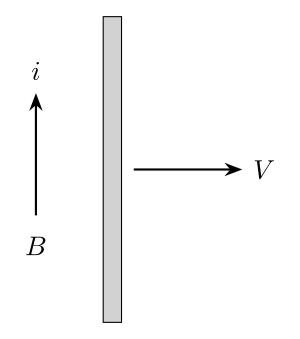
- TG EAPCET 2023Set eng-2023-05-14-AN1 markMCQQ.A conducting rod is moving towards right with a velocity 'V' in a uniform magnetic field 'B'. If the direction of induced current 'i' is as shown in the figure, then the direction of 'B' is [FIGURE] (A) in the plane of the paper towards right (B) in the plane of the paper towards left (C) perpendicular to the plane of the paper and into the paper (D) perpendicular to the plane of the paper and out of the paper
›Reveal solutionSolution
The force on the charges must be qv×B pointing up the rod. With v to the right, only a field into the page produces an upward v×B — option (C).
The concept first
When a conductor moves through a magnetic field, every free charge inside it is carried along at velocity v. A moving charge feels the magnetic (Lorentz) force
F=qv×B.
That force sweeps positive carriers to one end of the rod and leaves the other end negative — a separation of charge, which is exactly what an emf is. Inside the source (the rod), conventional current flows from the low-potential end to the high-potential end, i.e. in the direction of v×B. So the rule to remember is simply:
current inside the rod∥v×B.
Also remember the geometry constraint: if B is parallel (or antiparallel) to v, the cross product is zero and nothing at all happens. That instantly kills two of the options.
Step-by-step
1. Set up axes. Take x^ to the right, y^ up the page, and z^ out of the page (right-handed set).
2. Write what is given.
v=vx^(rod moves right)
i in the rod=iy^(current shown upward)
3. Impose the physics. We need
v×B ∥ +y^.
4. Eliminate the in-plane options (A) and (B). If B=±Bx^, then v×B=vx^×(±Bx^)=0 — no force on the carriers, no emf, no current. But the figure shows a current, so B cannot lie along the direction of motion. Options (A) and (B) are out.
5. Test "out of the page", B=Bz^: …
- TG EAPCET 2022Set eng-2022-07-19-AN1 markMCQQ.Two parallel conductor each 50m long, separated by 0.2m experience a force of 1N. If the current in first conductor is twice that of the second conductor, then what is the current in the second conductor? (μ0=4π×10−7) (A) 100 A (B) 200 A (C) 120 A (D) 50 A
›Reveal solutionSolution
F=2πdμ0(2I2)L=1 N gives I2=104, so the second conductor carries 100 A.
Concept — force between two parallel current-carrying conductors.
F=2πdμ0I1I2L
Step 1 — set up with the given ratio. Let the second conductor carry I, so the first carries 2I. With L=50 m, d=0.2 m, F=1 N:
1=2π×0.2(4π×10−7)(2I)(I)×50
Step 2 — simplify. …
- TG EAPCET 2022Set eng-2022-07-19-FN1 markMCQQ.A particle of mass m and charge q travelling with a velocity v along the x-axis enters a uniform electric field E directed along the y-axis. What will be the trajectory of the particle? (A) Circular (B) Elliptical (C) Parabolic (D) Helical
›Reveal solutionSolution
A charged particle moving perpendicular to a uniform electric field experiences a constant force perpendicular to its initial velocity, resulting in a parabolic trajectory — just like projectile motion under gravity.
The key insight here is that the electric field E is uniform and directed along the y-axis, while the particle's initial velocity v is purely along the x-axis. This means the force on the particle is F=qE, which is constant in both magnitude and direction (along y). There is no force along x, so the x-component of velocity remains unchanged.
This is exactly analogous to throwing a ball horizontally in a uniform gravitational field — the ball moves with constant horizontal speed while accelerating downward. Here, the electric field plays the role of gravity, and the charge q replaces mass in the force law.
-
Force and acceleration: The electric force is F=qEj^. By Newton’s second law, the acceleration is a=mqEj^, constant and along y.
-
Motion along x: No force in x, so ax=0. The initial velocity is v along x, hence x(t)=vt.
-
Motion along y: Initial velocity in y is zero. With constant acceleration ay=qE/m, we get y(t)=21mqEt2.
-
Eliminate time: From x=vt, we have t=x/v. Substituting into y(t):
y=21mqE(vx)2=2mv2qEx2
This is the equation of a parabola: y∝x2. …
-
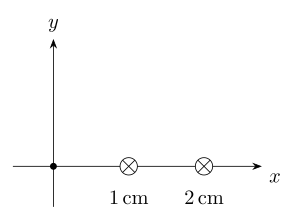
- TG EAPCET 2022Set eng-2022-07-20-AN1 markMCQQ.Two infinitely long thin wires are placed at (1 cm, 0 cm) and (2 cm, 0 cm) as shown in the figure. [FIGURE] The same current i flows in both the wires in the same direction, say, into the page. Let the magnetic field at the origin due to these wires is B. If B0 is the magnitude of the magnetic field if only the wire at (1 cm, 0 cm) was present, then the value of B/B0 is (A) 3/2 (B) 2/3 (C) 1/2 (D) 2
›Reveal solutionSolution
The magnetic field at the origin from two parallel wires carrying current into the page adds in the same direction (both fields point downward). Using the formula B=2πrμ0i, the ratio B/B0=1+21=3/2, so the answer is (A).
Concept & Intuition
The magnetic field due to a long straight wire circles around it according to the right-hand rule. For a wire carrying current into the page, the field at a point to its right points downward (south), and at a point to its left points upward (north). Here both wires are on the positive x‑axis, and the origin is to their left. So each wire alone produces a field at the origin that points in the same direction (downward, or into the negative y‑direction). Because the fields are vectors in the same direction, the total magnitude is simply the sum of the individual magnitudes. The ratio then becomes a simple comparison of distances.
Step‑by‑step reasoning
- Magnetic field from a single long wire For an infinitely long straight wire carrying current i, the magnitude of the magnetic field at a perpendicular distance r is
B=2πrμ0i.
The direction is given by the right‑hand rule: if the thumb points in the direction of the current (into the page), the fingers curl in the direction of B. At a point to the left of the wire, the field points downward (say, the −y^ direction).
- Field at the origin from the wire at x=1 cm Distance from origin: r1=1 cm =0.01 m. Magnitude:
B1=2π(0.01)μ0i.
This is exactly B0 (the field if only this wire were present). So
B0=2π(0.01)μ0i.
- Field at the origin from the wire at x=2 cm Distance from origin: r2=2 cm =0.02 m. Magnitude: B2=2π(0.02)μ0i=21⋅2π(0.01)μ0i=21B0. …
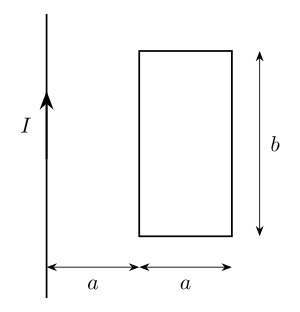
- TG EAPCET 2021Set eng-2021-08-06-AN1 markMCQQ.A long straight wire carrying current I and a rectangular frame with side lengths a and b lie in the same plane as shown in the figure. The mutual inductance of the wire and frame is [FIGURE] (A) 2πμ0ab (B) 4πμab (C) 2πμ0aln2 (D) 2πμ0bln2
›Reveal solutionSolution
Mutual inductance is found by calculating the magnetic flux through the rectangular loop due to the current in the long straight wire. The result is M=2πμ0bln2, so the correct option is (D).
Concept & Intuition
Mutual inductance M between two circuits is defined by M=IΦ, where Φ is the magnetic flux through one circuit due to a current I in the other. For a long straight wire, the magnetic field is not uniform — it falls off as 1/r. So the flux through the rectangular loop must be found by integrating B over the loop’s area. The key geometric detail is that the rectangle’s near side is at distance a from the wire and its far side at distance 2a (since the side length along the direction perpendicular to the wire is a). This specific ratio gives the clean ln2 result.
Step-by-step solution
- Set up coordinates and field expression Place the long straight wire along the y-axis. The rectangular frame lies in the same plane (the xy-plane). Let the rectangle extend from x=a to x=2a (so its width perpendicular to the wire is a) and have length b parallel to the wire (say from y=0 to y=b). The current I in the wire produces a magnetic field at a perpendicular distance x:
B(x)=2πxμ0I
directed into or out of the plane (depending on current direction), but we only care about magnitude for flux.
- Flux through a thin strip Consider a thin vertical strip of width dx at distance x from the wire, extending the full height b of the rectangle. The area of this strip is dA=bdx. The magnetic field is constant over this strip (since x is fixed). The flux through the strip is:
dΦ=B(x)dA=2πxμ0I⋅bdx
- Integrate over the rectangle’s width …
🎓Unlock everything free for 14 days
- ✓Full step-by-step solutions
- ✓Concept-first explanations
- ✓Methods, shortcuts & mistakes
- ✓PYQ mapping + timed mock tests
Full access for 14 days. No credit card required.