Chemistry · Ch 2 — Structure of Atom
Particle Nature of Electromagnetic Radiation: Planck's Quantum Theory
Particle Nature of Electromagnetic Radiation: Planck's Quantum Theory
2.3.2 Particle Nature of Electromagnetic Radiation: Planck’s Quantum Theory
The wave theory of light, so successful at explaining diffraction and interference, hit a wall when faced with certain experimental results. Phenomena like the radiation emitted by hot objects, the ejection of electrons from metals by light, and the specific patterns of atomic spectra simply could not be accounted for by classical physics. These failures forced scientists to reconsider the very nature of light, leading to a revolutionary idea: that electromagnetic radiation is not a continuous wave but is instead composed of discrete packets of energy.
The Problem of Black-Body Radiation
Any object at a temperature above absolute zero emits electromagnetic radiation. A perfect absorber and emitter of all such radiation is called a black body. A practical approximation is a hollow cavity with a tiny hole; any radiation entering the hole is trapped and absorbed by the walls. When heated, the radiation emitted from such a hole is called black-body radiation.
The key experimental observations were:
- The intensity of emitted radiation depends on the wavelength and the temperature of the body.
- At a given temperature, the intensity increases with wavelength, reaches a peak, and then decreases.
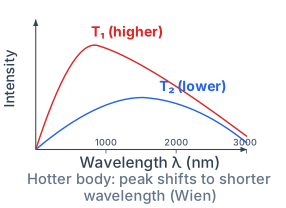
Drawn by us to help you understand the concept clearly, and verified to make sure it's accurate. For exams, practice from your textbook's own diagram.
What Fig. 2.8 Shows
The figure is a simple but powerful graph that captures a puzzle classical physics could not solve. The x-axis is wavelength in nanometres, running from 0 to about 3000 nm. The y-axis is intensity — essentially how much radiant energy is emitted at each wavelength — with an upward arrow indicating increasing intensity.
Two smooth curves rise from the origin, each corresponding to a different temperature. The red curve, labelled , peaks around 800–900 nm and reaches a higher maximum intensity. The blue curve, labelled , peaks much further to the right, near 1500–1600 nm, and its peak is noticeably lower. An annotation tells us .
The key visual message is this: as temperature increases, the entire curve shifts upward and leftward. The peak moves to shorter wavelengths, and the total emitted energy (area under the curve) increases dramatically.
The Physical Idea
A black body is an idealised object that absorbs all radiation falling on it and, when heated, emits radiation whose spectral distribution depends only on its temperature — not on what it is made of. The graph shows exactly this distribution at two different temperatures.
At lower temperatures, most of the emitted radiation is in the infrared region (longer wavelengths). As the rod in a furnace is heated, it first glows dull red, then bright red, then white, and finally blue-white. This progression is the peak shifting to shorter wavelengths — from infrared through red to blue. The figure captures this shift quantitatively.
Why the name "black body"? A perfect absorber appears black at room temperature because it reflects no light. But when heated, it becomes the most efficient possible emitter at every wavelength — hence its radiation is a fundamental benchmark.
The Formula That Emerges
Planck's quantum hypothesis was the breakthrough that explained this curve. He proposed that energy is emitted or absorbed only in discrete packets called quanta, with energy proportional to frequency:
where is the energy of one quantum (in joules), is the frequency of the radiation (in s or Hz), and J s is Planck's constant — a fundamental constant of nature.
Using this idea, Planck derived the exact mathematical form of the black-body radiation curve:
Here is the intensity at wavelength and temperature , is the speed of light, is Boltzmann's constant, and is the base of natural logarithms. The factor in the denominator is the direct consequence of quantisation — without it, classical theory predicted an absurd result called the "ultraviolet catastrophe" where intensity would keep rising without bound at short wavelengths.
The formula above is not required for memorisation in NCERT Class 11, but understanding its structure is valuable. The key takeaway is that Planck introduced quantisation () to fix a problem classical physics could not solve. The graph in Fig. 2.8 is the experimental fact; Planck's formula is the theoretical explanation.
What the Figure Teaches Beyond the Graph
The figure is the gateway to understanding that light has particle-like properties. The black-body radiation curve could not be explained by wave theory alone — it required the idea that energy comes in discrete packets. This same idea later explained the photoelectric effect (Einstein, 1905) and led to the dual nature of light: wave-like in propagation (interference, diffraction), particle-like in interaction with matter (emission, absorption). …
- As the temperature increases, the peak of the intensity curve shifts to shorter wavelengths (e.g., an iron rod glows dull red, then white, then blue as it gets hotter).
Classical physics could not explain this wavelength-intensity relationship. The predictions of the Rayleigh-Jeans law, for instance, matched experiment only at long wavelengths but diverged catastrophically at short wavelengths—a failure known as the "ultraviolet catastrophe."
Planck's Quantum Hypothesis
In 1900, Max Planck provided the solution by making a radical assumption. He proposed that the atoms in the walls of the black body behave like tiny oscillators. These oscillators could not absorb or emit energy continuously, but only in discrete, indivisible packets.
Planck's key postulate: Energy can be emitted or absorbed only in discrete quantities, not continuously. The smallest possible quantity of energy is called a quantum (plural: quanta).
The energy of a single quantum of radiation is directly proportional to its frequency.
Where:
- is the energy of one quantum (in joules, J)
- is the frequency of the radiation (in s or Hz)
- is Planck's constant, a fundamental constant of nature with a value of . …