Chemistry · Ch 2 — Structure of Atom
Photoelectric Effect
Photoelectric Effect
2.3.2a Photoelectric Effect
In 1887, Heinrich Hertz discovered that when light of a certain frequency strikes a clean metal surface, electrons are ejected. This is the photoelectric effect. The experimental results were puzzling:
The photoelectric effect could not be explained by classical wave theory. According to that theory, the energy of a light wave depends on its intensity (brightness). A brighter light should therefore eject electrons with more kinetic energy. This was not observed.
The key observations were:
- No Time Lag: Electrons are ejected the instant the light strikes the surface, regardless of the light's intensity.
- Intensity Affects Number, Not Energy: The number of electrons ejected is proportional to the intensity (brightness) of the light. However, the kinetic energy of the ejected electrons does not depend on the intensity.
- Threshold Frequency: For each metal, there is a characteristic minimum frequency, called the threshold frequency (). If the light's frequency is below , no electrons are ejected, no matter how intense the light. If the frequency is above , electrons are ejected immediately, and their kinetic energy increases with the frequency of the light.
For example, shining a very bright red light on potassium metal for hours will eject no electrons. But a very dim yellow light will instantly eject electrons. The wave theory could not explain this.
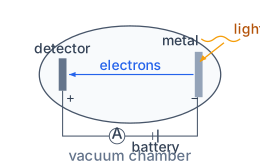
Drawn by us to help you understand the concept clearly, and verified to make sure it's accurate. For exams, practice from your textbook's own diagram.
Fig. 2.9 is a schematic of the apparatus used to demonstrate the photoelectric effect. The core idea is simple: light of a particular frequency strikes a clean metal surface inside an evacuated chamber, and electrons are ejected from that metal. Those ejected electrons — called photoelectrons — travel toward a detector, which measures their kinetic energy. An external circuit connects the detector, an ammeter, a battery, and the metal surface, with the battery’s polarity marked so that the metal is the negative electrode (cathode) and the detector is the positive electrode (anode). The ammeter measures the current due to the flow of photoelectrons.
The evacuated chamber is crucial: if air were present, ejected electrons would collide with gas molecules and lose energy before reaching the detector, making the measurement unreliable. The wavy arrow labelled “Light” represents the incoming electromagnetic radiation, and the straight arrow labelled “Electrons” shows the path of the photoelectrons from the metal to the detector. The battery provides the electric field that accelerates the electrons toward the detector; by varying the battery voltage, one can determine the maximum kinetic energy of the photoelectrons (the stopping potential).
What does this figure teach? It illustrates the experimental setup that led to three key observations that classical wave theory could not explain:
- No time lag — electrons are ejected the instant light strikes the metal, regardless of how dim the light is.
- Threshold frequency — for each metal, there is a minimum frequency below which no electrons are ejected, no matter how intense the light.
- Kinetic energy depends on frequency, not intensity — the maximum kinetic energy of ejected electrons increases linearly with the frequency of the incident light, but is independent of its brightness.
These results forced physicists to abandon the classical wave picture of light for this phenomenon. Einstein explained them in 1905 by treating light as a stream of particles (photons), each carrying energy , where is Planck’s constant () and is the frequency of the radiation.
Here:
- is the maximum kinetic energy of an ejected photoelectron ().
- is the energy of a single incident photon.
- is the work function — the minimum energy required to eject an electron from that particular metal.
- is the threshold frequency (characteristic of the metal).
The figure itself does not show a graph — it is a diagram of the equipment. But the formula above is the central result that the textbook develops using this experimental setup. The ammeter reading tells you how many electrons are flowing (proportional to light intensity), while the stopping potential (the battery voltage needed to just stop the current) gives you . By varying the frequency of the incident light and measuring the stopping potential, one can verify that is a linear function of , with slope and intercept . …
Einstein's Explanation (1905)
Albert Einstein extended Planck's quantum idea to explain the photoelectric effect. He proposed that light itself consists of a stream of particle-like packets of energy, which were later called photons. Each photon carries a quantum of energy given by .
Think of shining a light on a metal surface as shooting a beam of tiny, massless particles (photons) at it. Each photon carries a specific amount of energy determined by its frequency.
The process is a collision between a photon and an electron in the metal. The photon transfers its entire energy instantaneously to the electron. For the electron to be ejected, the photon's energy must be at least equal to the minimum energy required to remove the electron from the metal surface. This minimum energy is called the work function (), and it is related to the threshold frequency by .
If the photon's energy () is greater than the work function (), the excess energy appears as the kinetic energy of the ejected electron (the photoelectron).
Einstein's Photoelectric Equation:
Or equivalently:
Where:
- is the mass of the electron ( kg)
- is the velocity of the ejected electron
This equation perfectly explains all the observations:
- No time lag: The energy transfer is instantaneous in a single photon-electron collision.
- Intensity and number: A more intense beam has more photons, so it ejects more electrons. The kinetic energy of each electron depends only on the photon's energy (), not on the number of photons. …
| Metal | Li | Na | K | Mg | Cu | Ag |
| --- | --- | --- | --- | --- | --- | --- | …