Question of 46
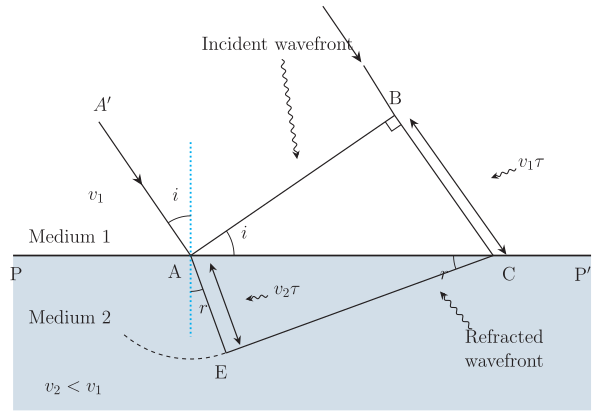
Q.(i) Using Huygens' principle, prove the laws of refraction of light. [3 marks]
(ii) The focal length of a convex lens in air is 20 cm. What is the focal length of the lens in water? (Refractive index of water with respect to air is 1.33 and refractive index of glass with respect to air is 1.5) [2 marks]
OR
(i) Establish the equation 1/v - 1/u = 1/f for a convex lens. (The symbols carry their usual meaning.) [3 marks]
(ii) Draw a labelled diagram of a compound microscope with appropriate levelling. [2 marks]
Tripura TbseHigher Secondary (+2 Stage) Examination 2023Subjective· 5mImportance★★★★★
0% · 0/46 Questions
You're viewing a preview — the full solution, concept, methods & PYQ mapping are locked.
Start your 14-day free trial to unlock the full solution →Applying Huygens' construction to an incident wavefront at a refracting surface and comparing the geometry of the two triangles formed gives Snell's law of refraction directly; separately, a lens is much less powerful in water than in air because the effective refractive index of the lens material relative to its surrounding medium drops sharply, so its focal length increases a great deal (about 4×, to ~78 cm).
- Proof of the laws of refraction using Huygens' principle: Consider a plane wavefront AB in a rarer medium (speed v1) incident obliquely on a plane refracting surface XY, meeting it first at A, with the ray AN making angle of incidence i with the normal. By Huygens' principle, every point on the wavefront is a source of secondary wavelets. Let the wavefront take time t to travel from B to C (in the rarer medium): BC = v1 t. During this same time t, the secondary wavelet from A (now travelling in the denser medium at speed v2) spreads out to a sphere of radius AD = v2 t. The new refracted wavefront is the common tangent CD drawn from C to this secondary wavelet sphere centred at A. From the geometry: in triangle ABC, sin i = BC/AC = v1 t / AC. In triangle ADC, sin r = AD/AC = v2 t / AC (where r is the angle of refraction, between the refracted ray and the normal). Dividing: sin i / sin r = v1/v2 Since v1 and v2 are constants for a given pair of media, sin i/sin r is a constant — this is Snell's law, and this constant is defined as the refractive index μ of the second medium with respect to the first (μ = v1/v2 = c/v2 divided by c/v1, consistent with μ = c/v for each medium). This also shows the incident ray, refracted ray and normal all lie in the same plane (since the construction is confined to the plane of incidence), which is the first law of refraction.
- Focal length of the lens in water: …
Unlock everything free for 14 days
- Full step-by-step solutions
- Concept-first explanations
- Methods, shortcuts & mistakes
- PYQ mapping + timed mock tests
Full access for 14 days. No credit card required.