Q.Using Huygens's principle, verify Snell's law of refraction for the case when a plane wavefront travels from a rarer medium to a denser medium.
You're viewing a preview — the full solution, concept, methods & PYQ mapping are locked.
Start your 14-day free trial to unlock the full solution →Huygens's construction shows that as a plane wavefront crosses from a rarer to a denser medium, the ratio sin i/sin r equals the (constant) ratio of wave speeds v1/v2 — which is exactly Snell's law.
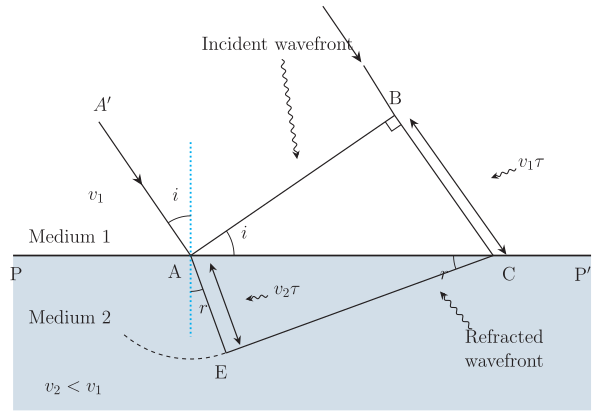
Consider a plane wavefront AB in a rarer medium (speed v1) incident on a plane boundary XY at angle of incidence i, entering a denser medium (speed v2 < v1) beyond the boundary. Let the wavefront take time τ for point B to travel from B to reach point C on the boundary; in this same time τ, the secondary wavelet from A (already at the boundary when B was at its starting point) spreads out into the denser medium as a hemisphere of radius v2τ, since it now travels at the slower speed v2.
From the right triangle ABC (with AC along the boundary and BC = v1τ):
Let CE be the refracted wavefront, tangent to the secondary wavelet of radius AE = v2τ drawn from A. From the right triangle AEC:
Dividing the two:
…
Unlock everything free for 14 days
- Full step-by-step solutions
- Concept-first explanations
- Methods, shortcuts & mistakes
- PYQ mapping + timed mock tests
Full access for 14 days. No credit card required.