Chemistry · Ch 4 — Chemical Bonding and Molecular Structure
Bond Length
Bond Length
Bond Length: The Equilibrium Distance
The bond length is the distance between the nuclei of two bonded atoms when the molecule is at its most stable, lowest-energy state. At this point, the attractive and repulsive forces between the atoms are perfectly balanced, so the nuclei are at their equilibrium separation. This distance is not measured directly with a ruler; it is determined experimentally using techniques such as spectroscopy, X-ray diffraction, and electron diffraction.
Each atom in a bonded pair contributes a certain portion to the total bond length. For a covalent bond, the contribution from a single atom is called its covalent radius. The covalent radius is approximately the radius of an atom's core when it is in contact with the core of an adjacent atom in a bonded situation. More precisely, for a homonuclear diatomic molecule (like or ), the covalent radius is exactly half the distance between the two nuclei.
For a heteronuclear diatomic molecule , the bond length is the sum of the covalent radii of the two atoms:
where and are the covalent radii of atoms A and B, respectively.
Drawn by us to help you understand the concept clearly, and verified to make sure it's accurate. For exams, practice from your textbook's own diagram.
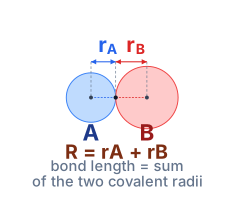
Fig. 4.1 is a schematic diagram of a diatomic molecule AB. Two circles, representing the electron clouds of atoms A and B, are drawn so that they just touch each other — their surfaces are in contact. A small dot at the centre of each circle marks the nucleus of that atom. A double-headed arrow spans the distance between the two nuclei, and is labelled “Bond length”.
The figure has no axes or curves; it is a simple geometric sketch. Its purpose is to show that the bond length is the sum of two contributions: the distance from nucleus A to the point of contact (the covalent radius of atom A) plus the distance from that same contact point to nucleus B (the covalent radius of atom B). In the drawing, the two circles meet at a single point, so the bond length is exactly the sum of the two radii.
The physical idea is that when two atoms form a covalent bond, their cores (the inner parts of their electron clouds) come into contact. The distance between the two nuclei at this equilibrium position is the bond length. Each atom contributes its own “covalent radius” — essentially half the distance between two identical bonded atoms in a homonuclear molecule. For a heteronuclear molecule AB, the bond length is the sum of the two different covalent radii.
The central formula the textbook develops from this figure is:
where is the bond length (the equilibrium internuclear distance), is the covalent radius of atom A, and is the covalent radius of atom B. This additive relationship is the key takeaway: the bond length is not an arbitrary number but a sum of atomic contributions.
Do not confuse covalent radius with van der Waals radius. The covalent radius is half the distance between two bonded identical atoms in the same molecule. The van der Waals radius is half the distance between two non-bonded identical atoms in separate molecules in a solid — it is always larger. Fig. 4.2 in the textbook makes this distinction clear for chlorine. …
Covalent Radius vs. van der Waals Radius
It is crucial to distinguish between the covalent radius and the van der Waals radius. The van der Waals radius represents the overall size of an atom, including its valence shell, in a non-bonded situation. It is half the distance between two identical atoms in separate molecules that are just touching in a solid (held together only by weak van der Waals forces).
A common mistake is to confuse the covalent radius with the van der Waals radius. The covalent radius is always smaller than the van der Waals radius because a covalent bond pulls the atoms much closer together than the weak forces between non-bonded molecules.
For example, in a chlorine molecule ():
- The bond length is 198 pm.
- The covalent radius of chlorine is half of this: pm.
- The van der Waals radius of chlorine is 180 pm (half the distance between two chlorine atoms in separate molecules in solid chlorine, which is 360 pm).
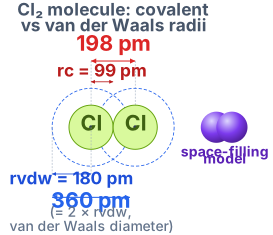
The inner circle in a diagram of a chlorine molecule corresponds to the size of the chlorine atom based on its covalent radius ( pm), while the outer circle corresponds to its van der Waals radius ( pm).
Drawn by us to help you understand the concept clearly, and verified to make sure it's accurate. For exams, practice from your textbook's own diagram.
Fig. 4.2 is a schematic of a single Cl₂ molecule, drawn as two overlapping circles. The key point is that the same atom has two different “sizes” depending on whether it is bonded or not.
The inner, solid circle of each chlorine atom represents its covalent radius (). This is the distance from the nucleus to the point where the two atoms “touch” when they share electrons. In the diagram, the two solid circles meet at the centre of the molecule. The distance between the two nuclei — the bond length — is therefore . For chlorine, the textbook gives , so the bond length is .
The outer, dashed circle around each chlorine atom represents its van der Waals radius (). This is the distance from the nucleus to the outermost edge of the electron cloud when the atom is not bonded. In a solid, the distance between the nuclei of two non-bonded chlorine atoms in separate molecules is . For chlorine, , so that non-bonded separation is .
The physical idea is simple but crucial: a bonded atom is “smaller” than a non-bonded one. The covalent radius measures the core that participates in the bond; the van der Waals radius measures the full extent of the electron cloud, including the outer valence shell that repels other molecules.
The two radii are defined by the same formula structure, but for different situations:
For a heteronuclear molecule AB (Fig. 4.1 in the textbook), the bond length is the sum of the two covalent radii:
…
Factors Affecting Bond Length
Bond length is not a fixed property; it varies depending on the type of bond and the atoms involved. The textbook provides tables of typical values. …
| Bond type | Bond length (pm) |
|---|---|
| O–H | 96 |
| C–H | 107 |
| N–O | 136 |
| C–O | 143 |
| C–N | 143 |
| C–C | 154 |
| C=O | 121 |
| N=O | 122 |
| C=C | 133 |
| Molecule | Bond length (pm) |
|---|---|
| (H–H) | 74 |
| (F–F) | 144 |
| (Cl–Cl) | 199 |
| (Br–Br) | 228 |
| (I–I) | 267 |
| (N≡N) | 109 |
| (O=O) | 121 |
| HF (H–F) | 92 |
Single/double/triple-bond radii in parentheses (1)/(2)/(3).
| Element | /pm |
|---|---|
| H | 37 |
| C | 77(1), 67(2), 60(3) |
| N | 74(1), 65(2), 55(3) |
| O | 66(1), 57(2) |
| F | 64 |
| Cl | 99 |
| P | 110 |
| S | 104(1), 95(2) |
| Br | 114 |
| As | 121 |