Chemistry · Ch 4 — Chemical Bonding and Molecular Structure
Resonance Structures
Resonance Structures
The Problem with a Single Lewis Structure
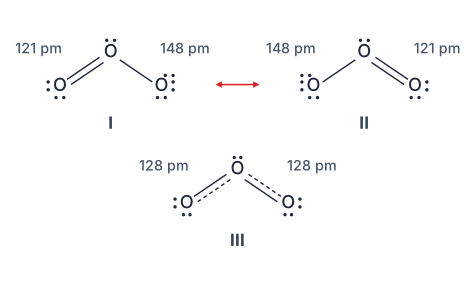
A single Lewis structure often fails to match experimental reality. Consider ozone, . You can draw two perfectly valid Lewis structures for it:
- Structure I:
- Structure II:
In both, one bond is a single bond () and the other is a double bond (). The textbook gives the normal bond lengths as 148 pm for a single bond and 121 pm for a double bond. If either structure were the true picture, the ozone molecule would have one short bond and one long bond.
But experiment shows something different. Both oxygen-oxygen bonds in are identical, with a length of 128 pm. This value is exactly midway between a single and a double bond. A single Lewis structure simply cannot represent this.
The Concept of Resonance
To resolve this, the concept of resonance was introduced. The key idea is this: when one Lewis structure is inadequate, we describe the molecule as a hybrid of several contributing structures.
These contributing structures are called canonical structures or resonance structures. They must have:
- The same positions of the nuclei.
- Nearly the same energy.
- The same number of bonding and non-bonding electron pairs.
The actual molecule is not any one of these canonical forms. It is a resonance hybrid of all of them. The hybrid is more stable (has lower energy) than any single canonical structure. Resonance is indicated by a double-headed arrow () placed between the canonical structures.
The double-headed arrow () means resonance. It does not mean an equilibrium between separate molecules. It is a single molecule whose true structure is an average of the drawn forms.
For ozone, the resonance hybrid (structure III in the textbook) is best represented as having two equivalent bonds that are each intermediate between a single and a double bond. The hybrid is often drawn with a dashed line to show the partial bond character.
Drawn by us to help you understand the concept clearly, and verified to make sure it's accurate. For exams, practice from your textbook's own diagram.
Fig. 4.3 in the NCERT textbook is a schematic diagram that shows three structures for the ozone molecule, O₃, arranged in a row. On the far left is a Lewis structure labelled I, and on the far right is a second Lewis structure labelled II. Between them is a double-headed arrow (↔), the standard symbol for resonance. Below these two structures, centred and labelled III, is a third diagram: the resonance hybrid.
Each of the two canonical structures (I and II) is a bent molecule with a central oxygen atom bonded to two terminal oxygen atoms. In structure I, the left-hand O–O bond is drawn as a double bond (O=O) and the right-hand bond as a single bond (O–O). In structure II, the double bond is on the right and the single bond on the left. Both structures also show two lone pairs on the central oxygen and three lone pairs on each terminal oxygen. The bent geometry is drawn without a printed angle value, matching the book's figure.
The resonance hybrid (III) keeps the same bent shape, with each O–O linkage drawn as a full line plus a dashed second stroke — each bond identical and intermediate in character between a single and a double bond, and both labelled 128 pm.
The physical idea this figure teaches is that a single Lewis structure cannot accurately represent the ozone molecule. Experimentally, both O–O bonds in O₃ are found to be 128 pm long — exactly the same length, and lying between the normal single-bond length (148 pm) and double-bond length (121 pm). No single Lewis structure can show two identical bonds that are neither purely single nor purely double. The concept of resonance solves this: the real molecule is a resonance hybrid of the two canonical forms, and its properties (bond length, bond energy, electron distribution) are an average of those forms. The double-headed arrow is not an equilibrium arrow; it means the actual structure is a blend, not a mixture that flips back and forth.
A common mistake is to think the ozone molecule spends half its time in structure I and half in structure II. That is wrong. The canonical forms have no real existence. The molecule has a single, stable structure — the resonance hybrid — at all times. The arrow simply indicates that we need more than one Lewis structure to describe it.
The key formula that emerges from this discussion is the relationship between bond length and bond order. For a diatomic bond, bond order is defined as half the difference between the number of bonding electrons and antibonding electrons. In O₃, each O–O bond has a bond order of 1.5 (one single bond and one double bond shared over two equivalent positions). The textbook does not give a formula for bond order here, but the central quantitative idea is that the resonance hybrid has a bond order that is the average of the canonical forms:
where 1 is the bond order of a single bond and 2 is the bond order of a double bond. This average bond order of 1.5 corresponds to the experimental bond length of 128 pm, which lies between 148 pm (bond order 1) and 121 pm (bond order 2). …
Other Examples of Resonance
The Carbonate Ion ()
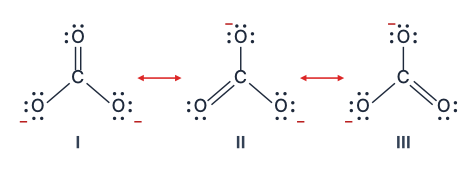
A single Lewis structure for the carbonate ion would show one carbon-oxygen double bond and two carbon-oxygen single bonds. This would imply that one bond is different from the other two. However, experimental evidence shows that all three carbon-oxygen bonds in are identical and equivalent.
Therefore, the carbonate ion is best described as a resonance hybrid of three equivalent canonical structures. In each structure, the double bond is located on a different oxygen atom.
Drawn by us to help you understand the concept clearly, and verified to make sure it's accurate. For exams, practice from your textbook's own diagram.
Fig. 4.4 shows three Lewis structures of the carbonate ion, , arranged side by side and connected by double-headed resonance arrows. Each structure is a canonical form — a valid but incomplete representation of the ion. In every form, carbon sits at the centre of a trigonal planar arrangement of three oxygen atoms. Two of the C–O bonds are single bonds, and one is a double bond. The double bond rotates from one oxygen to the next across the three structures: in structure I it is on the top oxygen, in structure II on the right oxygen, and in structure III on the left oxygen. Each oxygen that is singly bonded carries a formal negative charge, so each canonical form has a total charge of distributed over two oxygens. The resonance arrow between them indicates that no single structure is correct by itself; the real ion is a resonance hybrid of all three.
The physical idea is that a single Lewis structure forces unequal bonds — one double and two single — but experiment shows that all three C–O bonds in are identical in length and strength. The bond length is intermediate between a typical C–O single bond and a C=O double bond. Resonance resolves this contradiction: the actual structure is a blend of the three canonical forms, so each bond has one-third double-bond character and two-thirds single-bond character. The hybrid cannot be drawn with a single Lewis structure; it is often represented with a dashed circle inside the triangle of oxygens to show that the electrons are delocalised over all three bonds.
The key result that the textbook develops with this figure is the stabilisation and bond equalisation that resonance produces. The energy of the resonance hybrid is lower than the energy of any individual canonical form — this is called resonance stabilisation. The bond order in the hybrid is not 1 or 2 but an average:
Each canonical form carries a total C–O bond order of spread over the ion's three C–O positions, so in the hybrid each bond has order — between a single and a double bond, matching the experimental bond length. …
The Carbon Dioxide Molecule ()
The experimentally determined carbon-oxygen bond length in is 115 pm. The textbook gives the normal bond lengths as:
- (double bond): 121 pm
- (triple bond): 110 pm
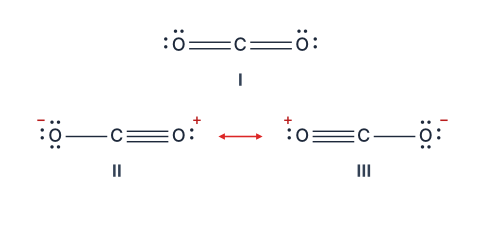
The observed bond length of 115 pm lies between these two values. A single Lewis structure () cannot explain this. To account for the intermediate bond length, we must consider resonance. The structure of is best described as a hybrid of three canonical forms:
- Form I:
- Form II:
- Form III:
The resonance hybrid averages the bond characteristics, resulting in bonds that are stronger and shorter than a pure double bond, but weaker and longer than a pure triple bond.
Drawn by us to help you understand the concept clearly, and verified to make sure it's accurate. For exams, practice from your textbook's own diagram.
Fig. 4.5 shows three Lewis structures for carbon dioxide, arranged side by side and connected by double-headed resonance arrows. The molecule is linear throughout — all three structures have the atoms in the same straight-line arrangement: O–C–O. What changes is the distribution of bonds and lone pairs.
Structure I is the familiar Lewis structure: O=C=O, with two double bonds and two lone pairs on each oxygen. Structure II has a triple bond between the central carbon and the left oxygen, and a single bond between carbon and the right oxygen; the left oxygen now carries one lone pair, the right oxygen carries three lone pairs. Structure III is the mirror image of II: the triple bond is on the right, the single bond on the left, and the lone-pair counts swap accordingly.
The double-headed arrows between them are the standard resonance symbol. They do not mean the molecule flips back and forth between these forms. They mean the true structure of CO₂ is a resonance hybrid — a weighted average of all three canonical forms.
What the figure teaches
The central physical idea is that a single Lewis structure often fails to match experimental data. For CO₂, the measured C–O bond length is 115 pm. A normal C=O double bond is 121 pm; a normal C≡O triple bond is 110 pm. The experimental value lies squarely between them. No single structure — not the all-double-bond form, not either triple-single form — can account for this. Only by taking all three as contributing to a resonance hybrid do we get bonds that are intermediate in length and strength.
Resonance stabilises the molecule. The energy of the resonance hybrid is lower than the energy of any individual canonical structure. This extra stability is called the resonance energy.
The key formula the textbook develops with this figure
The textbook does not give a single formula for resonance itself, but it uses the CO₂ example to introduce the concept of dipole moment as a vector sum — and that idea is directly relevant here. For a polyatomic molecule like CO₂, the net dipole moment is:
where is the dipole moment vector of each individual bond. Each bond dipole has magnitude , with the magnitude of partial charge and the separation distance between charge centres. The unit is the Debye (D), where .
For CO₂, the molecule is linear and symmetric. The two C=O bond dipoles are equal in magnitude and point in opposite directions. Their vector sum is zero:
That is why CO₂ has no net dipole moment — a fact that the resonance hybrid, with its symmetric charge distribution, correctly predicts. …
General Statements about Resonance
The textbook makes two general points about the effect of resonance:
-
Resonance stabilizes the molecule. The energy of the resonance hybrid is always lower than the energy of any single canonical structure. This energy difference is called the resonance energy.
-
Resonance averages the bond characteristics. Bond lengths, bond orders, and charge distributions in the hybrid are an average of those in the canonical structures. This is why the bonds in are all the same length, and the bonds in are all the same length.
Common Misconceptions about Resonance
The textbook explicitly warns against several common misunderstandings. You must remember these:
- The canonical forms have no real existence. They are only theoretical constructs we draw on paper. The molecule does not "flip" between them. …