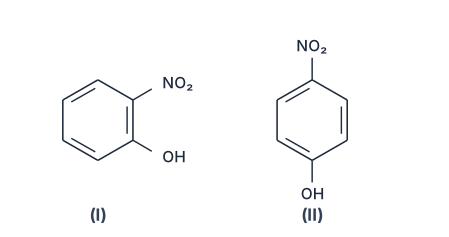
Q.Structures of molecules of two compounds are given below :
You're viewing a preview — the full solution, concept, methods & PYQ mapping are locked.
Start your 14-day free trial to unlock the full solution →Ortho-nitrophenol exhibits intramolecular hydrogen bonding, while para-nitrophenol forms intermolecular hydrogen bonds. Due to stronger intermolecular forces, para-nitrophenol has a higher melting point and is more soluble in water than ortho-nitrophenol.
Understanding the nature of hydrogen bonding is key to explaining the physical properties of these compounds. Hydrogen bonding occurs when a hydrogen atom bonded to a highly electronegative atom (like oxygen, nitrogen, or fluorine) is attracted to another highly electronegative atom in the same or a different molecule. The position of the nitro group relative to the hydroxyl group significantly influences the type of hydrogen bonding possible.
-
Understanding Hydrogen Bonding in Nitrophenols
-
Compound (I): Ortho-nitrophenol (2-nitrophenol)
In ortho-nitrophenol, the hydroxyl () group and the nitro () group are on adjacent carbon atoms of the benzene ring. This close proximity allows the hydrogen atom of the hydroxyl group to form a hydrogen bond with an oxygen atom of the nitro group within the same molecule. This type of hydrogen bonding is called intramolecular hydrogen bonding.
The structure can be visualized as:
-
    where the H of -OH forms a bond with an O of -NO$_2$ on the adjacent carbon.

*   **Compound (II): Para-nitrophenol (4-nitrophenol)**
    In para-nitrophenol, the hydroxyl ($-\text{OH}$) group and the nitro ($-\text{NO}_2$) group are on opposite carbon atoms of the benzene ring. The distance between these groups is too large for hydrogen bonding to occur within the same molecule. Instead, the hydrogen atom of the hydroxyl group of one molecule forms a hydrogen bond with an oxygen atom of the nitro group (or hydroxyl group) of an *adjacent molecule*. This type of hydrogen bonding is called **intermolecular hydrogen bonding**.

    The structure can be visualized as:
    where the H of -OH on one molecule forms a bond with an O of -NO$_2$ on another molecule.

> [!IMPORTANT]
> Intramolecular hydrogen bonding occurs *within* a single molecule, forming a ring-like structure. Intermolecular hydrogen bonding occurs *between* different molecules, leading to molecular association.
2. Explaining Melting Point Differences
The melting point of a compound is directly related to the energy required to overcome the intermolecular forces holding the molecules together in the solid state.

*   **Ortho-nitrophenol (Intramolecular H-bonding)**
    Since ortho-nitrophenol forms intramolecular hydrogen bonds, its hydrogen bonding capacity is satisfied *within* each molecule. This reduces the availability of the hydroxyl hydrogen and nitro oxygen atoms to form strong hydrogen bonds with *other* ortho-nitrophenol molecules. Consequently, the overall intermolecular forces (van der Waals forces, dipole-dipole interactions, and weaker intermolecular H-bonds) between ortho-nitrophenol molecules are relatively weaker. Less energy is required to separate these molecules, leading to a lower melting point.

*   **Para-nitrophenol (Intermolecular H-bonding)**
    Para-nitrophenol forms strong intermolecular hydrogen bonds. This means that individual para-nitrophenol molecules associate with each other, forming larger, more stable aggregates or chains in the solid state. These extensive intermolecular hydrogen bonds create a strong network of attractive forces between molecules. A significant amount of energy is needed to break these strong intermolecular attractions to transition from solid to liquid, resulting in a higher melting point.

Therefore, para-nitrophenol, with its stronger intermolecular hydrogen bonding, will have a higher melting point than ortho-nitrophenol. …
Unlock everything free for 14 days
- Full step-by-step solutions
- Concept-first explanations
- Methods, shortcuts & mistakes
- PYQ mapping + timed mock tests
Full access for 14 days. No credit card required.