Chemistry · Ch 1 — Some Basic Concepts of Chemistry
Percentage Composition
Percentage Composition
So far we were dealing with the number of entities present in a given sample; many a time, information regarding the percentage of a particular element present in a compound is required. Suppose an unknown or new compound is given to you — the first question you would ask is: what is its formula, and in what ratio are its constituents present? For known compounds too, such information provides a check on purity: one can check the purity of a given sample by analysing this data.
Drawn by us to help you understand the concept clearly, and verified to make sure it's accurate. For exams, practice from your textbook's own diagram.
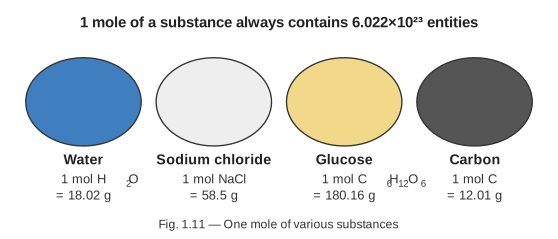
Fig. 1.11 shows four everyday substances side by side, each in the amount that makes up exactly one mole: 18.02 g of water, 58.5 g of sodium chloride, 180.16 g of glucose, and 12.01 g of carbon. Even though these masses are all different, each sample contains the same number of elementary entities -- 6.022x10^23, Avogadro's number -- which is the whole point o …
The mass per cent of each element is worked out from the compound's formula and molar mass:
Worked case 1: water (H₂O)
Molar mass of water = 18.02 g.
Worked case 2: ethanol (C₂H₅OH)
Molar mass of ethanol = (2 × 12.01) + (6 × 1.008) + 16.00 = 46.068 g.
Always check that the percentages add up to approximately 100%. For ethanol: 52.14 + 13.13 + 34.73 = 100.00%. …