Physics · Ch 3 — Current Electricity
Ohm's Law
Ohm's Law
Ohm’s Law: The Fundamental Relation
Ohm’s law is a basic experimental law discovered by G.S. Ohm in 1828. It describes the relationship between the current flowing through a conductor and the potential difference across its ends.
For a conductor carrying a current and having a potential difference between its ends, Ohm’s law states:
Introducing the constant of proportionality , called the resistance of the conductor, we write:
- is the potential difference (in volts, V).
- is the current (in amperes, A).
- is the resistance (in ohms, ).
The SI unit of resistance is the ohm, denoted by the symbol .
Dependence of Resistance on Dimensions
The resistance depends on both the material of the conductor and its dimensions (length and cross-sectional area). This dependence can be understood by considering a rectangular slab of length and cross-sectional area .
Effect of Length
Imagine two identical slabs placed end-to-end, so the total length becomes . The current through the combination is the same as through one slab. The potential difference across each slab is , so the total potential difference across the combination is . Using Ohm’s law, the resistance of the combination is:
Thus, doubling the length doubles the resistance. In general:
Effect of Cross-Sectional Area
Now consider cutting the slab lengthwise into two identical halves, each of length but cross-sectional area . For a given voltage across the full slab, the current through the full slab is . Each half-slab carries current (since the total current splits equally). The potential difference across each half-slab is still . The resistance of each half-slab is:
Thus, halving the cross-sectional area doubles the resistance. In general:
Combined Relation
Combining the proportionalities for length and area:
Introducing a constant of proportionality (called resistivity), which depends only on the material and not on the dimensions, we get:
- is the resistivity (in ohm-metre, m).
- is the length of the conductor (in m).
- is the cross-sectional area (in m²).
Ohm’s Law in Terms of Current Density and Electric Field
The current per unit area normal to the current flow is called current density, denoted by . Its SI unit is A/m².
If a uniform electric field exists inside the conductor of length , then the potential difference is . Substituting into Ohm’s law and using : …
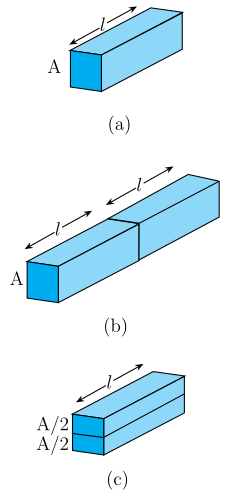
Drawn by us to help you understand the concept clearly, and verified to make sure it's accurate. For exams, practice from your textbook's own diagram.
What the Figure Shows
The figure is a conceptual tool, not a graph. It uses three perspective drawings of a rectangular slab (like a bar of metal) to show how changing the length or cross-sectional area of a conductor changes its resistance.
- Panel (a): A single slab of length and cross-sectional area . The left end-face is shaded and labelled ; the long top edge is labelled . This is the reference conductor with resistance .
- Panel (b): Two identical slabs from (a) placed end-to-end. The total length is now (the top edge shows two segments). The left face is still labelled . The resistance of this combination is .
- Panel (c): The same slab from (a) is split lengthwise into two thin slabs stacked on top of each other. The left end-face is annotated over (each half has area ). The top edge is still labelled . The resistance of each half-slab is .
The Physical Idea
The figure teaches that resistance is a geometric property of a conductor, not just a material property. By keeping the material and current the same, the figure isolates the effect of shape:
- Length effect (panel b): Doubling the length (while keeping area constant) doubles the resistance. This is because the electrons must travel twice the distance, encountering twice the number of atomic collisions.
- Area effect (panel c): Halving the cross-sectional area (while keeping length constant) also doubles the resistance. This is because the same current is now squeezed through half the space, making it harder for electrons to flow.
Key Formula Developed
From these observations, the textbook derives the resistance formula:
Where:
- is the resistance of the conductor (unit: ohm, ).
- (rho) is the resistivity of the material — a constant that depends only on the material, not on its shape.
- is the length of the conductor. …