Business Mathematics and Basic Statistics · Ch 9 — Sets — Operations and Functions
Commutative and Distributive Properties of Set Operations
Commutative and Distributive Properties of Set Operations
Union and intersection both satisfy a commutative property — the order in which the two sets are combined does not matter:
Drawing the Venn diagram for and for produces the exact same shaded region (both circles shaded, regardless of which one is "named first"); the same is true for and (the overlapping lens is the same region no matter which set's name is written first). This syllabus takes these as basic, intuitively obvious properties — stated and verified on finite sets and via Venn diagrams, with no formal proof required.
Union and intersection also satisfy two distributive properties, each describing how one operation spreads over the other:
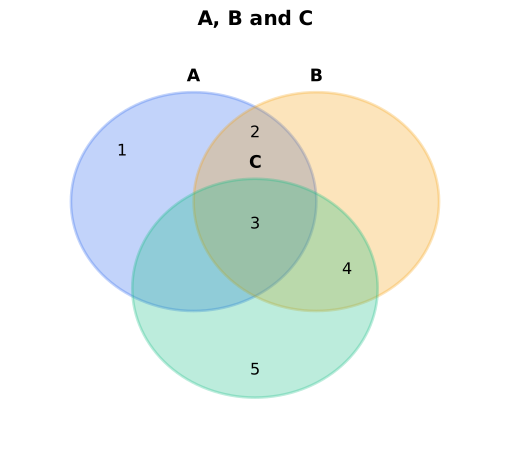
The figure above places every element of Worked Example 6's sets — , , — into its correct region: inside only, inside only, shared by and only, shared by and only, and shared by all three sets. Reading the diagram this way lets both sides of each distributive identity be checked by eye — and both work out to the same four elements, . …
and — the order of the two sets does not af …
and — each operation distributes over the other, taken as axioms (no proof) and veri …