Business Mathematics and Basic Statistics · Ch 9 — Sets — Operations and Functions
De Morgan's Laws
De Morgan's Laws
De Morgan's Laws describe how the complement of a union or intersection relates to the complements of the individual sets — they are among the most useful identities in this chapter, and come up constantly in later probability and logic contexts as well.
In words: "the complement of a union is the intersection of the complements," and "the complement of an intersection is the union of the complements" — notice the operation flips (union becomes intersection, and vice versa) each time a complement is taken across it.
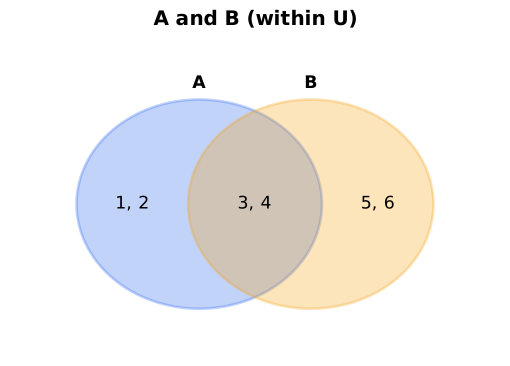
The figure above places every element of Worked Example 7's sets — , , — into its correct region: inside only, inside only, and shared by both. Everything outside both circles — , never drawn inside either circle — is exactly , and it is also exactly : the same region reached two different ways, which is what De Morgan's Law asserts. …
— the complement of a union equals the intersection of t …
— the complement of an intersection equals the union of t …