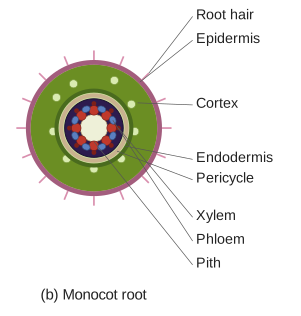
Monocot Root Anatomy – From Intuition to Precision
Think of a root as a straw that has to do two jobs at once: pull water up and stay anchored in the ground. A monocot root (like in maize, wheat, or grass) is built differently from a dicot root because monocots are designed for a fibrous, shallow root system that spreads out. That design choice shows up in the internal anatomy.
The most striking difference you will see under a microscope: a monocot root has many separate strands of xylem (water-conducting tissue) arranged in a ring, and right in the centre, a large, soft region called the pith. Dicot roots, by contrast, have only a few xylem strands and almost no pith.
The Big Picture – What You See in a Cross-Section
If you cut a monocot root crosswise and stain it, you will see concentric layers, like rings in a tree but much more organised. From outside to inside:
- Epidermis – the outermost single layer of cells, with root hairs.
- Cortex – a thick region of loosely packed cells, storing food and allowing water to move sideways.
- Endodermis – a single layer of tightly packed cells that acts as a checkpoint. Every water molecule must pass through these cells, not between them, because of the Casparian strip (a waterproof band).
- Pericycle – a thin layer just inside the endodermis. It gives rise to lateral roots.
- Vascular cylinder – the central core. Here, xylem and phloem are arranged in an alternating ring.
- Pith – the large, soft centre made of parenchyma cells.
The pith is the defining feature of a monocot root. It occupies the centre, and the vascular bundles (xylem and phloem) are arranged around it. In a dicot root, the centre is occupied by xylem, and there is little to no pith.
The Vascular Arrangement – Polyarch Xylem
The term polyarch means "many arches" – many separate strands of xylem. In a monocot root, you typically see 8 to 15 (or more) xylem strands arranged in a ring. Between each xylem strand lies a phloem strand. This alternating pattern (xylem – phloem – xylem – phloem) is the same as in dicots, but the number of strands is much higher.
Why so many? A fibrous root system has many thin roots, each with a small diameter. To pull enough water, each root needs many separate water-conducting channels. Polyarch xylem is the solution.
Polyarch condition: Many xylem strands (typically 8–15+) arranged in a ring, alternating with phloem strands.
The Pith – Why Is It So Large?
The pith is made of thin-walled parenchyma cells. In a monocot root, the pith is large and distinct. Its function is storage – it holds starch and other nutrients. But there is a structural reason too: because the vascular strands are pushed outward to the periphery, the centre is left empty. That empty space gets filled with pith.
In a dicot root, the xylem itself occupies the centre, so there is no room for a pith. This is a fundamental architectural difference.
The pith is not a vascular tissue. It is ground tissue (parenchyma) that stores food. In older monocot roots, the pith may become hollow or sclerenchymatous (hardened).
Step-by-Step – How to Identify a Monocot Root Under a Microscope
- Look for a thick cortex – many layers of loosely arranged cells.
- Find the endodermis – a single layer with Casparian strips (stains differently).
- Inside that, the pericycle – one or more layers of thin-walled cells. …