Q.Describe in detail the structure of the eukaryotic nucleus, covering the nuclear envelope and its pores, the nucleoplasm and chromatin, and the nucleolus, and explain the overall functional significance of the nucleus to the cell.
You're viewing a preview — the full solution, concept, methods & PYQ mapping are locked.
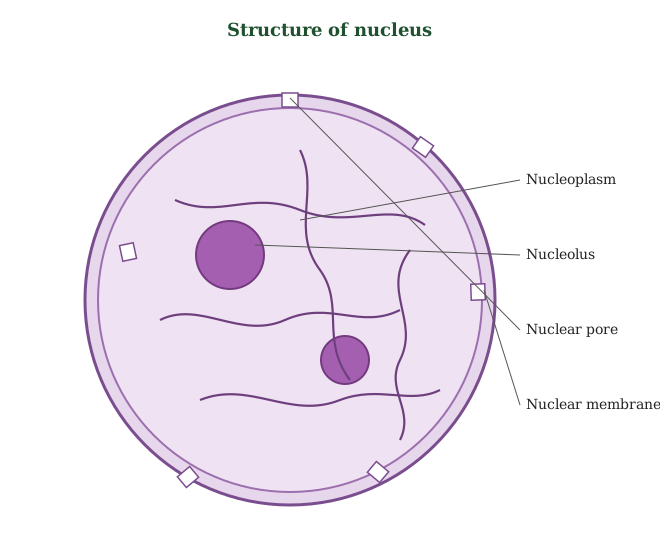
Start your 14-day free trial to unlock the full solution →The nucleus, first identified by Robert Brown in 1831, is usually the most conspicuous organelle in a eukaryotic cell, generally spherical and roughly centrally placed. It is enclosed by a nuclear envelope made of two concentric membranes, an outer and an inner membrane, enclosing the fluid-filled nucleoplasm between them (strictly, within the inner membrane). The outer membrane is typically continuous with the endoplasmic reticulum, and may itself carry ribosomes on its cytoplasm-facing surface. At regular intervals, the two membranes of the envelope fuse to form nuclear pores -- complex protein-lined channels that regulate and facilitate the passage of large molecules, including mRNA and ribosomal subunits moving out to the cytoplasm, and regulatory proteins moving in.
Within the nucleoplasm lies the genetic material, organised in a non-dividing cell as a diffuse, thread-like network called chromatin, consisting of DNA closely associated with histone proteins to form nucleoprotein fibres. As a cell prepares to divide, this chromatin network progressively condenses into the compact, well-defined, rod-shaped chromosomes, each bearing a constricted centromere region at which spindle fibres attach via the kinetochore.
Also within the nucleoplasm, without any membrane of its own, lies one or more dense, rounded bodies called the nucleolus -- the site at which ribosomal RNA (rRNA) is synthesised and where the large and small ribosomal subunits are partly assembled before export through the nuclear pores to be completed and used in the cytoplasm for protein synthesis. Because this activity scales with a cell's protein-synthetic demands, the nucleolus tends to be especially large in cells very actively engaged in making proteins. …
Unlock everything free for 14 days
- Full step-by-step solutions
- Concept-first explanations
- Methods, shortcuts & mistakes
- PYQ mapping + timed mock tests
Full access for 14 days. No credit card required.