Question 36 of 42
Q.(a) Write down the Einstein's photoelectric equation. Explain the emission of photoelectrons from a metal surface using this equation. [1+1]
(b) Plot the variation of photoelectric-current with respect to collector plate potential for different intensities of incident radiation. [1]
West Bengal WbchseWest Bengal HS (WBCHSE) Board 2024Subjective· 3mImportance★★★★★
86% · 36/42 Questions
You're viewing a preview — the full solution, concept, methods & PYQ mapping are locked.
Start your 14-day free trial to unlock the full solution →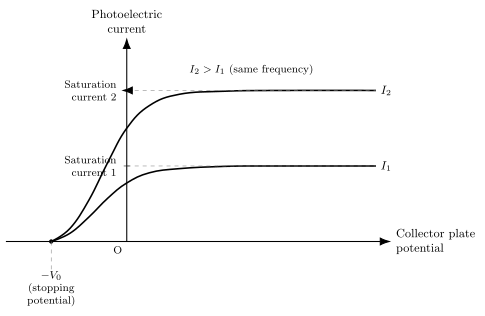
A photon transfers its entire energy to one electron; part goes to overcoming the metal's work function, the rest becomes the electron's kinetic energy — this single equation explains why intensity changes the current but not the maximum electron energy.
- Einstein's photoelectric equation: or equivalently where is the energy of an incident photon, is the work function (minimum energy needed to free an electron from the metal surface), and is the maximum kinetic energy of the emitted photoelectron. Explanation of emission: Light is treated as a stream of photons, each of energy (Planck-Einstein relation). In the photoelectric effect, a single photon is absorbed by a single electron in the metal in one indivisible event (not gradually, as classical wave theory would suggest). If exceeds the work function , the electron is ejected instantly, carrying away the leftover energy as kinetic energy. Electrons emitted from just below the surface lose some energy overcoming internal collisions before escaping, so most electrons have kinetic energy less than ; only those emitted from the very surface, with no internal loss, attain the maximum value . If (frequency below the threshold ), NO photoelectrons are emitted at all, no matter how intense the light — confirming the photon (particle) picture over the classical wave picture.
- I–V graph for different intensities: For a FIXED frequency, plotting photoelectric current (I) against collector plate (retarding) potential (V) for two different intensities (same frequency): …
Unlock everything free for 14 days
- Full step-by-step solutions
- Concept-first explanations
- Methods, shortcuts & mistakes
- PYQ mapping + timed mock tests
Full access for 14 days. No credit card required.