Question 36 of 46
Q.(a) Using Huygens' construction, draw a figure showing the propagation of plane wave refracting at a plane surface separating two media. Hence, verify Snell's law of refraction. (1+2)
(b) An unpolarized beam of light is incident on a group of three polarising sheets, which are arranged in such a way that the characteristic direction of each polarising sheet makes an angle of 30° with that of the preceding sheet. What fraction of light is transmitted?
(2)
OR
(a) In Young's double slit experiment, deduce the conditions for
(i) constructive and
(ii) destructive interference at a point on the screen. (2+1+1)
(b) Draw a graph showing variation of the resultant intensity in the interference pattern against position on the screen. (1)
West Bengal WbchseWest Bengal HS (WBCHSE) Board 2023Subjective· 5mImportance★★★★★
78% · 36/46 Questions
You're viewing a preview — the full solution, concept, methods & PYQ mapping are locked.
Start your 14-day free trial to unlock the full solution →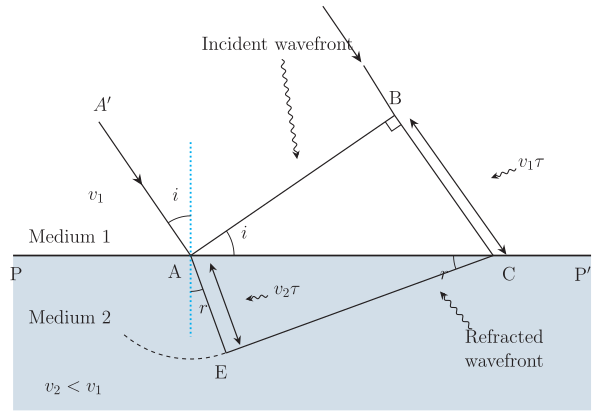
Huygens' principle constructs the refracted wavefront from secondary wavelets, whose geometry directly reproduces Snell's law; passing unpolarised light through 3 polarisers each rotated 30° from the previous one transmits 9/32 of the original intensity.
- Huygens' construction and Snell's law (described): Consider a plane wavefront AB incident obliquely on a plane interface XY separating medium 1 (speed ) from medium 2 (speed ), making angle of incidence with the normal. According to Huygens' principle, every point on the wavefront acts as a source of secondary spherical wavelets that spread out with the speed appropriate to the medium they are in. At the instant point A on the wavefront touches the interface, point B (also on the incident wavefront) still has to travel a distance (at speed ) to reach the interface, taking time . During this same time , the secondary wavelet from A (already at the interface, now inside medium 2) spreads out to a sphere of radius . The new refracted wavefront is the common tangent CD drawn from C to this expanding wavelet. From the right triangles (angle at A) and (angle at C, the angle of refraction), with as the common hypotenuse: Dividing: This is Snell's law of refraction, where is the refractive index of medium 2 relative to medium 1 — derived purely from the geometry of Huygens' wavelets.
- Fraction of light transmitted through three polarisers: …
Unlock everything free for 14 days
- Full step-by-step solutions
- Concept-first explanations
- Methods, shortcuts & mistakes
- PYQ mapping + timed mock tests
Full access for 14 days. No credit card required.