Q.A plane wavefront travelling in a rarer medium of speed is incident on the plane boundary of a denser medium of speed (with ) at an angle of incidence . Using Huygens' construction, derive the relation connecting the angle of refraction to the two speeds, and explain why the refracted wavefront bends towards the normal.
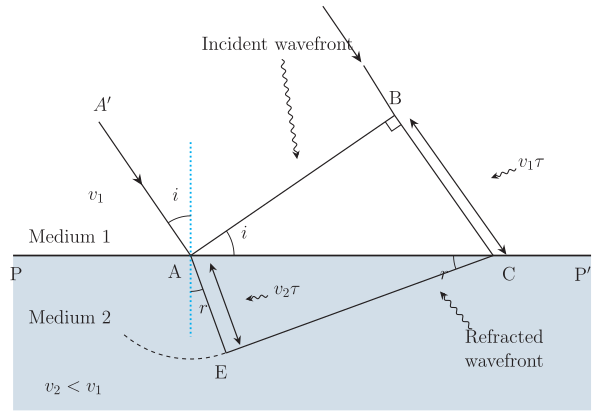
Let the plane wavefront in medium 1 (speed ) be incident on the interface at , at angle of incidence . In time , point reaches the interface at , so . In the same time, the secondary wavelet sent out from into medium 2 (speed ) has grown to radius . The refracted wavefront is the tangent , making angle of refraction with the normal.
In right triangle : .
In right triangle : .
Dividing the two relations cancels the common factor :
Since medium 2 is denser, , so , i.e. , i.e. . The refracted wavefront therefore bends towards the normal on entering the denser medium -- physically, because the part of the wavefront that has already entered the slower medium is 'held back' relative to the part still in the faster medium, tilting the wavefront (and hence the ray, perpendicular to it) closer to the normal.
; since , , so the wavefront bends towards the normal when entering the denser medium.
Unlock everything free for 14 days
- Full step-by-step solutions
- Concept-first explanations
- Methods, shortcuts & mistakes
- PYQ mapping + timed mock tests
Full access for 14 days. No credit card required.