Botany · Ch 5 — Cell: The Unit of Life
Golgi Apparatus
Golgi Apparatus
The Golgi apparatus was first noticed in 1898 by Camillo Golgi, who observed densely stained, net-like structures lying close to the nucleus. These structures were later named Golgi bodies in his honour.
Structure
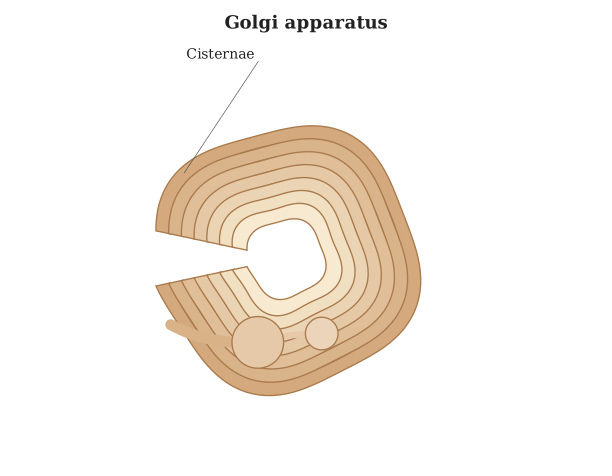
The Golgi apparatus is built from many flat, disc-shaped sacs called cisternae, each roughly half a micrometre to one micrometre across. Its main structural features are:
- The cisternae are stacked one above another, lying parallel to each other.
- The number of cisternae in a single Golgi complex varies from cell to cell.
- The stack is arranged concentrically near the nucleus, and it has two clearly different sides.
- The cis face, also called the forming face, is convex.
- The trans face, also called the maturing face, is concave.
- The cis and trans faces are entirely different from one another in character, yet they remain interconnected.
What the Golgi apparatus does
The chief role of the Golgi apparatus is the packaging of materials so they can be delivered either to targets inside the cell or secreted out of the cell. The process works in a directed flow:
- Materials to be packaged arrive from the ER in the form of vesicles.
- These vesicles fuse with the cis (forming) face of the Golgi apparatus.
- The material then moves across the stack towards the maturing face.
This flow of vesicles from the ER explains why the Golgi apparatus stays in close association with the endoplasmic reticulum.
Modification of proteins …
Drawn by us to help you understand the concept clearly, and verified to make sure it's accurate. For exams, practice from your textbook's own diagram.
This figure shows the Golgi apparatus as a stack of flattened, membrane-bound sacs called cisternae, arranged in a curved pile. The stack has two distinct faces. The convex cis, or forming, face lies near the endoplasmic reticulum and receives vesicles carrying newly made materials. The concave trans, or maturing, face lies on the opposite side and releases finished products. Materials pass through the stack and are chemically modified along the way, then small vesicles pinch off from the edges to carry them onward. The Golgi packages, labels and dispatches proteins and other products to their destinations inside or o …