Botany · Ch 5 — Cell: The Unit of Life
Ribosomes
Ribosomes
Ribosomes are small, dense particles built from ribosomal RNA together with protein — because of this combination they are called ribonucleoproteins — and unlike most other organelles they carry no surrounding membrane at all. Every ribosome is made of two unequal subunits, a larger one and a smaller one, that come together only when a ribosome is actively translating.
Ribosome size is described using the Svedberg unit (S), a measure of how fast a particle settles during centrifugation rather than a simple measure of size, which is why the numbers do not add up arithmetically. Prokaryotic cells carry 70S ribosomes, built from a 50S large subunit and a 30S small subunit. Eukaryotic cells carry the larger 80S ribosomes, built from a 60S large subunit and a 40S small subunit. …
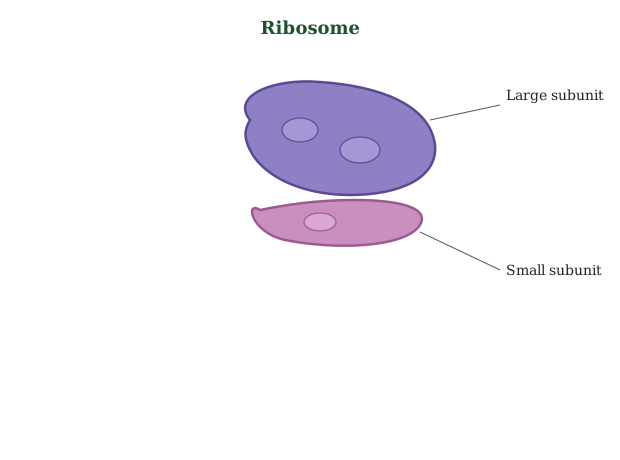
Drawn by us to help you understand the concept clearly, and verified to make sure it's accurate. For exams, practice from your textbook's own diagram.
This figure shows a ribosome, the tiny structure on which proteins are assembled. Each ribosome is made of two unequal parts, a larger subunit and a smaller subunit, that fit together only when work begins. A strand of messenger RNA threads through the groove between the two subunits, and the ribosome reads it to string amino acids into a protein chain. A ribosome is built of RNA and protein together, so it is called a ribonucleoprotein, and unlike most cell structures it has no surrounding membrane. Ribosomes float freely in the cytoplasm or sit on the rough endoplasmic reticulum. The point to take away is that …