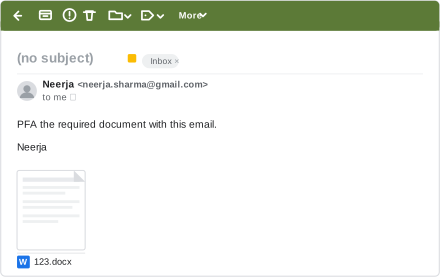
Q.Neerja is a student of Class XI. She has opted for Computer Science. Neerja prepared the project assigned to her. She mailed it to her teacher. The snapshot of that email is shown below.
You're viewing a preview — the full solution, concept, methods & PYQ mapping are locked.
Start your 14-day free trial to unlock the full solution →This question tests understanding of professional email etiquette by identifying missing elements in a student's email to her teacher.
Understanding Email Etiquette
Email etiquette refers to the principles of behavior one should follow when composing and sending professional or formal emails. In an academic or professional context, a well-structured email demonstrates respect, clarity, and professionalism. Each element serves a purpose: the subject line helps the recipient prioritize and file the message, a formal greeting establishes the appropriate tone, self-explanatory terms ensure clarity, a proper signature provides context, and closing regards show courtesy.
When Neerja sends her project to her teacher, she is engaging in formal academic communication. The email should be complete, clear, and respectful. Let's examine each element against the snapshot provided.
Analysis of Each Email Etiquette Element
- Subject of the mail
The snapshot clearly shows
(no subject)in the subject line. A subject line is essential because it tells the recipient what the email is about before they open it. In this case, something like "Class XI Computer Science Project Submission" would immediately inform the teacher of the email's purpose. This etiquette is MISSING. - Formal greeting The email body begins directly with "PFA the required document with this email." There is no greeting such as "Dear Sir/Madam," "Respected Teacher," or even "Good morning/afternoon." A formal greeting sets the appropriate tone for professional communication and shows respect. This etiquette is MISSING.
- Self-explanatory terms Neerja writes "PFA the required document." While "PFA" (Please Find Attached) is commonly used in professional emails, it is an abbreviation that may not be universally understood, especially in an academic setting with students. More importantly, "the required document" is vague—it doesn't specify what the document is (the project), what it's about, or which assignment it refers to. The attachment is named "123.docx," which is completely non-descriptive. A self-explanatory approach would be: "Please find attached my Computer Science project on [topic name]" with a file named something like "Neerja_CS_Project.docx." This etiquette is MISSING.
- Identity of the sender The sender's identity appears in two places: the email header shows "Neerja <[email]>" and the message ends with "Neerja." The teacher can clearly identify who sent the email. While a more complete signature (including class, roll number, or section) would be better practice, the basic identity of the sender is present. This etiquette is PRESENT (though minimal).
- Regards …
Unlock everything free for 14 days
- Full step-by-step solutions
- Concept-first explanations
- Methods, shortcuts & mistakes
- PYQ mapping + timed mock tests
Full access for 14 days. No credit card required.