Biology · Ch 4 — Animal Kingdom
Class – Osteichthyes
Class – Osteichthyes
Class Osteichthyes contains the bony fishes — fishes whose skeleton is made of true bone. Like Chondrichthyes, they belong to the super class Pisces, but they differ from the cartilaginous fishes in several important ways.
Habitat and body
This class includes both marine and freshwater fishes. The body is streamlined and supported by a bony endoskeleton. The mouth is usually placed at the front end of the body (terminal position).
Gills, scales and buoyancy
- They have four pairs of gills, and on each side these are protected by a bony cover called the operculum.
- The skin is covered with cycloid or ctenoid scales.
- An air bladder is present, and it allows the fish to regulate its buoyancy — a key advantage over the cartilaginous fishes, which lack this organ and must keep swimming.
Heart, temperature and reproduction
- The heart is two-chambered, with one auricle and one ventricle.
- They are cold-blooded animals.
- Sexes are separate, fertilisation is usually external, they are mostly oviparous (egg-laying), and development is direct (the young resemble the adult without a distinct larval stage). …
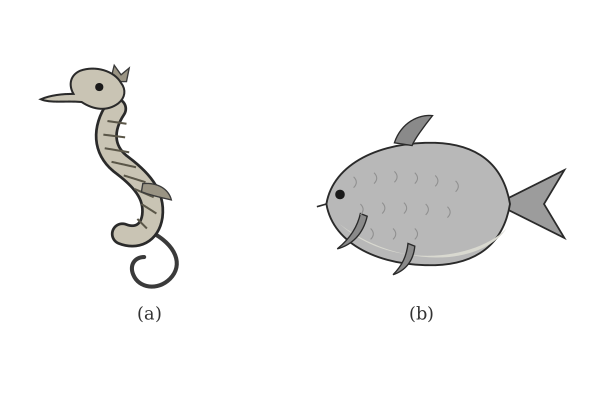
Drawn by us to help you understand the concept clearly, and verified to make sure it's accurate. For exams, practice from your NCERT textbook's own diagram.
These belong to class Osteichthyes, the bony fishes, whose skeleton is made of hard bone rather than cartilage. Their gills are covered and protected by a bony flap called the operculum, and most possess an air bladder, a gas-filled sac that helps them stay buoyant so they need not swim constantly to avoid sinking. Their bodies are usually covered with thin bony scales. Bony fishes live in both fresh water and the sea and form the largest group of fishes. Hippocampus is the sea horse, an unusual marine bon …