Biology · Ch 4 — Animal Kingdom
Phylum – Chordata
Phylum – Chordata
Phylum Chordata gathers together all animals that share a small set of defining structural features at some point in their life. Whatever their outward appearance, these animals are built on the same fundamental plan, which sets them apart from every other group in the animal kingdom.
The three fundamental chordate features
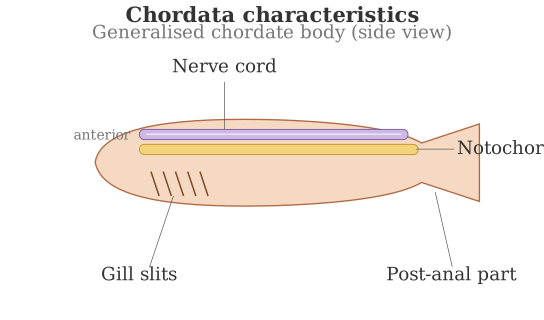
Three characters, seen together, mark an animal as a chordate:
- Notochord — a firm, flexible rod that runs along the length of the body and provides internal support.
- Dorsal, hollow nerve cord — the central nervous system lies along the back (dorsal side), is tube-like (hollow) and forms a single cord.
- Paired pharyngeal gill slits — the wall of the pharynx is perforated by openings arranged in pairs.
Along with these, chordates are bilaterally symmetrical, triploblastic (built from three germ layers) and coelomate, and they work at the organ-system level of organisation. Two further features are typical of the group: a post-anal tail (a part of the body extending beyond the anus) and a closed circulatory system in which blood flows within vessels. The heart, when present, lies on the ventral (lower) side of the body.
Chordates compared with non-chordates
The chordate body plan is essentially a mirror-image arrangement of the non-chordate plan, and the two can be contrasted feature by feature:
| Feature | Chordates | Non-chordates |
|---|---|---|
| Notochord | Present | Absent |
| Central nervous system | Dorsal, hollow and single | Ventral, solid and double |
| Pharyngeal gill slits | Present (pharynx perforated) | Absent |
| Position of heart | Ventral | Dorsal, if a heart is present |
| Post-anal tail | Present | Absent |
The three subphyla
Phylum Chordata is divided into three subphyla — Urochordata (also called Tunicata), Cephalochordata and Vertebrata.
Urochordata and Cephalochordata are together called protochordates, and both are found only in the sea (exclusively marine). They differ in how far the notochord persists:
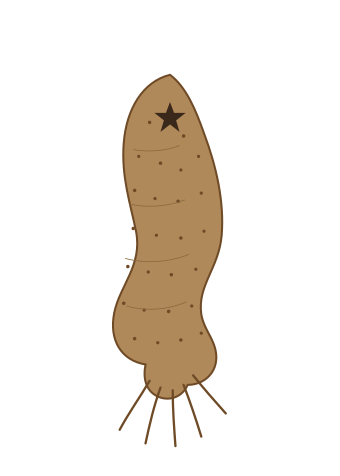
- In Urochordata, the notochord is confined to the tail of the larva and does not remain in the adult. Examples include Ascidia, Salpa and Doliolum.
- In Cephalochordata, the notochord runs the whole way from the head to the tail and stays present throughout life. The example is Branchiostoma, also known as Amphioxus or the lancelet.
Subphylum Vertebrata
In members of Vertebrata, the notochord appears only during the embryonic stage; in the adult it is replaced by a vertebral column made of cartilage or bone. This leads to an important logical point: every vertebrate is a chordate, but not every chordate is a vertebrate — the protochordates are chordates that never develop a backbone.
Besides the basic chordate characters, vertebrates possess:
- a ventral, muscular heart with two, three or four chambers; …
Drawn by us to help you understand the concept clearly, and verified to make sure it's accurate. For exams, practice from your NCERT textbook's own diagram.
This diagram shows the three features that define phylum Chordata and set its members apart from all other animals. First is the notochord, a flexible rod running lengthwise along the back that supports the body, at least at some stage of life. Second is a single, hollow nerve cord lying on the dorsal or upper side of the body, unlike the solid ventral nerve cords of other phyla. Third are pharyngeal gill slits, openings in the throat region used for filter feeding or breathing. Chordates also have a post-anal …
Drawn by us to help you understand the concept clearly, and verified to make sure it's accurate. For exams, practice from your NCERT textbook's own diagram.
This is Ascidia, a marine animal belonging to Urochordata, one of the primitive chordate subgroups. It illustrates an important point about chordate features: the notochord is present only in the tail region of the free-swimming larva, and it is lost when the larva settles and changes into the fixed, sac-like adult. Because the notochord is confined to the tail (uro means tail), the group is named Urochordata. The adult attaches to a surface and feeds by drawing water through its body to filter out food. This example shows that an animal can be a tru …