Biology · Ch 4 — Animal Kingdom
Phylum – Coelenterata (Cnidaria)
Phylum – Coelenterata (Cnidaria)
Coelenterates, also called cnidarians, are aquatic animals that live mostly in the sea. Some stay fixed to a surface (sessile) while others swim freely, and all of them share a radially symmetrical body plan, meaning the parts are arranged around a central axis so that any vertical cut through the centre gives two similar halves.
Where the name comes from
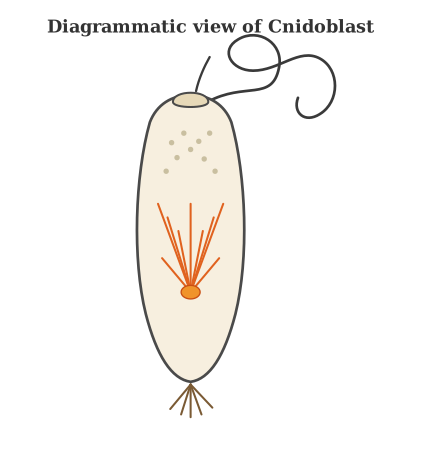
The name Cnidaria refers to special stinging cells found on the tentacles and body surface. These cells are called cnidoblasts or cnidocytes, and each one holds a tiny stinging capsule known as a nematocyst. The cnidoblasts serve three jobs: they help the animal anchor itself, they defend it against enemies, and they help it capture prey.
Body organisation and layers
- These animals show a tissue level of organisation, so their cells are grouped into tissues but not yet into distinct organs.
- They are diploblastic, meaning the body is built from just two germ layers with a jelly-like substance between them.
Digestion and the body cavity
A central cavity called the gastro-vascular cavity (coelenteron) runs through the body. It has only a single opening that acts as the mouth, and this mouth sits on a raised region known as the hypostome. Food is broken down both outside the cells (extracellular digestion) and inside them (intracellular digestion). In certain cnidarians, such as corals, the body is supported by a hard skeleton made of calcium carbonate.
Two body forms and metagenesis
Cnidarians occur in two basic shapes:
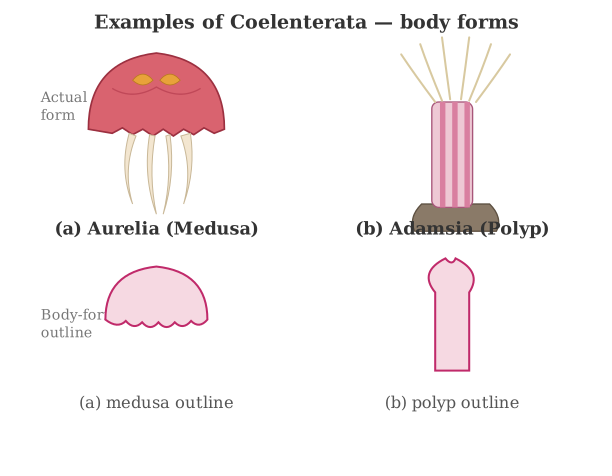
- Polyp — a sessile, cylindrical form, as seen in Hydra and Adamsia.
- Medusa — an umbrella-shaped, free-swimming form, as seen in Aurelia, the jellyfish. …
Drawn by us to help you understand the concept clearly, and verified to make sure it's accurate. For exams, practice from your NCERT textbook's own diagram.
These outlines show the two body forms found in phylum Coelenterata (Cnidaria). The polyp is a fixed, cylindrical form with the mouth and tentacles pointing upward, like Hydra or a sea anemone, while the medusa is a free-swimming, umbrella-shaped form with the mouth and tentacles hanging down, like a jellyfish. Some cnidarians show both forms at different stages of their life. All are radially symmetrical and diploblastic, and they carry stinging cells called cnidoblasts on their tentacles, used to capture prey and for defence. The …
Drawn by us to help you understand the concept clearly, and verified to make sure it's accurate. For exams, practice from your NCERT textbook's own diagram.
This figure shows a single cnidoblast (cnidocyte), the stinging cell that gives phylum Cnidaria its name. At the outer end of the cell sits a small lid-like cover called the operculum, with a short trigger bristle, the cnidocil, projecting from it. Coiled tightly inside the cell is a long, thread-like stinging structure, the nematocyst, packed within its own capsule; when the cnidocil is touched, the operculum flips open and the coiled thread shoots out and uncoils explosively. The base of the cell tapers to a point anchored by short filaments. This single specialised cell is what a cnidarian uses to anchor itse …