Q.A square piece of tin of side 18 cm is to be made into a box without top, by cutting a square from each corner and folding up the flaps to form the box. What should be the side of the square to be cut off so that the volume of the box is the maximum possible.
🔒You're viewing a preview — the full solution, concept, methods & PYQ mapping are locked.
🔒 Start your 14-day free trial to unlock the full solution →Concept understanding — Optimization Word Problem
Optimization Word Problems
Imagine planning a garden with 40 metres of fencing and wanting the largest rectangular area. A long, thin rectangle wastes space; a square feels roomier; somewhere in between lies the best shape. That is an optimisation problem — a fixed resource and a quantity to make as large (or as small) as possible.
Every optimisation word problem has the same skeleton: the best outcome — maximum area, minimum cost, largest volume, shortest time — under a constraint — limited material, a fixed budget, a given perimeter.
The Plan of Attack
The problem gives you a story, not a graph. Your job is to turn it into a single-variable function and find its peak or valley:
- Name the quantity to optimise — call it Q, and write it using variables.
- Find the constraint — a relation between those variables (e.g. "perimeter =40").
- Reduce to one variable — use the constraint to eliminate the rest.
- Differentiate — solve Q′(x)=0 to find the critical points.
- Confirm — use Q′′(x)<0 for a maximum or Q′′(x)>0 for a minimum.
- Answer the question asked — give the actual dimensions/cost, not just x.
In board exams these problems almost always reduce to a quadratic or cubic. Once Q(x) is written, the calculus is mechanical.
The Garden, Worked
40 m of fencing encloses a rectangle; maximise the area.
- Objective: A=lw.
- Constraint: 2l+2w=40, so l+w=20.
- Reduce: w=20−l, giving A(l)=l(20−l)=20l−l2.
- Differentiate: A′(l)=20−2l=0⟹l=10.
- Confirm: A′′(l)=−2<0, a maximum.
So l=w=10 m — a 10 m × 10 m square.
A common slip: solving A′(l)=0 and stopping. Always check max vs min, and answer in the units asked.
The Common Families
| Problem type | Typical objective | Typical constraint |
|--------------|-------------------|--------------------| …
Concept: Optimization Word Problem — maximizing volume by choosing the cut size.
Let the side of the square cut from each corner be x cm. After cutting and folding, the base of the box becomes a square of side 18−2x, and the height is x. The volume is:
V(x)=x(18−2x)2=4x(9−x)2
We need 0<x<9 for a valid box. Differentiate and set V′(x)=0: …
This is a classic box-maximization problem: cutting squares of side x from each corner of an 18×18 sheet gives a box of volume V(x)=x(18−2x)2. Using calculus, the maximum volume occurs when x=3 cm, so the side of the square to cut off is 3 cm.
We start with a flat square of tin, 18 cm on each side. The goal is to cut identical squares from the four corners, then fold up the flaps to form an open-top box. The question asks: what size square should we cut so that the box holds the greatest volume?
This is a classic optimization word problem. The key idea is to express the volume of the box as a function of the cut size, then use differentiation to find where that function reaches its maximum. Because the box has no top, the height of the box equals the side of the cut-out square. The length and width of the base shrink by twice the cut size (since we remove a square from both ends of each side).
Let’s work through it step by step.
-
Define the variable.
Let x cm be the side length of the square cut from each corner. Since the original side is 18 cm, after cutting, the base of the box becomes a square of side 18−2x cm. The height of the box is exactly x cm (the flaps are folded up).
-
Write the volume function.
Volume of a box = (base area) × (height).
Base area = (18−2x)2, height = x.
So
V(x)=x(18−2x)2.
The domain: x must be positive (we cut something) and less than 9 (otherwise the base vanishes or becomes negative). So 0<x<9.
- Differentiate to find critical points. Expand first (or use product rule). Let’s expand:
V(x)=x(324−72x+4x2)=4x3−72x2+324x.
Differentiate:
V′(x)=12x2−144x+324.
Set V′(x)=0:
12x2−144x+324=0.
Divide through by 12:
x2−12x+27=0.
Factor:
(x−3)(x−9)=0.
So x=3 or x=9.
x=9 is at the boundary of the domain (base becomes zero), so it gives zero volume — not a maximum. The only interior critical point is x=3.
- Confirm it’s a maximum. Use the second derivative test: V′′(x)=24x−144. …
Method: Open-Box-From-a-Sheet Optimization (Cut-and-Fold Volume Problems)
This method solves the classic "cut squares from the corners of a sheet, fold up the flaps, maximize the box's volume" family of problems.
Steps
Step 1: Define the cut length as the single variable
Let x be the side length of the square cut from each corner. This single variable determines every dimension of the resulting box.
Step 2: Express the box's length, width, and height in terms of x
Because a square of side x is removed from both ends of each side of the sheet, each side of the base shrinks by 2x (not x), while the height of the box equals x (the folded-up flap). For a square sheet of side a:
base side=a−2x,height=x
Step 3: Write the volume as a function of x and identify its valid domain
V(x)=x(a−2x)2
The domain is restricted to 0<x<a/2, since the base side must stay positive. …
Common Mistakes
Mistake 1: Writing the base side as a−x instead of a−2x
Why it's wrong: a square is cut from each of the four corners, which removes a strip of width x from both ends of every side — so each side shrinks by 2x total, not x. Using a−x silently changes the whole volume function and gives a wrong critical point. Correct approach: always sketch the folded sheet and note that two corner-cuts affect each side.
Mistake 2: Forgetting the domain restriction and accepting the boundary root as the answer
Why it's wrong: the derivative's factored form typically produces two roots, one of which sits exactly at the edge of the valid domain (where the base side becomes zero, giving zero volume) — that root can never be a genuine maximum, since it makes the box degenerate. Correct approach: always check 0<x<a/2 and discard any root outside (or at the edge of) that range before comparing. …
Showing the 12 most recent of 19 on this concept.
- AP EAPCET 2021Set eng-2021-10-05-FN1 markMCQQ.From a rectangular sheet having dimensions 30 cm×80 cm, four equal squares of side x cm are cut at each corner. The remaining sides of the rectangle are folded up vertically so as to form an open rectangular box. Find the value of 'x' for which the volume of the box formed is maximum. (A) x=30 cm (B) x=20 cm (C) x=320 cm (D) x=15 cm
›Reveal solutionSolution
Express box volume as a function of the cut-square side x, maximize with calculus, and discard the root that isn't physically valid. The answer is (C).
Concept and Intuition
Cutting squares of side x from each corner and folding up gives a box of dimensions (30−2x)×(80−2x)×x. The volume is a cubic in x with two critical points; physically x must be less than half the shorter side (15 cm), which rules out one root.
Step-by-Step Solution
- V(x)=x(30−2x)(80−2x).
- Expand: (30−2x)(80−2x)=2400−60x−160x+4x2=2400−220x+4x2.
- V(x)=2400x−220x2+4x3.
- V′(x)=2400−440x+12x2. Set to 0: 12x2−440x+2400=0⇒3x2−110x+600=0.
- x=6110±1102−4(3)(600)=6110±12100−7200=6110±70, giving x=30 or x=320. …
- AP EAPCET 2023Set eng-2023-05-16-FN1 markMCQQ.Given that the solid obtained by rotating a rectangle about one of its side is a cylinder. If the perimeter of a rectangle is 48 cm and the volume of the cylinder formed by rotating it is maximum, then the dimensions of that rectangle is (A) 14, 10 (B) 20, 4 (C) 18, 6 (D) 8, 16
›Reveal solutionSolution
Maximise V=πr2h subject to 2(r+h)=48; the optimum rectangle is 8×16.
Concept and Intuition
Rotating a rectangle about one of its sides sweeps the opposite side around in a circle, producing a cylinder whose height equals the rotation-axis side and whose radius equals the other side. This converts a plane geometry optimisation into a single-variable calculus problem once the perimeter constraint eliminates one variable.
Step-by-Step Solution
- Let the side about which we rotate be h (height of the cylinder) and the other side be r (radius of the cylinder).
- Perimeter constraint: 2(h+r)=48⇒h+r=24⇒h=24−r.
- Volume: V(r)=πr2h=πr2(24−r)=π(24r2−r3).
- drdV=π(48r−3r2)=3πr(16−r). Setting this to zero: r=0 (rejected, degenerate) or r=16.
- Then h=24−16=8. …
- AP EAPCET 2022Set eng-2022-07-07-AN1 markMCQQ.If an open cylinder of given surface area has maximum volume then its radius is (A) Height of the cylinder (B) Height of the cylinder / 2 (C) 2 times Height of the cylinder (D) 3 times Height of the cylinder
›Reveal solutionSolution
A constrained-optimisation problem: maximise the volume of an open cylinder for a fixed surface area. Answer: the radius equals the height (r=h).
Concept and Intuition
"Open" cylinder means it has only one circular base (like a cup, no lid), so its total surface area is base + lateral surface, S=πr2+2πrh — different from a closed cylinder (two bases) which would give a different optimum (h=2r). Fixing S lets you express h in terms of r, turning the volume into a single-variable function of r to maximise.
Step-by-Step Solution
- Surface constraint: S=πr2+2πrh⇒h=2πrS−πr2.
- Volume: V=πr2h=πr2⋅2πrS−πr2=2r(S−πr2)=2Sr−πr3.
- Differentiate w.r.t. r and set to zero: drdV=2S−3πr2=0⇒S=3πr2. …
- AP EAPCET 2026Set eng-2026-05-18-FN1 markMCQQ.The maximum volume (in cu. m) of the right circular cone having slant height 3m. is (A) 6π (B) 33π (C) 34π (D) 23π
›Reveal solutionSolution
Express the cone's volume in terms of its height alone using the fixed slant height, then maximize; the maximum volume is 23π m3.
Concept and Intuition
With the slant height l fixed, radius and height are linked by r2+h2=l2 (Pythagoras on the cone's cross-section). This turns a two-variable optimization (over r and h) into a single-variable one, which we handle with ordinary calculus.
Step-by-Step Solution
- Given l=3, so r2+h2=9 ⇒ r2=9−h2 (with 0<h<3).
- Volume of a cone:
V=31πr2h=3π(9−h2)h=3π(9h−h3).
- Differentiate with respect to h and set to zero:
dhdV=3π(9−3h2)=0 ⇒ h2=3 ⇒ h=3.
- Check it's a maximum: dh2d2V=3π(−6h)<0 for h>0, confirming a maximum.
- Substitute back: …
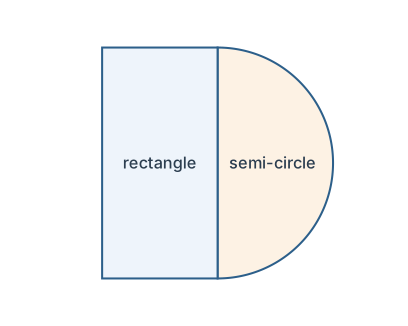
- AP EAPCET 2021Set eng-2021-10-05-FN1 markMCQQ.A window is in the shape of a rectangle, with a semi-circle fused to one of its sides, as shown in the figure. [FIGURE] (a rectangle with a semi-circle attached to its right side, forming a window shape) If the perimeter of the window is fixed as 20 units, then its maximum area can be _____ sq. units. (A) π+4400 (B) π+420 (C) π+4100 (D) π+4200
›Reveal solutionSolution
This is a constrained optimization problem: maximize the area of a rectangle with a semicircle on one side, given a fixed perimeter of 20. The maximum area is π+4200, so the correct option is (D).
We have a window shaped like a rectangle with a semicircle attached to its right side. The semicircle’s diameter equals the height of the rectangle. The total perimeter is fixed at 20 units. We want the maximum possible area.
Why this approach works:
When a shape’s perimeter is fixed, the area is maximized by making the shape as “round” as possible — but here the shape is partly rectangular, so we need to balance the rectangle’s width and height. We’ll express area in terms of one variable, then use calculus (or completing the square) to find the maximum.
-
Define variables
Let the rectangle have width x (horizontal side) and height y (vertical side). The semicircle sits on the right side, so its diameter is y, and its radius is r=y/2.
-
Write the perimeter
The perimeter consists of:
- Left vertical side: y
- Top horizontal side: x
- Bottom horizontal side: x
- Right vertical side: y (but this is not part of the outer boundary — the semicircle replaces it)
- The curved semicircular arc: πr=π(y/2)
So total perimeter:
P=y+x+x+π2y=2x+y+2πy
Given P=20:
2x+y(1+2π)=20
- Solve for x in terms of y
2x=20−y(1+2π)⇒x=10−2y(1+2π)
Simplify:
x=10−2y−4πy
-
Write the area
Area = rectangle area + semicircle area:
- Rectangle: x⋅y
- Semicircle: 21πr2=21π(2y)2=8πy2
So:
A=xy+8πy2
Substitute x:
A=y(10−2y−4πy)+8πy2
A=10y−2y2−4πy2+8πy2
- Combine the y2 terms −4πy2+8πy2=−8πy2 So:
A=10y−2y2−8πy2
Factor y2:
A=10y−y2(21+8π)
Write 21=84, so:
A=10y−y2(84+π)
- Maximize using calculus …
-
- AP EAPCET 2022Set eng-2022-07-06-FN1 markMCQQ.The maximum area of a right angled triangle with hypotenuse h is (A) 22h2 (B) 2h2 (C) 2h2 (D) 4h2
›Reveal solutionSolution
Maximising the area of a right triangle with fixed hypotenuse h occurs at the isosceles case, giving area h2/4.
Concept and Intuition
For a right triangle with legs a,b and fixed hypotenuse h (so a2+b2=h2 is a constraint), the area 21ab is maximised by symmetry when a=b — this is a classic constrained-optimisation result, provable via calculus or the AM-GM inequality (a2+b2≥2ab, so ab≤2a2+b2=2h2, with equality iff a=b).
Step-by-Step Solution
- Let the legs be a and b=h2−a2 (from Pythagoras), and area S=21ah2−a2.
- Maximise S2=41a2(h2−a2) instead (avoids the square root). Let u=a2: S2=41u(h2−u), a downward parabola in u, maximised at u=h2/2.
- So a2=h2/2⇒a=h/2, and then b2=h2−a2=h2/2⇒b=h/2 too — the triangle is isosceles right-angled. …
- AP EAPCET 2022Set eng-2022-07-04-AN1 markMCQQ.A closed cylinder of given volume will have least surface area when the ratio of its height and base radius is (A) 2:1 (B) 1:2 (C) 2:3 (D) 3:2
›Reveal solutionSolution
Minimising the total surface area of a closed cylinder for a fixed volume, via ordinary calculus, gives the classic result h=2r, i.e. height-to-radius ratio 2:1.
Concept and Intuition
This is a standard optimisation problem: express the surface area as a function of one variable (using the volume constraint to eliminate the other), then find where its derivative vanishes.
Step-by-Step Solution
- Volume constraint: V=πr2h⇒h=πr2V.
- Total surface area (closed cylinder, both circular ends included): S=2πr2+2πrh.
- Substitute h: S=2πr2+2πr⋅πr2V=2πr2+r2V.
- Differentiate with respect to r: drdS=4πr−r22V.
- Set to zero: 4πr=r22V⇒4πr3=2V⇒r3=2πV.
- Since V=πr2h: r3=2ππr2h=2r2h⇒r=2h⇒h=2r. …
- AP EAPCET 2021Set eng-2021-08-23-AN1 markMCQQ.If the area of a circular sector of perimeter 60 m is to be maximized, then its radius must be ______ m (A) 20 (B) 15 (C) 10 (D) 5
›Reveal solutionSolution
Expressing the sector's area purely in terms of r using the fixed-perimeter constraint gives A=30r−r2, maximized at r=15.
Concept and Intuition
A circular sector's perimeter includes the two straight radii plus the arc length: P=2r+rθ. Its area is A=21r2θ. Using the fixed perimeter to eliminate θ turns this into a single-variable optimization in r.
Step-by-Step Solution
- Perimeter: 2r+rθ=60⇒θ=r60−2r.
- Area: A=21r2θ=21r2⋅r60−2r=21r(60−2r)=30r−r2.
- Maximize: drdA=30−2r. Set to 0: r=15.
- Second derivative dr2d2A=−2<0, confirming a maximum. …
- AP EAPCET 2022Set eng-2022-07-07-FN1 markMCQQ.The perimeter of a sector is constant. If its area is to be maximum, the sectorical angle should be (A) 6πc (B) 4πc (C) 4c (D) 2c
›Reveal solutionSolution
Expressing the sector's area purely in terms of its radius (using the fixed-perimeter constraint) and maximizing gives r=P/4, and back-substituting gives the optimal sectorial angle θ=2 radians.
Concept and Intuition
A circular sector's boundary consists of two straight radii and one arc, so its perimeter is P=2r+rθ. Since P is held fixed, θ is not a free variable — it is determined by r. This turns the two-variable area formula A=21r2θ into a single-variable optimisation problem in r alone.
Step-by-Step Solution
- Perimeter: P=2r+rθ (constant) ⇒θ=rP−2r.
- Area: A=21r2θ=21r2⋅rP−2r=21r(P−2r)=2Pr−r2.
- Differentiate w.r.t. r: drdA=2P−2r. Set to zero: r=4P.
- Second derivative dr2d2A=−2<0, confirming a maximum.
- Substitute back into θ=rP−2r: with r=P/4, θ=P/4P−P/2=P/4P/2=2. …
- AP EAPCET 2026Set eng-2026-05-18-AN1 markMCQQ.If a sector of maximum area is made with a wire of length 40 cm, then the area (in sq cms) of that sector is (A) 50 (B) 100 (C) 25 (D) 200
›Reveal solutionSolution
Maximize sector area subject to a fixed wire (perimeter = two radii + arc) using single-variable calculus.
Concept and Intuition
A sector's boundary made of wire consists of two straight radii plus the curved arc, so the constraint is 2r+s=40 where s=rθ is the arc length. The area formula A=21rs (half the product of radius and arc length) then becomes a function of r alone once s is eliminated via the constraint, letting ordinary optimization find the maximizing radius.
Step-by-Step Solution
- Constraint: 2r+s=40⇒s=40−2r (with 0<r<20).
- Area: A=21rs=21r(40−2r)=20r−r2.
- Differentiate: drdA=20−2r. Set to zero: r=10.
- Check it's a maximum: dr2d2A=−2<0, confirming a maximum. …
- AP EAPCET 2022Set eng-2022-07-08-FN1 markMCQQ.Maximum area of the rectangle inscribed in a circle of radius 10 cms is (A) 100 (B) 200 (C) 250 (D) 150
›Reveal solutionSolution
This tests the classical optimization result that the square is the area-maximizing rectangle inscribed in a given circle.
Concept and Intuition
A rectangle inscribed in a circle of radius r has its diagonal equal to the circle's diameter 2r. If the sides are x,y, then x2+y2=(2r)2, and by AM-GM, xy (the area) is maximized when x=y, i.e. when the rectangle is a square.
Step-by-Step Solution
- Let the rectangle have sides x,y with diagonal =2r=20: x2+y2=400.
- Area A=xy. Maximize subject to x2+y2=400: by AM-GM/symmetry, max occurs at x=y.
- Then 2x2=400⇒x2=200⇒x=y=200.
- Max area =xy=200. …
- AP EAPCET 2023Set eng-2023-05-19-FN1 markMCQQ.If the height of a cone of greatest volume that can be inscribed in a sphere of radius R is kR, then ratio of the volume of the cone to the volume of the sphere is (A) 8:27 (B) 27:64 (C) 8:125 (D) 4:5
›Reveal solutionSolution
Standard optimization: the cone of greatest volume inscribed in a sphere has height 4R/3, and its volume is 8/27 of the sphere's.
Concept and Intuition
Setting the base circle of the cone at height h above the sphere's lowest point (with apex at that lowest point), the base radius satisfies r2=2Rh−h2 by the geometry of the circle. Maximizing V(h)=31πr2h gives the classical height 34R.
Step-by-Step Solution
- r2=R2−(h−R)2=2Rh−h2.
- V(h)=31πr2h=31π(2Rh2−h3).
- dhdV=31π(4Rh−3h2)=31πh(4R−3h); setting this to 0 (excluding h=0) gives h=34R, so k=34.
- At this h: r2=2R⋅34R−(34R)2=38R2−916R2=98R2.
- Vmax=31π⋅98R2⋅34R=8132πR3.
- Vsphere=34πR3. …
🎓Unlock everything free for 14 days
- ✓Full step-by-step solutions
- ✓Concept-first explanations
- ✓Methods, shortcuts & mistakes
- ✓PYQ mapping + timed mock tests
Full access for 14 days. No credit card required.