Q.Consider the experiment of tossing a coin. If the coin shows head, toss it again but if it shows tail, then throw a die. Find the conditional probability of the event that 'the die shows a number greater than 4' given that 'there is at least one tail'.
🔒You're viewing a preview — the full solution, concept, methods & PYQ mapping are locked.
🔒 Start your 14-day free trial to unlock the full solution →Concept understanding — Conditional Probability
Conditional Probability
Roll a die and ask "what is the chance of an even number?" — that is 3/6. But suppose someone tells you the result is greater than 3. Now you are no longer looking at all six faces, only at {4,5,6}, and two of those (4 and 6) are even, so the probability becomes 2/3. That change — from the probability of A to the probability of A given that B has already occurred — is conditional probability.
The Idea: Shrink the Sample Space
Conditioning on B throws away every outcome where B is false and treats B as the new "whole world." You measure A only against what is still possible.
Think of filtering a table of data: unconditional probability uses every row; conditional probability keeps only the rows where the condition is true.
The Definition
For events A and B with P(B)>0,
P(A∣B)=P(B)P(A∩B).
We divide by P(B) to rescale so that B itself has probability 1; the surviving part of A is the overlap A∩B. Checking the die: P(A∩B)=P({4,6})=62 and P(B)=63, so P(A∣B)=3/62/6=32, matching the intuition.
Rearranging gives the multiplication rule P(A∩B)=P(A∣B)P(B), which is usually the easier way to compute a joint probability when a problem says "given that."
Two Cautions
- P(A∣B) and P(B∣A) are generally not equal; swapping them is the classic mistake. They are linked by Bayes' theorem, P(A∣B)=P(B)P(B∣A)P(A). …
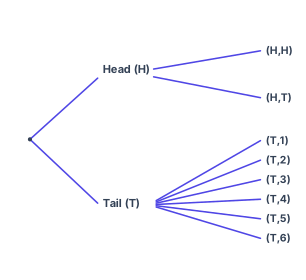
Idea: The outcomes here are NOT equally likely, so weight each by its true probability before using P(A∣B)=P(B)P(A∩B).
Outcomes and their probabilities:
- Head first, then coin: HH, HT, each 21⋅21=41.
- Tail first, then die: T1,…,T6, each 21⋅61=121.
Events:
- A = die shows >4 = {T5,T6}, so P(A)=121+121=61.
- B = at least one tail = everything except HH, so P(B)=1−41=43. …
Because the branch outcomes are not equally likely (HT has probability 41 while each T-die outcome has 121), the conditional probability that the die shows more than 4, given at least one tail, is 92.
Why the outcomes are not equally likely
The experiment branches on the first toss:
- If the coin shows head, we toss the coin again, giving HH or HT.
- If it shows tail, we throw a die, giving T1, T2, T3, T4, T5, T6.
The first toss is fair, so P(H)=P(T)=21. On the head branch the second toss is fair, so
P(HH)=P(HT)=21⋅21=41.
On the tail branch the die is fair, so each of the six outcomes has
P(Ti)=21⋅61=121.
These probabilities sum to 2⋅41+6⋅121=21+21=1, as they should. The eight outcomes are therefore NOT equally likely, so we must use probabilities, not raw counts.
Defining the events
- A: the die shows a number greater than 4, i.e. 5 or 6. A die is thrown only after a tail, so A={T5,T6}.
- B: there is at least one tail. Every outcome has a tail except HH, so B={HT,T1,T2,T3,T4,T5,T6}.
Computing the probabilities
P(B): easiest via the complement. The only "no tail" outcome is HH with probability 41, so …
Method: Conditional probability when outcomes are NOT equally likely
Use this for branching experiments (a coin decides whether you toss again or throw a die) where the final outcomes carry different probabilities. Counting outcomes fails here — you must weight by probability.
Steps
Step 1: Build the tree and attach a probability to each leaf.
Multiply along each branch. A "head then head/tail" leaf has probability 21⋅21=41, while a "tail then die face" leaf has 21⋅61=121. Confirm all leaf probabilities sum to 1.
Step 2: Add probabilities (not counts) for each event. …
Common Mistakes
Mistake 1: Treating all eight leaves as equally likely.
Why it's wrong: a "head then head/tail" leaf has probability 41, but each "tail then die" leaf has only 121; equal weighting wrongly gives 72. Correct approach: weight each leaf by its branch product before adding, giving 92.
Mistake 2: Counting outcomes instead of adding probabilities. …
Showing the 12 most recent of 69 on this concept.
- AP EAPCET 2023Set eng-2023-05-16-AN1 markMCQQ.Two dice are rolled. If A denote the event that the same number shows on each die and B denote the event that the sum of the numbers on both dice is greater than 7, then P(A∣B) and P(B∣A) respectively are (A) 52,41 (B) 51,21 (C) 51,41 (D) 21,53
›Reveal solutionSolution
Counting the 36 equally likely dice outcomes directly gives P(A∣B)=51 and P(B∣A)=21.
Concept and Intuition
With two fair dice there are 36 equally likely outcomes, so every probability here reduces to simple counting: enumerate the outcomes in A, in B, and in A∩B, then apply the conditional probability formula P(X∣Y)=P(Y)P(X∩Y) directly as a ratio of counts.
Step-by-Step Solution
- A = "same number on each die": outcomes (1,1),(2,2),(3,3),(4,4),(5,5),(6,6) — 6 outcomes, so P(A)=366.
- B = "sum >7", i.e. sum ∈{8,9,10,11,12}. Counting pairs per sum: sum 8 has 5 pairs, 9 has 4, 10 has 3, 11 has 2, 12 has 1 — total 5+4+3+2+1=15 outcomes, so P(B)=3615.
- A∩B: doubles with sum >7 — check each double: (4,4) sum 8 ✓, (5,5) sum 10 ✓, (6,6) sum 12 ✓; (1,1),(2,2),(3,3) have sums 2,4,6, all ≤7 — excluded. So A∩B has 3 outcomes, P(A∩B)=363. …
- AP EAPCET 2025Set eng-2025-05-23-AN1 markMCQQ.A die is thrown twice. Let A be the event of getting a prime number when the die is thrown first time and B be the event of getting an even number when the die is thrown second time. Then P(A/Bˉ)= (A) 21 (B) 32 (C) 51 (D) 53
›Reveal solutionSolution
Since A and B (hence Bˉ) come from two independent throws of the die, conditioning on Bˉ does not change P(A); the answer is 1/2.
Concept and Intuition
When two events are determined by physically independent trials (first throw vs second throw of a die), any conditional probability between them collapses to the unconditional probability — conditioning on an independent event changes nothing.
Step-by-Step Solution
- A: prime number on the first throw, i.e. outcome in {2,3,5}, so P(A)=63=21.
- B: even number on the second throw, i.e. outcome in {2,4,6}, so P(B)=21, and P(Bˉ)=21 (odd on the second throw). …
- AP EAPCET 2023Set eng-2023-05-17-FN1 markMCQQ.A pair of dice is thrown. Then the probability that either of the dice shows 2 when their sum is 6 is (A) 21 (B) 51 (C) 52 (D) 53
›Reveal solutionSolution
This is a conditional probability: restrict the sample space to pairs summing to 6, then count how many of those have a 2 on either die.
Concept and Intuition
"Given that the sum is 6" restricts attention to only those (die1, die2) pairs whose total is 6. Within that restricted, equally-likely set, we simply count the favourable outcomes.
Step-by-Step Solution
- Pairs (d1,d2) with d1+d2=6: (1,5),(2,4),(3,3),(4,2),(5,1) — 5 outcomes, each equally likely given the sum is 6.
- Favourable outcomes (either die shows 2): (2,4) and (4,2) — 2 outcomes.
- Required probability =52.
Common Mistakes …
- AP EAPCET 2022Set eng-2022-07-06-AN1 markMCQQ.An unbiased coin is tossed 3 times. If the third toss gets head, then the probability of getting at least one more head is (A) 3/4 (B) 1/4 (C) 1/2 (D) 1/3
›Reveal solutionSolution
This tests recognizing conditional independence: given the third toss's outcome, the first two tosses remain independent unbiased flips, so their probability is unaffected by the condition. Answer: 3/4.
Concept and Intuition
Since coin tosses are independent events, knowing the outcome of the third toss (head) gives us no information about the first two tosses. So the question really just asks: what's the probability of getting at least one head in two independent fair coin tosses? This is most easily computed via the complement (no heads at all in two tosses).
Step-by-Step Solution
- The condition 'the third toss gets head' is independent of the outcomes of the first two tosses (each coin toss is independent of the others).
- So conditioning on the third toss being heads doesn't change the probabilities for the first two tosses — they remain two independent fair coin flips.
- We want P(at least one head among the first two tosses).
- Use the complement: P(no heads in first two tosses)=P(both tails)=21×21=41.
- So P(at least one head)=1−41=43.
Common Mistakes …
- AP EAPCET 2026Set eng-2026-05-15-FN1 markMCQQ.For a biased die, the probabilities for different faces to turn up are given belowThe die is tossed and you are told that either face 1 or 2 has turned up. Then the probability that it is face 1 is (A) 3310 (B) 215 (C) 218 (D) 421
Face 1 2 3 4 5 6 Probability 0.1 0.32 0.21 0.15 0.05 0.17 ›Reveal solutionSolution
Conditioning on "face 1 or face 2" just means renormalizing the two individual probabilities so they add to 1.
Concept and Intuition
P(face 1∣face 1 or 2)=P(face 1)+P(face 2)P(face 1), since these two events are mutually exclusive and their union is the conditioning event.
Step-by-Step Solution
- P(1)=0.1, P(2)=0.32.
- P(1 or 2)=0.1+0.32=0.42.
- P(1∣1 or 2)=0.420.1=4210=215.
Common Mistakes …
- AP EAPCET 2025Set eng-2025-05-21-FN1 markMCQQ.A person is known to speak the truth in 3 out of 4 occasions. If he throws a die and reports that it is six, then the probability that it is actually six is (A) 83 (B) 72 (C) 91 (D) 54
›Reveal solutionSolution
A classic Bayes'-theorem problem: combine the prior P(six)=1/6 with the witness's reliability 3/4 to get the posterior probability it's actually six, given he reports six. The answer is 3/8.
Concept and Intuition
Before he speaks, the die has P(six)=1/6. His report is evidence, but he isn't perfectly reliable (truthful 3/4 of the time). Bayes' theorem updates the prior probability using how likely the report "six" is under each of the two possibilities (six actually occurred vs. it didn't).
Step-by-Step Solution
- Let E1 = the die actually shows six, E2 = it doesn't. P(E1)=61, P(E2)=65.
- Let A = he reports "six". If E1 occurred, he reports six truthfully with probability 43: P(A∣E1)=43.
- If E2 occurred, he reports "six" only if he lies, with probability 41: P(A∣E2)=41.
- By Bayes' theorem:
P(E1∣A)=P(A∣E1)P(E1)+P(A∣E2)P(E2)P(A∣E1)P(E1).
- Numerator: 43⋅61=243=81.
- Denominator's second term: 41⋅65=245.
- Sum =243+245=248=31. …
- AP EAPCET 2021Set eng-2021-08-24-AN1 markMCQQ.A box contains n coins, m of which are fair and the rest are biased. When a biased coin is tossed, the probability of getting a head is twice as likely as tail. A coin is drawn from the box at random and is tossed twice. It is found that first time it shows head and the second time it shows tail. Then the probability that the coin drawn is fair is (A) 8n+m7m (B) 8n+m9m (C) 8m+n7m (D) 8m+n9m
›Reveal solutionSolution
This is a Bayes'-theorem problem; computing the likelihoods for fair vs. biased coins and combining with the prior m/n gives 8n+m9m.
Concept and Intuition
Bayes' theorem updates our belief about which "type" of coin was drawn, given the observed outcome (head then tail), by weighing each type's prior probability by how likely it was to produce that exact outcome.
Step-by-Step Solution
- Fair coin: P(H)=P(T)=21, so P(HT∣fair)=21⋅21=41.
- Biased coin: head is twice as likely as tail, so P(H)=32,P(T)=31; P(HT∣biased)=32⋅31=92.
- Priors: P(fair)=nm, P(biased)=nn−m. …
- AP EAPCET 2026Set eng-2026-05-12-FN1 markMCQQ.A die is thrown three times. If the sum of the numbers thrown is 15, then the probability that the first throw was a Four, is (A) 61 (B) 51 (C) 1085 (D) 1081
›Reveal solutionSolution
A conditional probability found by directly counting favourable die-triples against all triples summing to the given total.
Concept and Intuition
P(first=4∣sum=15)=#{triples with sum=15}#{triples with first=4, sum=15} — a straightforward application of conditional probability by counting, since all 63 triples are equally likely.
Step-by-Step Solution
- If the first throw is 4, the other two throws (each from 1 to 6) must sum to 15−4=11.
- Pairs of dice summing to 11: (5,6) and (6,5) — 2 ways.
- Now count all triples (a,b,c), each in 1–6, with a+b+c=15. Substitute a′=6−a,b′=6−b,c′=6−c (each in 0–5): then a′+b′+c′=18−15=3.
- Number of non-negative integer solutions to a′+b′+c′=3 is (23+2)=10; since 3<5 none violate the upper bound of 5, so all 10 are valid.
- So there are 10 triples with sum 15 in total. …
- AP EAPCET 2023Set eng-2023-05-17-AN1 markMCQQ.Three boxes B1, B2 and B3 contain balls with different colors as follows:A die is thrown. Box B1 is chosen if either 1 or 2 turns up. Box B2 is chosen if 3 or 4 turns up and box B3 is chosen if 5 or 6 turns up. Having chosen a box in this way, a ball is drawn at random from that box. If the ball drawn is found to be Red, then the probability that it is drawn from box B2 is (A) 127 (B) 125 (C) 121 (D) 263
White Black Red B1 2 1 2 B2 3 2 4 B3 4 3 2 ›Reveal solutionSolution
A Bayes'-theorem problem: reverse the conditional probability "ball is Red, which box?" using the total-probability formula.
Concept and Intuition
Bayes' theorem lets us "invert" a conditional probability. We know P(Red∣Bi) for each box and the prior P(Bi) (each 1/3 since the die is fair and each box corresponds to two faces); we want the posterior P(B2∣Red).
Step-by-Step Solution
- Totals in each box: B1: 2+1+2=5; B2: 3+2+4=9; B3: 4+3+2=9.
- P(Red∣B1)=52, P(Red∣B2)=94, P(Red∣B3)=92.
- Each box has prior probability 31 (each box corresponds to two die faces out of six).
- Total probability: P(Red)=31(52+94+92)=31(52+32)=31⋅1516=4516. …
- AP EAPCET 2024Set eng-2024-05-22-FN1 markMCQQ.Two persons A and B throw three unbiased dice one after the another. If A gets the sum 13, then the probability that B gets higher sum is (A) 2165 (B) 274 (C) 21635 (D) 21620
›Reveal solutionSolution
This tests knowing (or deriving) the distribution of the sum of three dice and just needs P(sum>13) since B's throw is independent of A's. Answer: 35/216.
Concept and Intuition
Since the two people throw independently, "A got 13" tells us nothing about B's throw — we just need P(sum of 3 dice>13)=P(sum≥14) out of all 63=216 equally likely outcomes.
Step-by-Step Solution
- Total outcomes for three dice: 63=216.
- The number of ways to get sum s with 3 dice is symmetric: N(s)=N(21−s) (since replacing each die value v by 7−v maps sum s to 21−s).
- Known counts: N(3)=1,N(4)=3,N(5)=6,N(6)=10,N(7)=15; by symmetry N(18)=1,N(17)=3,N(16)=6,N(15)=10,N(14)=15. …
- AP EAPCET 2026Set eng-2026-05-15-AN1 markMCQQ.If it is known that a woman has two children and she has at least one girl child, the probability that the woman has both girl children is (A) 41 (B) 31 (C) 32 (D) 21
›Reveal solutionSolution
This is a classic conditional-probability trap: conditioning on "at least one girl" (not "the elder/first child is a girl") leaves 3 equally likely outcomes, of which 1 is both-girls, giving 31.
Concept and Intuition
With two children, birth order matters for counting equally likely outcomes: BB,BG,GB,GG, each with probability 1/4. The event "at least one girl" is a set of outcomes, not a statement about a specific (e.g. first) child, so it correctly removes only BB and keeps three outcomes, not two. This distinguishes it from the simpler (and different) question "given the elder child is a girl," which would leave only {GB,GG} and give probability 1/2.
Step-by-Step Solution
- Sample space (ordered by birth, say elder-younger): {BB,BG,GB,GG}, each with probability 41.
- Event E = "at least one girl" = {BG,GB,GG}, so P(E)=43. …
- AP EAPCET 2021Set eng-2021-08-19-AN1 markMCQQ.Let X be a random variable which takes values 1,2,3,4 such that P(X=r)=Kr3 where r=1,2,3,4 then ________ (A) K=1001 and P(21<X<25X>1)=978 (B) K=991 and P(21<X<25X>1)=998 (C) K=1001 and P(21<X<25X>1)=998 (D) K=1001 and P(21<X<25X>1)=9910
›Reveal solutionSolution
First find K from total probability =1, then compute a conditional probability by restricting the sample space to X>1 and finding which values also satisfy 21<X<25.
Concept and Intuition
For a discrete probability mass function, probabilities across all values must sum to 1 — this pins down the normalizing constant K. A conditional probability P(E∣F) then equals P(E∩F)/P(F), restricting attention to outcomes already known to lie in F.
Step-by-Step Solution
- P(X=r)=Kr3 for r=1,2,3,4. Sum to 1: K(1+8+27+64)=K(100)=1⇒K=1001.
- So P(X=1)=1001, P(X=2)=1008, P(X=3)=10027, P(X=4)=10064.
- Event F={X>1}={2,3,4}, with P(F)=1008+27+64=10099.
- Event E={21<X<25}: since X takes integer values, this means X∈{1,2}.
- E∩F={2} (since X=1 is excluded by F). P(E∩F)=P(X=2)=1008. …
🎓Unlock everything free for 14 days
- ✓Full step-by-step solutions
- ✓Concept-first explanations
- ✓Methods, shortcuts & mistakes
- ✓PYQ mapping + timed mock tests
Full access for 14 days. No credit card required.