Q.If a is any non-zero vector, then (a⋅i^)i^+(a⋅j^)j^+(a⋅k^)k^ equals ________.
🔒You're viewing a preview — the full solution, concept, methods & PYQ mapping are locked.
🔒 Start your 14-day free trial to unlock the full solution →Concept understanding — Vector Component Extraction
Vector Component Extraction: The Intuition
Imagine pushing a heavy box across the floor at an angle — not straight forward, but slightly downward. Some of your effort moves the box forward, and some presses it into the floor. The force you apply is a single vector, but its effect splits into two independent directions: horizontal and vertical.
That splitting is vector component extraction. Any vector can be seen as the sum of two (or three) simpler vectors pointing along chosen reference directions — usually the coordinate axes. Each of those simpler vectors is a component.
"Component" means "a part of a whole." In vectors, the components are the parts that add up to give the original vector.
The Precise Statement
Given a vector v in a plane, and perpendicular axes x and y, the components of v are its projections onto those axes:
v=vxi^+vyj^
where i^ and j^ are unit vectors along the x and y axes, and vx, vy are scalar components (numbers, possibly negative).
If v makes an angle θ from the positive x-axis, then:
vx=∣v∣cosθandvy=∣v∣sinθ
Component along an axis=(magnitude of vector)×cos(angle between vector and that axis)
Why This Works: The Geometry
Draw a vector from the origin. Drop a perpendicular from its tip to the x-axis — that gives vx. Drop another to the y-axis — that gives vy. The original vector is the diagonal of the rectangle formed by vx and vy. This is the Pythagorean theorem in reverse: if you know the hypotenuse and one angle, trigonometry gives you the legs.
A Concrete Example
A force of 10 N acts at 30∘ above the horizontal.
- Fx=10cos30∘=10×23=53≈8.66 N
- Fy=10sin30∘=10×21=5 N
So the force vector is 8.66i^+5j^ N.
A common mistake: using sin for the horizontal component and cos for the vertical. Check: if the angle is measured from the x-axis, the side adjacent to it is along x — that's cos; the opposite side is along y — that's sin.
Why This Matters …
The key idea is that the expression is the decomposition of a into its Cartesian components — essentially the vector triple product identity applied to basis vectors.
Step 1: Write a in component form:
a=a1i^+a2j^+a3k^.
Step 2: Dot with each unit vector:
a⋅i^=a1, a⋅j^=a2, a⋅k^=a3. …
The expression is the component form of a itself. Since i^,j^,k^ are orthonormal basis vectors, the sum of the projections onto each axis reconstructs the original vector. The answer is a.
The key here is to recognise what the expression (a⋅i^)i^+(a⋅j^)j^+(a⋅k^)k^ actually means.
When you take the dot product a⋅i^, you get the scalar component of a along the x-axis. Multiplying that scalar by the unit vector i^ gives you the vector component of a in the x-direction. The same holds for j^ and k^.
So the sum is simply the decomposition of a into its Cartesian components, added back together. That sum must equal a itself.
Let’s verify it step by step.
-
Write a in component form.
Any vector in 3D can be written as a=a1i^+a2j^+a3k^, where a1,a2,a3 are real numbers.
-
Compute each dot product.
- a⋅i^=(a1i^+a2j^+a3k^)⋅i^=a1 (since i^⋅i^=1, j^⋅i^=0, k^⋅i^=0).
- Similarly, a⋅j^=a2 and a⋅k^=a3.
-
Multiply each scalar by its unit vector.
- (a⋅i^)i^=a1i^
- (a⋅j^)j^=a2j^
- (a⋅k^)k^=a3k^
-
Add them up.
a1i^+a2j^+a3k^=a …
Method: Reconstructing a Vector from Its Projections onto i^,j^,k^
Use this for expressions of the form (a⋅i^)i^+(a⋅j^)j^+(a⋅k^)k^.
Steps
Step 1: Interpret each term as a projection
a⋅i^ is the scalar component of a along the x-axis; multiplying by i^ turns it back into the vector component in that direction. The same holds for j^ and k^.
Step 2: Use orthonormality of the basis …
Common Mistakes
Mistake 1: Thinking the expression gives ∣a∣ or ∣a∣2
Why it's wrong: each term is a scalar (a⋅i^) times a vector (i^), so the sum is a vector, not a length. Correct approach: it reconstructs a itself.
Mistake 2: Not using the orthonormality of i^,j^,k^
Why it's wrong: only because the basis is orthonormal do the dot products reduce to the plain coordinates a1,a2,a3. Correct approach: use i^⋅i^=1, i^⋅j^=0, etc., to pick off the components. …
- AP EAPCET 2026Set eng-2026-05-12-AN1 markMCQQ.If the resultant of three vectors Aˉ=−i^+2j^+3k^, Bˉ=−2i^−j^−4k^ and Cˉ is a vector in the positive z-direction with a magnitude of 2 units, then the vector Cˉ= (A) 3i^−j^+3k^ (B) 3i^−2j^−3k^ (C) 2i^−3j^+2k^ (D) 2i^+3j^−2k^
›Reveal solutionSolution
This is a direct vector-addition problem: knowing the resultant of A,B,C is 2k^, we solve for C by subtraction. The answer is C=3i^−j^+3k^.
Concept and Intuition
If three vectors sum to a known resultant, the unknown one is just the resultant minus the sum of the known ones — vector subtraction is done component-by-component, independently along i^, j^, k^.
Step-by-Step Solution
- Given A=−i^+2j^+3k^ and B=−2i^−j^−4k^.
- Add them: A+B=(−1−2)i^+(2−1)j^+(3−4)k^=−3i^+j^−k^.
- The resultant A+B+C is a vector along +z^ with magnitude 2, i.e. A+B+C=2k^. …
- AP EAPCET 2026Set eng-2026-05-18-FN1 markMCQQ.If the vector components of a vector aˉ along a vector bˉ=4iˉ+5jˉ+3kˉ and perpendicular to bˉ are respectively 257(4iˉ+5jˉ+3kˉ) and 251(47iˉ−10jˉ−46kˉ) then ∣aˉ∣2= (A) 6 (B) 9 (C) 11 (D) 17
›Reveal solutionSolution
The vector equals the sum of its parallel and perpendicular components — add them and square the magnitude.
Concept and Intuition
Any vector decomposes uniquely into a component along a given direction plus a component perpendicular to it; the two given pieces ARE that decomposition, so aˉ is simply their vector sum, no projection formula needed.
Step-by-Step Solution
- aˉ=257(4iˉ+5jˉ+3kˉ)+251(47iˉ−10jˉ−46kˉ).
- iˉ-component: 257×4+47=2528+47=2575=3.
- jˉ-component: 257×5−10=2535−10=2525=1.
- kˉ-component: 257×3−46=2521−46=25−25=−1. …
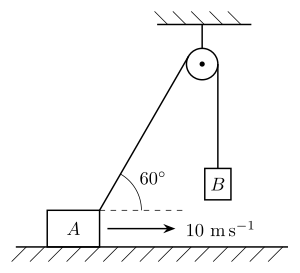
- AP EAPCET 2026Set ap-2026-05-20-AN1 markMCQQ.[FIGURE] (block 'A' rests on a horizontal surface and moves horizontally at 10 ms−1; a string from block A runs at 60° up to a pulley fixed to the ceiling and down the other side to a vertically hanging block 'B') As shown in the figure, block 'A' placed on a horizontal surface is moving horizontally with a speed of 10 ms−1. The speed of hanging block 'B' at the given instant of time is (A) 10 ms−1 (B) 5 ms−1 (C) 53 ms−1 (D) 20 ms−1
›Reveal solutionSolution
The key idea is that the string’s length is constant, so the component of block A’s velocity along the string must equal block B’s upward speed. Using the 60° angle, we find block B’s speed is 10cos60∘=5 m/s. The correct option is (B).
The problem involves a classic constrained motion setup: two blocks connected by a string that passes over a fixed pulley. The string’s length doesn’t change, so the rate at which the string shortens on one side must equal the rate at which it lengthens on the other. Here, block A moves horizontally, pulling the string along the 60° direction; block B moves vertically. The trick is to relate A’s horizontal speed to the speed of the string segment that actually moves B.
-
Identify the constraint
The string is inextensible. Therefore, the speed of block B (which moves straight up or down) equals the speed at which the string is being pulled along its own direction from block A’s side. That is, the component of A’s velocity parallel to the string is what matters.
-
Resolve A’s velocity along the string
Block A moves horizontally to the right at 10 m/s. The string makes a 60∘ angle with the horizontal (measured at A). The component of A’s velocity along the string is:
vstring=vAcos60∘=10×21=5 m/s.
This is the speed at which the string is being pulled from A’s side.
- Relate to block B’s speed …
-
- AP EAPCET 2025Set eng-2025-05-22-AN1 markMCQQ.If the magnitude of a vector pˉ is 25 units and its y-component is 7 units, then its x-component is (A) 24 units (B) 18 units (C) 32 units (D) 16 units
›Reveal solutionSolution
A right-triangle (Pythagorean) resolution of a 2D vector into its rectangular components; x=24 units.
Concept and Intuition
Any 2D vector's magnitude and its two perpendicular (x and y) components form a right triangle, so ∣p∣2=px2+py2. Knowing the magnitude and one component lets you solve for the other.
Step-by-Step Solution
- Given ∣p∣=25, py=7.
- px2=∣p∣2−py2=625−49=576.
- px=576=24 units. …
- AP EAPCET 2025Set eng-2025-05-23-AN1 markMCQQ.If α, β and γ are the angles made by a vector with x, y and z axes respectively, then sin2α+sin2β= (A) sin2γ (B) cos2γ (C) 1+cos2γ (D) 1+sin2γ
›Reveal solutionSolution
This tests the fundamental identity of direction cosines, cos2α+cos2β+cos2γ=1. Rearranging gives sin2α+sin2β=1+cos2γ, option (C).
Concept and Intuition
For any vector in 3D space, the direction cosines with respect to the three coordinate axes always satisfy l2+m2+n2=1 where l=cosα, m=cosβ, n=cosγ. This single identity is the key to relating any combination of these angles' sines and cosines.
Step-by-Step Solution
- Direction cosine identity: cos2α+cos2β+cos2γ=1.
- Use sin2θ=1−cos2θ for each of α,β:
sin2α+sin2β=(1−cos2α)+(1−cos2β)=2−(cos2α+cos2β).
- From the identity, cos2α+cos2β=1−cos2γ.
- Substitute: sin2α+sin2β=2−(1−cos2γ)=1+cos2γ.
Common Mistakes …
- AP EAPCET 2022Set eng-2022-07-04-AN1 markMCQQ.If P, Q are two points on the curve y=2x+2 in the rectangular Cartesian coordinate system such that OP.iˉ=−1, OQ.iˉ=2 then OQ−4OP= (A) 3iˉ+8jˉ (B) 4iˉ+6jˉ (C) 6iˉ+8jˉ (D) 4iˉ+3jˉ
›Reveal solutionSolution
The dot-product conditions simply pin down the x-coordinates of P and Q; plugging into the curve equation gives their y-coordinates, and a direct vector combination finishes the problem.
Concept and Intuition
OP⋅iˉ is just the x-component of the position vector OP (the dot product with the unit vector iˉ picks out the x-coordinate). So these conditions directly specify where on the curve P and Q sit.
Step-by-Step Solution
- OP⋅iˉ=−1⇒ P has x=−1. Since P lies on y=2x+2: yP=2−1+2=21=2. So P=(−1,2).
- OQ⋅iˉ=2⇒ Q has x=2. Then yQ=22+2=24=16. So Q=(2,16).
- OQ=2iˉ+16jˉ, OP=−iˉ+2jˉ. …
- AP EAPCET 2022Set eng-2022-07-05-FN1 markMCQQ.The component of a vector P=3i^+4j^ along the direction (i^+2j^) is (A) 58 (B) 511 (C) 211 (D) 10
›Reveal solutionSolution
This tests finding the scalar component of a vector along a given direction using the dot product with the unit vector of that direction.
Concept and Intuition
The component of P along a direction is the projection of P onto the unit vector of that direction: P⋅n^, where n^ is obtained by normalizing the given direction vector.
Step-by-Step Solution
- Direction vector: i^+2j^, magnitude =12+22=5.
- Unit vector: n^=5i^+2j^.
- P=3i^+4j^. …
- AP EAPCET 2022Set eng-2022-07-05-FN1 markMCQQ.If two vectors A and B are mutually perpendicular, then the component of A⋅B along the direction of A+B is (A) ∣A∣2+∣B∣2 (B) ∣A∣2−∣B∣2 (C) ∣A∣2+∣B∣2∣A∣2−∣B∣2 (D) ∣A∣2−∣B∣2∣A∣2+∣B∣2
›Reveal solutionSolution
This is the standard problem of finding the component of (A−B) along (A+B) for two mutually perpendicular vectors — a scalar cannot have a directional component, so the intended quantity must be a vector combination, and only this reading matches a listed option exactly.
Concept and Intuition
The component of any vector V along a direction n^ is V⋅n^. Here the natural vector to project is (A−B) along (A+B). Since A⊥B, we know A⋅B=0, which simplifies both the dot product and the magnitude of A+B nicely (Pythagoras-like).
Step-by-Step Solution
- Unit vector along A+B: n^=∣A+B∣A+B.
- Since A⊥B, A⋅B=0, so ∣A+B∣2=∣A∣2+∣B∣2+2A⋅B=∣A∣2+∣B∣2, giving ∣A+B∣=∣A∣2+∣B∣2.
- Component of (A−B) along n^: (A−B)⋅n^=∣A+B∣(A−B)⋅(A+B).
- Expand numerator: (A−B)⋅(A+B)=∣A∣2−A⋅B+B⋅A−∣B∣2=∣A∣2−∣B∣2 (using A⋅B=0). …
- AP EAPCET 2022Set eng-2022-07-08-AN1 markMCQQ.A vector P directed along the x-axis is added to vector Q which has a magnitude of 10 m. The resultant vector is directed along the y-axis, with a magnitude that is 2 times that of P. The magnitude of P is (A) 10 m (B) 52 m (C) 6 m (D) 25 m
›Reveal solutionSolution
Setting the resultant's x-component to zero and its y-component to 2P, and using ∣Q∣=10, gives P=25 m.
Concept and Intuition
Vector addition in components: if the sum of two vectors points purely along one axis, the components along the other axis must cancel exactly. This gives one equation; combined with the given magnitude of Q, we get a second equation — enough to solve for P.
Step-by-Step Solution
- Let P=(P,0) since it's along the x-axis, and Q=(Qx,Qy) with ∣Q∣=10⇒Qx2+Qy2=100.
- Resultant R=P+Q=(P+Qx, Qy). Since R is along the y-axis, its x-component is zero: P+Qx=0⇒Qx=−P.
- R's magnitude is given as 2P (twice that of P), and since R is purely along y: ∣R∣=∣Qy∣=2P. …
- AP EAPCET 2021Set eng-2021-08-19-FN1 markMCQQ.One of the rectangular components of a force of 40 N is 203 N. What is the other rectangular component? (A) 10 N (B) 20 N (C) 30 N (D) 25 N
›Reveal solutionSolution
Since the two rectangular components combine via Pythagoras to give the resultant, the missing component is 402−(203)2=20N.
Concept and Intuition
Rectangular components of a force are mutually perpendicular, so the magnitude of the resultant is the hypotenuse of a right triangle whose legs are the two components: Fresultant2=Fx2+Fy2.
Step-by-Step Solution
- Let the resultant force be F=40N, one component F1=203N, and the other component F2 unknown.
- By Pythagoras: F2=F12+F22⇒F22=F2−F12.
- Compute F12=(203)2=400×3=1200.
- Compute F2=402=1600. …
🎓Unlock everything free for 14 days
- ✓Full step-by-step solutions
- ✓Concept-first explanations
- ✓Methods, shortcuts & mistakes
- ✓PYQ mapping + timed mock tests
Full access for 14 days. No credit card required.