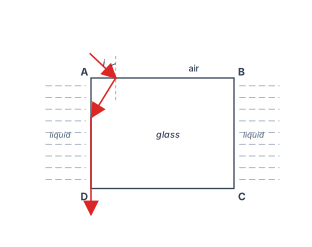
Q.A rectangular glass slab ABCD (refractive index 1.5) is surrounded by a transparent liquid (refractive index 1.25) as shown in the figure. A ray of light is incident on face AB at an angle such that it is refracted out grazing the face AD. Find the value of angle .
You're viewing a preview — the full solution, concept, methods & PYQ mapping are locked.
Start your 14-day free trial to unlock the full solution →This problem involves applying Snell's Law at two interfaces and using geometry. The condition that the ray grazes face AD means the angle of incidence inside the glass at AD is the critical angle. This critical angle is then related to the angle of refraction at face AB, which finally allows us to find the angle of incidence using Snell's Law. The value of angle is .
To find the angle of incidence , we need to work backward from the final condition: the ray grazing face AD. This condition tells us the angle of incidence inside the glass at face AD. We can then use the geometry of the rectangular slab to relate this angle to the angle of refraction at face AB. Finally, applying Snell's Law at face AB will give us the angle .
The geometry of the slab and the ray path are shown in the figure:
-
Identify Refractive Indices and the Critical Angle Condition at Face AD
The refractive index of the glass slab is .
The refractive index of the surrounding liquid is .
The ray of light, after refracting into the glass, strikes face AD and grazes out into the liquid. This means the angle of refraction in the liquid at face AD is . The angle of incidence inside the glass at face AD is therefore the critical angle, let's call it .
For a ray going from a denser medium () to a rarer medium () at the critical angle , Snell's Law gives , which simplifies to .
Applying this to face AD, where light goes from glass () to liquid ():
Now, we find , which will be useful later:
-
Relate Angles Using Geometry of the Rectangular Slab
As the figure shows, the ray enters at face AB and exits grazing the adjacent face AD. Let be the angle of refraction at face AB (inside the glass), measured with respect to the normal to face AB.
The angle of incidence at face AD is , measured with respect to the normal to face AD.
Since ABCD is a rectangular slab, faces AB and AD are perpendicular. Consequently, the normal to face AB is perpendicular to the normal to face AD.
Consider the path of the refracted ray inside the glass. In the right-angled triangle formed by the ray and the two normals (one at AB, one at AD), the angles are related by:
This means .
Therefore, . …
Unlock everything free for 14 days
- Full step-by-step solutions
- Concept-first explanations
- Methods, shortcuts & mistakes
- PYQ mapping + timed mock tests
Full access for 14 days. No credit card required.