Q.(a) State the two conditions under which total internal reflection occurs.
You're viewing a preview — the full solution, concept, methods & PYQ mapping are locked.
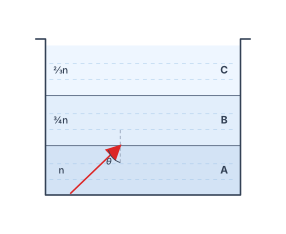
Start your 14-day free trial to unlock the full solution →The beam fails to enter region C because it undergoes total internal reflection at the B–C interface. By applying Snell’s law at A–B and then the critical angle condition at B–C, we find that this happens precisely when .
(a) Two conditions for total internal reflection
- Light must travel from an optically denser medium to a rarer medium (i.e., ).
- The angle of incidence in the denser medium must exceed the critical angle for that pair of media.
(b) Proving the beam does not enter region C for
The key insight is that the beam must cross two interfaces in sequence: first from A to B, then from B to C. If total internal reflection occurs at the second interface (B–C), the beam never enters C. So we need to find the condition on that forces the angle of incidence at B–C to be at least the critical angle for that boundary.
Step 1: Refraction at the A–B interface
The beam starts in layer A (refractive index ) and enters layer B (refractive index ). Let the angle of refraction in B be . By Snell’s law:
Cancel (non-zero):
Since the interfaces are parallel, the angle in B is also the angle of incidence at the B–C interface. This is a standard geometry trick — the refracted ray in B meets the next boundary at the same angle it made with the normal in B.
Step 2: Critical angle for the B–C interface
Layer B (index ) is denser than layer C (index ). The critical angle for the B–C boundary satisfies:
Step 3: Condition for total internal reflection at B–C
For the beam to not enter C, the angle of incidence at B–C (which is ) must be at least the critical angle:
Substitute and :
…
Unlock everything free for 14 days
- Full step-by-step solutions
- Concept-first explanations
- Methods, shortcuts & mistakes
- PYQ mapping + timed mock tests
Full access for 14 days. No credit card required.