Geography · Ch 15 — Atmospheric Circulation and Weather Systems
Local Winds
Local Winds
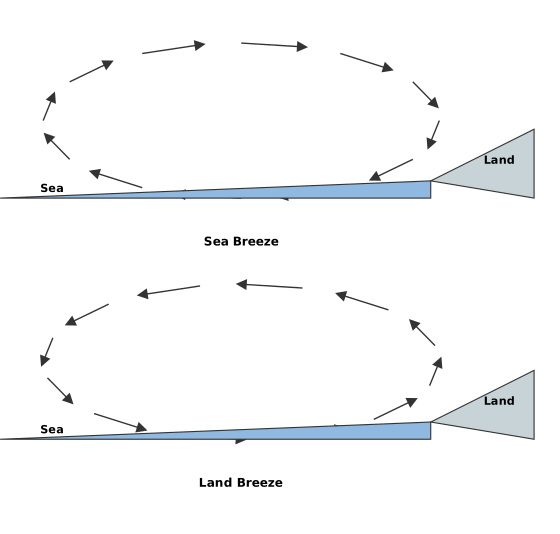
The diagram is built as two stacked cross-sections, each showing a slice of land on one side meeting a sea on the other. The land is drawn as a sloped surface, so you can picture a coastline with a gentle rise inland; the sea is a flat, open expanse beside it. The two panels are labelled for the two times of day, and the only difference between them is the direction of the air movement.
In the upper panel, Sea Breeze, the land is warmer than the sea. The diagram shows a single large circular loop of arrows. Air rises over the land, moves out over the sea at height, sinks over the cooler water, and then flows back toward the land at the surface. The key surface arrows point from sea to land — that onshore flow is the sea breeze itself. The loop is closed, so you can trace the full circuit: warm land → rising air → offshore flow aloft → sinking over sea → onshore flow at ground.
In the lower panel, Land Breeze, the situation is reversed. The sea is now warmer than the land, so the loop runs the other way. Air rises over the sea, moves toward the land at height, descends over the cooler land, and flows out to sea at the surface. The surface arrows point from land to sea — that offshore flow is the land breeze. Again the loop is closed, showing a complete circulation cell.
What the two panels together teach is that a local wind is simply the surface leg of a small convection cell driven by a temperature difference. During the day, the land heats faster than the sea, so air over land becomes buoyant and rises, creating a low-pressure area at the surface. The sea, being cooler, has relatively higher pressure, and air moves from high to low pressure — from sea to land. At night the land cools faster, so the temperature difference flips: the sea is now the warmer surface, air rises over it, and the surface flow runs from the cooler land out to sea. …
Local winds are born out of the everyday or seasonal differences in how the Earth's surface heats and cools. Because land, water, and slopes absorb and release heat at different rates, the air above them behaves differently, creating winds that are common, local, or regional in scale.
Land and Sea Breezes
Land and sea absorb and transfer heat differently. During the day, the land heats up faster and becomes warmer than the sea. The air over the land rises, creating a low-pressure area, while the sea remains relatively cool, keeping the pressure over it relatively high. This sets up a pressure gradient from sea to land, and the wind blows from the sea to the land as the sea breeze.
At night, the conditions reverse. The land loses heat faster and becomes cooler than the sea. The pressure gradient now runs from the land to the sea, producing the land breeze.
Mountain and Valley Winds
In mountainous regions, the slopes get heated up during the day. The air moves upslope, and to fill the resulting gap, air from the valley blows up the valley. This wind is known as the valley breeze.
During the night, the slopes cool down, and the dense air descends into the valley as the mountain wind. The cool air of the high plateaus and ice fields that drains into the valley is called a katabatic wind. …
Differences in the heating and cooling of earth surfaces and the cycles those develop daily or annually can create several common, local or regional winds.
Land and Sea Breezes: During the day the land heats up faster and becomes warmer than the sea -- over the land the air rises, giving rise to a low pressure area, whereas the sea is relatively cool and the pressure over the sea is relatively high. Thus, a pressure gradient from sea to land is created and the wind blows from the sea to the land as the sea breeze. In the night the reversal of condition takes place -- the land loses heat faster and is cooler than the sea; the pressure gradient is from the land to the sea, and hence land breeze results. …