Geography · Ch 6 — Natural Hazards and Disasters
Consequences of Drought
Consequences of Drought
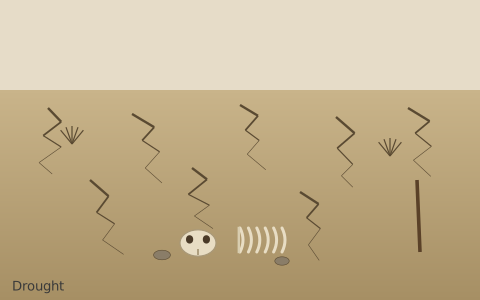
The diagram is a single, unlabelled scene — no panels, no arrows, no captions beyond the word "Drought" itself. It shows a stretch of ground that has cracked into a mosaic of deep, irregular fissures, the kind you see when topsoil has baked and shrunk under prolonged heat with no moisture to bind it. The earth is pale and dusty, parched to the point of lifelessness.
Scattered across this cracked surface are the remains of animals — bones and a skull, bleached and dry. They are not arranged in any deliberate way; they lie where they fell, which is exactly the point. Livestock die when fodder and water run out, and their carcasses are left to whiten in the sun because there is no one and nothing left to tend to them. Beside the bones stand a few sparse, dead-looking shrubs, their branches bare and brittle, and a single thin wooden stake driven upright into the ground — perhaps a fence post, perhaps a marker, now useless in a landscape that can support neither crops nor cattle.
What the image teaches is not a mechanism but a consequence. The textbook text lists the cascading failures of drought — crop failure, fodder scarcity, water shortage — and the diagram condenses all of them into one frame. The cracked earth is the jalkal (water scarcity), the dead shrubs and stake are the failed akal (food scarcity) and trinkal (fodder scarcity), and the bones are the mass death of cattle that follows. The scene is static, but it implies motion: the humans and livestock have already migrated away, leaving only what could not move or survive. That absence of people is itself a message — drought empties a landscape before it destroys it. …
Drought does not end when the rains fail. Its effects ripple outward, hitting food production, water supply, livestock, and human health in a chain of linked crises. The most devastating situation arises when a region suffers a shortage in all three essentials at once — food grains, fodder, and water. Each shortage has its own local name: scarcity of food grains is called akal, scarcity of fodder is trinkal, and shortage of water is jalkal. When all three fail together, the condition is known as trikal, and this is the most severe form of drought.
The visible face of drought is grim. Large-scale death of cattle and other animals becomes common, and both humans and livestock are forced to migrate in search of survival. These migrations are among the most frequently witnessed sights in drought-affected areas. A further danger comes from water itself — when water is scarce, people are compelled to consume contaminated water, which leads to the spread of waterborne diseases such as gastro-enteritis, cholera, and hepatitis.
Droughts carry both immediate and long-term disastrous consequences for the social and physical environment. Because of this dual nature, planning for drought must address both time horizons separately.
Immediate measures focus on saving lives in the short term. These include the distribution of safe drinking water, providing medicines for the victims, ensuring the availability of fodder and water for cattle, and shifting people along with their livestock to safer places. …
Drought has a cascading effect on many other aspects of environment and society. The most direct effect is crop failure and shortage of food-grains, which is locally called akal (food scarcity). Other consequences that follow are shortage of fodder, called trinkal (fodder scarcity), and shortage of water called jalkal (water scarcity). Shortage of all the three -- food, fodder and water, is the most devastating and is called trikal.
Other consequences of drought are large scale death of cattle and other domestic animals, and migration of human and livestock population. In the absence of adequate and clean drinking water, people are sometimes forced to consume contaminated water, resulting in the spread of many water-borne diseases like gastro-enteritis, cholera and hepatitis. …