Geography · Ch 6 — Natural Hazards and Disasters
Tsunami
Tsunami
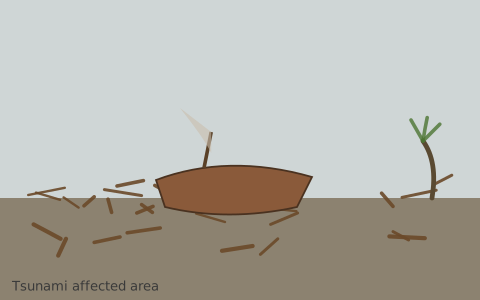
The photograph shows the aftermath of a tsunami on a coastal strip. The ground is littered with the wreckage of what was once a working shoreline: a damaged boat lies tilted among the debris, its hull broken and useless. Around it are splintered wooden structures — the remains of huts, jetties or small fishing shelters — reduced to scattered planks and beams. Palm trees, which normally stand tall along such coasts, are uprooted or leaning at unnatural angles, their trunks snapped or tilted by the force of the water.
What makes the image instructive is not any single object but the combination of them. A tsunami does not arrive as a neat, single wave that simply recedes; it surges inland with enormous energy, carrying debris with it and smashing everything in its path. The boat, the wooden buildings and the palms were all part of the same coastal landscape, and all were struck together. The fact that the trees are uprooted rather than merely bent tells you the water was deep and fast-moving. The splintered wood tells you the structures were not built to withstand lateral force — they were overwhelmed from the side, not from above.
The diagram also carries a quiet lesson about vulnerability. Coastal areas are densely populated and packed with human activity — fishing, trade, settlement — which is exactly why a tsunami's toll on life and property is so much higher than that of many other hazards. The wrecked boat and broken huts are not random damage; they are the destruction of livelihoods. A ship at sea, by contrast, would have felt little — the same wave that flattened this shore would have lifted a vessel only a metre or two, because over deep water the tsunami has a very long wavelength and a tiny height. The devastation appears only where the wave enters shallow water, shortens, and rises. …
Tsunami
A tsunami is not a single wave but a series of waves triggered by the sudden displacement of a large volume of ocean water. The most common causes are earthquakes and volcanic eruptions that make the sea-floor move abruptly. This sudden movement pushes the water above it into high vertical waves, which is why tsunamis are also called seismic sea waves or harbour waves.
The behaviour of a tsunami depends entirely on the depth of the water it is travelling through. In the open ocean, the wave has a very long wavelength and a very limited wave-height. A ship at sea barely notices a tsunami passing beneath it — the wave lifts the vessel only a metre or two, and each rise and fall takes several minutes. This is why tsunamis are so difficult to detect in the deep sea and why ships are rarely harmed by them. The impact is far greater near the coast. When a tsunami enters shallow water, its wavelength gets reduced while its period (the time between successive waves) remains unchanged. This forces the wave-height to increase dramatically — sometimes up to 15 metres or more. Because of this behaviour, tsunamis are also referred to as shallow water waves.
The initial seismic disturbance creates only one instantaneous vertical wave, but after that first jolt, a series of afterwaves form. These waves oscillate between a high crest and a low trough as the water tries to restore its normal level. When these towering waves reach the coast, they release the enormous energy stored in them. The water flows turbulently onto the land, destroying port-cities, towns, buildings, structures and entire settlements.
Tsunamis are most frequently observed along the Pacific Ring of Fire, particularly along the coasts of Alaska, Japan, the Philippines and other islands of Southeast Asia. They also strike Indonesia, Malaysia, Myanmar, Sri Lanka and India. Coastal areas are among the most densely populated regions of the world and are centres of intense human activity, so the loss of life and property from a tsunami is likely to be far higher than from other natural hazards affecting the coast. …
Tsunami is a Japanese term consisting of two words, tsu (harbour) and nami (waves). It is a wave train or series of waves in a water body caused by the displacement of a large volume of water, generally in an ocean. Earthquakes, volcanic eruptions and other underwater explosions, landslides, glacier calvings and, rarely, meteorite ocean impacts have the potential to generate a tsunami.
Unlike wind-generated waves, which only travel through the upper layer of the ocean, tsunami waves involve movement of the water column right up to the sea floor and are, therefore, sometimes referred to as ‘shallow-water waves’ as their wave-length is very large compared to the ocean depth. Away from the coast, their length can surpass 100 km and period can vary from five minutes to one hour. As the tsunami waves travel into shallow water, their speed decreases and their amplitude increases -- this can generate waves of over 15 metres in height near coastal areas. …