History · Ch 2 — An Empire Across Three Continents
Controlling Workers
Controlling Workers
The Roman empire’s prosperity rested on a vast labour force, and the state took care to keep that force under strict control. Workers were bound to their occupations, with sons expected to follow their fathers’ trades, and the law punished those who tried to escape their lot …
'Soon afterwards the City Prefect, Lucius Pedanius Secundus, was murdered by one of his slaves. After the murder, ancient custom required that every slave residing under the same roof must be executed. But a crowd gathered, eager to save so many innocent lives; and rioting began. The senate-house was besieged. Inside, there was feeling against excessive severity, but the majority opposed any change (….) [The senators] favouring execution prevailed. However, great crowds ready with stones and torches prevented the order from being carried out. Nero rebuked the population by edict, and lined with troops the whole ro …
Drawn by us to help you understand the concept clearly, and verified to make sure it's accurate. For exams, practice from your NCERT textbook's own diagram.
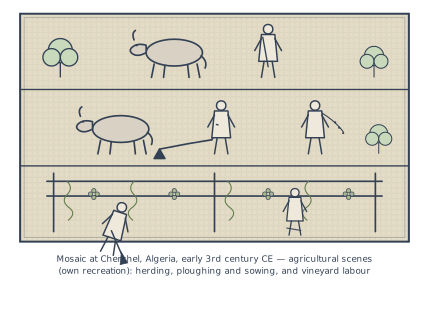
The mosaic at Cherchel, Algeria, dates to the early third century CE — a period when the Roman Empire was at its height. Cherchel itself was an important coastal city in the Roman province of Mauretania Caesariensis, and this floor mosaic is a rare, detailed glimpse into the agricultural economy that sustained such provincial towns. The artwork is divided into two horizontal registers, each showing a different stage of farm work.
The upper register shows ploughing and sowing. A team of oxen, yoked together, pulls a plough through the soil while a labourer guides the implement. Behind him, another worker scatters seed by hand — the classic broadcast-sowing method. This pairing of plough and seed is deliberate: it captures the two essential acts of preparing a field, and the sequence reads left to right as a single continuous operation. The presence of the yoked team tells us this was not subsistence hoe-farming but organised, animal-powered agriculture, capable of working larger plots.
The lower register shifts to the vineyard. Workers are shown tending vines trained on a trellis — a structure of stakes and crossbars that lifts the plants off the ground. This is skilled, seasonal labour: pruning, tying, or harvesting the vines, all tasks that require care and repeat through the year. The trellis itself is significant, because it signals a deliberate investment in viticulture, not casual grape-picking. Wine was a major trade commodity in the Roman world, and North African estates produced it in volume for export across the Mediterranean. …