History · Ch 3 — Nomadic Empires
Introduction
Introduction
How We Know About the Mongols
The term ‘nomadic empire’ can sound almost like a contradiction. Nomads are usually imagined as wanderers, living in family groups with a simple economy and little formal government, while an ‘empire’ suggests a fixed territory, an elaborate administration, and centralised power over a vast population. Yet this contrast collapses completely once we look at what the Mongols, under Genghis Khan, actually built: starting from a nomadic society on the Central Asian steppe, they created a transcontinental empire spanning Europe and Asia through the thirteenth and fourteenth centuries, adapting their traditional customs into both a formidable military machine and a genuinely sophisticated system of governance.
Writing this history is not straightforward, because the Mongols themselves produced very little literature of their own. Most of what we know comes from chronicles, travelogues and documents written by settled, city-based scholars — Buddhist, Confucian, Christian, Turkish and Muslim — many of whom viewed nomadic life with suspicion or open hostility. A few who lived at or served the Mongol court, however, left more sympathetic accounts. Because the empire spanned such a vast territory, sources on it survive in many languages — Chinese, Mongolian, Persian and Arabic are the most important, alongside Italian, Latin, French and Russian — and the same episode is often told very differently in different traditions (the Mongolian and Chinese versions of the earliest narrative of Genghis Khan’s life do not agree, and neither do the Italian and Latin versions of Marco Polo’s account of the Mongol court). Some of the most valuable modern research came from Russian scholars from the eighteenth century onward, including a body of Marxist historiography in the early twentieth century that read Mongol history through a framework of evolving ‘modes of production’. Reconstructing a reliable account of the Mongols, then, means constantly weighing these outside — often hostile — sources against one another.
The thirteenth century opened with a new force reshaping the political map of Eurasia. In the steppes of Central Asia, a single leader, Genghis Khan (died 1227), had succeeded in uniting the Mongol people. What made this more than a tribal consolidation was the scale of his ambition: Genghis Khan believed he carried a mandate from God to rule the entire world. His own lifetime was spent securing control over the Mongol tribes and leading campaigns into neighbouring regions — north China, Transoxiana, Afghanistan, eastern Iran and the Russian steppes. But his descendants went much further, pushing outward to build what became the largest empire the world had ever seen.
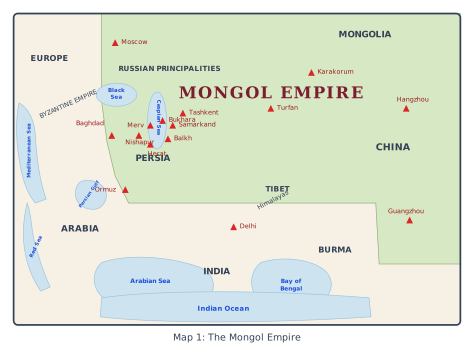
The map is a political map of Asia and eastern Europe, and its single subject is the full territorial sweep of the Mongol Empire. The shaded region is the empire’s extent under Genghis Khan and his successors, and it is drawn generously: it covers Mongolia itself, China, Tibet, Persia, and stretches into part of Russia and Central Asia. That shading is the map’s core statement — it shows not a single campaign or a moment in time, but the accumulated conquests of several generations, from Genghis Khan’s own campaigns into north China, Transoxiana, Afghanistan, eastern Iran and the Russian steppes, to the later expeditions of his descendants that carried Mongol power into the Middle East and Europe.
The map anchors this vast territory with two kinds of markers. The imperial capital, Karakorum, is located — the political heart of the empire, the city from which the Great Khans ruled. Alongside it, a set of major cities is placed against the region’s seas and mountain ranges: Moscow, Baghdad, Samarkand, Bukhara, Delhi and Hangzhou. These are not random dots. Each one is a node in the story the chapter tells — Moscow, the limit of Batu’s devastating 1236–41 campaigns; Baghdad, the seat of the Abbasid caliphate that the Mongols would destroy; Samarkand and Bukhara, the great cities of Transoxiana that Genghis Khan himself sacked, Bukhara being the very city whose capture Juwaini describes; Delhi, the capital of the Delhi Sultanate on the empire’s southern edge; and Hangzhou, the southern Chinese city that marked how far Mongol conquest reached into China. The physical geography — seas and mountain ranges — is drawn in to make sense of how such a sprawling dominion was connected and where its natural boundaries lay.
What the map teaches is scale. It is the visual answer to the chapter’s central question: how did the Mongols create an empire that dwarfed Alexander’s? The shaded territory spans the entire width of the Eurasian landmass, from the China coast to the edges of Europe, and the placement of Karakorum in the middle of it shows how a steppe capital could sit at the centre of a world empire. The cities, spread from Moscow to Hangzhou and from Baghdad to Delhi, make concrete the claim that the Mongols ruled the largest empire the world had ever seen — and they do so without a single arrow or battle line, purely through the geography of conquest.
This vision of world dominion was not a private family ambition; it was proclaimed openly to other rulers. Genghis Khan's grandson Mongke (reigned 1251–60) sent a warning to the French king Louis IX (reigned 1226–70). The message was blunt: in Heaven there is only one Eternal Sky, and on Earth there is only one Lord — Genghis Khan, the Son of Heaven. Mongke told Louis that when the whole world, from sunrise to sunset, was united in joy and peace under the Eternal Heaven's decree, the Mongols' intentions would become clear. If Louis refused to believe this decree, hiding behind the excuse that his country was far away, his mountains mighty and his sea vast, and if he then brought an army against the Mongols, they knew what they could do. The Eternal Heaven, who had made easy what was difficult and near what was far off, would decide the outcome.
These were not empty words. Between 1236 and 1241, Batu — another grandson of Genghis Khan — led campaigns that devastated Russian lands up to Moscow, seized Poland and Hungary, and camped outside Vienna. In the thirteenth century it genuinely seemed that the Eternal Sky favoured the Mongols. Across much of China, the Middle East and Europe, people interpreted Genghis Khan's conquests as the 'wrath of God' — a sign that the Day of Judgement had begun.
A striking record of this terror survives in the work of Juwaini, a Persian chronicler of the late thirteenth century who wrote about the Mongol rulers of Iran. Juwaini described the capture of Bukhara in 1220. After the city fell, Genghis Khan went to the festival ground where the city's wealthy residents had gathered and addressed them directly. He told them they had committed great sins, and that the great ones among them were the sinners. His proof, he said, was simple: he was the punishment of God. If they had not sinned so gravely, God would not have sent a punishment like him upon them. One man who escaped from Bukhara after its capture reached Khurasan, where he was asked what had happened to the city. His answer was chillingly brief: 'They came, they mined the walls, they burnt, they slew, they plundered and they departed.'
Juwaini, a late-thirteenth-century Persian chronicler of the Mongol rulers of Iran, carried an account of the capture of Bukhara in 1220. After the conquest of the city, Juwaini reported, Genghis Khan went to the festival ground where the rich residents of the city were and addressed them: 'O people know that you have committed great sins, and that the great ones among you have committed these sins. If you ask me what proof I have for these words, I say it is because I am the punishment of God. If you had not committed great sins, God would not have sent a punishment like me upon you'… Now one man had escaped from Bukhara after its capture and had come to Khurasan. He was questioned about the fate of the city and replied: 'They came, they [mined the walls], they burnt, they slew, they plundered and they departed.'
The scale of the Mongol achievement raises obvious questions. How did the Mongols create an empire that dwarfed the conquests of Alexander, the earlier 'World Conqueror'? In a pre-industrial age, with poor technology and slow communications, what skills did they deploy to administer and control such a vast dominion? And for a man so confident of his divinely granted right to rule, how did Genghis Khan relate to the diverse social and religious groups within his empire — what happened to that plurality in the making of his imperium?
Before any of this can be answered, the chapter insists on starting with humbler questions. Who were the Mongols? Where did they live? Who did they interact with, and how do we know about their society and politics? These basic facts of geography and social organisation come first, because the empire's astonishing rise cannot be understood without knowing the people who built it.