History · Ch 2 — An Empire Across Three Continents
Economic Expansion
Economic Expansion
The period after Augustus saw the empire’s economy grow not by conquering new land, but by making the existing provinces work harder. This expansion was driven by a simple yet powerful force: the demand for goods from the city of Rome itself, which acted like a giant magnet pulling in resources from across the Mediterranean. To meet this demand, the Romans developed new techniques in mining and agriculture, and they built a vast network of roads and safe sea routes that tied the entire region into a single, thriving market …
Drawn by us to help you understand the concept clearly, and verified to make sure it's accurate. For exams, practice from your NCERT textbook's own diagram.
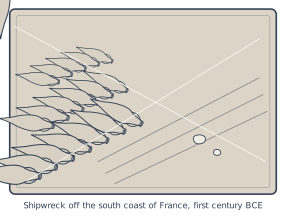
The figure shows the remains of a Roman merchant vessel that sank off the southern coast of France in the first century BCE. What survives is not the ship itself but its cargo: a dense scatter of amphorae — the tall, two-handled clay jars that were the standard bulk containers of the ancient Mediterranean. These particular amphorae are Italian in origin, and they carry a stamped mark identifying a producer whose workshop lay near the Lake of Fondi, a coastal lagoon in central Italy, south of Rome. The wreck therefore documents a real commercial route: goods made in Italy, packed in Italy, and shipped across the sea to a destination in Gaul.
The layout of the figure is essentially archaeological. It presents the wreck site as it would appear on the seabed, with the amphorae lying in rows or clusters where they settled when the ship broke apart. The stamped marks on the jars are shown close up, so you can read the producer's name as a kind of ancient brand. The arrows or labels in the figure connect the physical objects to their geographical and economic context — pointing from the Italian coast to the French wreck site, and from the amphorae to their contents, wine and olive oil, which were sealed inside for the voyage. …