History · Ch 3 — Nomadic Empires
Conclusion: Situating Genghis Khan and the Mongols in World History
Conclusion: Situating Genghis Khan and the Mongols in World History
The way we remember Genghis Khan depends almost entirely on whose history we are reading. For the settled peoples of the thirteenth century — the townsfolk of China, Iran and eastern Europe — the Mongols were a terror: conquerors, destroyers of cities, responsible for the deaths of thousands. That image of the destroyer is the one that has stuck in the popular imagination even today. But for the Mongols themselves, Genghis Khan was the greatest leader of all time. He united the Mongol people, freed them from endless tribal warfare and from Chinese exploitation, brought them prosperity, built a grand transcontinental empire, and restored trade routes and markets that attracted distant travellers like the Venetian Marco Polo.
These two images are not merely a matter of different perspectives. They should make us pause and reflect on how a single dominant perspective — that of the defeated, sedentary peoples — can completely erase all others. The Mongols left behind no chronicles of their own in the way that settled empires did, so almost everything we know about them comes from the pens of their enemies or their subjects. That is why the contrast matters: it is not just that people saw the same events differently, but that one version of events has survived and been repeated, while the other has had to be recovered.
Consider the sheer size of the Mongol dominion in the thirteenth century and the diversity of peoples and faiths it embraced. The Mongol Khans themselves belonged to a variety of religions — Shaman, Buddhist, Christian and eventually Islam — yet they never let their personal beliefs dictate public policy. They recruited administrators and armed contingents from people of all ethnic groups and religions. Theirs was a multi-ethnic, multilingual, multi-religious regime that did not feel threatened by its own pluralistic constitution. This was utterly unusual for the time. Historians are only now studying the ways in which the Mongols provided ideological models for later regimes, such as the Mughals of India, to follow.
The Mongol empire's defining feature was not conquest alone but its pluralism: rulers of different faiths who kept personal belief separate from public policy, and who staffed their administration and armies from every ethnic and religious group within their domains.
The nature of the documentation on the Mongols — and on any nomadic regime — makes it virtually impossible to understand the inspiration that led to the confederation of fragmented groups of people in pursuit of an ambition to create an empire. We can see what they built, but the inner drive that brought scattered tribes together under one banner remains largely hidden from us. The Mongol empire eventually altered in its different milieus, adapting to the various regions it ruled, but the inspiration of its founder remained a powerful force long after his death.
Drawn by us to help you understand the concept clearly, and verified to make sure it's accurate. For exams, practice from your NCERT textbook's own diagram.
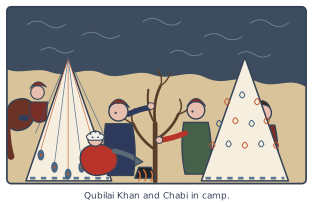
The miniature shows a Mongol imperial camp at its most intimate scale: two white felt gers, the classic round felt tents of the steppe, pitched on opposite sides of the encampment. They are decorated, not plain — a sign that these belong to the ruling household, not to ordinary herders. Between them, under a stormy sky, a small fire burns, and gathered around it are several robed figures and a horse. The scene is quiet, domestic, almost mundane.
What makes the image remarkable is what it does not show. There are no city walls, no palaces, no thrones, no bureaucrats with scrolls. Qubilai Khan, the ruler of the largest land empire in history, is depicted living in a felt tent in the open air, surrounded by a handful of attendants and a single horse. The caption names him alongside his wife Chabi, and the setting is a camp — not a capital. This is the Mongol court at its height, still operating in the manner of the steppe nomads from whom it sprang.
The painting is a Persian or Central Asian miniature, which matters for how we read it. The artist was working in a settled, urban tradition, yet chose to represent the Mongol elite in their nomadic element. The stormy sky adds a note of drama and impermanence — the weather of the open steppe is part of the scene, not excluded from it. The composition, with the two gers framing the central fire, suggests a deliberate, ordered encampment: even in the wilderness, the court has a layout, a rhythm, a hierarchy. …
That force is visible in the career of Timur, the monarch who aspired to universal dominion at the end of the fourteenth century. Timur hesitated to declare himself monarch simply because he was not of Genghis Khanid descent. When he finally did declare his independent sovereignty, he did so as the son-in-law (guregen) of the Genghis Khanid family. Even a conqueror of Timur's ambition felt the need to anchor his legitimacy in the lineage of Genghis Khan — a striking measure of how enduring the founder's prestige had become. …
Drawn by us to help you understand the concept clearly, and verified to make sure it's accurate. For exams, practice from your NCERT textbook's own diagram.
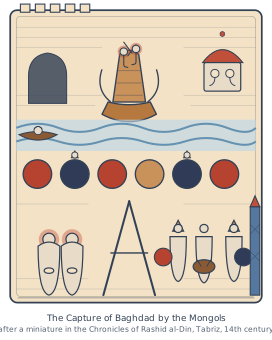
The miniature shows the Mongol siege of Baghdad in 1258, the event that ended the Abbasid Caliphate. The city is drawn as a walled enclosure with brick walls and towers, the standard way Persian painters rendered a fortified town. Outside those walls the artist has packed in the machinery and chaos of a siege: a wooden siege tower with an armed soldier inside, mangonels (stone-throwing engines) aimed at the battlements, and mounted attackers sweeping toward the city. A river runs through the scene, and on it sits a boat carrying captives — a quiet but deliberate detail, since the Mongols routinely used prisoners as human shields and forced labour during sieges.
The foreground is given over to mourning figures, which is the painter's way of signalling the human cost of the conquest. This is not a neutral battle scene; it is a lament. The composition works on two levels at once: the technical business of taking a city (towers, engines, cavalry) and the emotional aftermath of its fall (grief, captivity, loss). The walled city itself is the focal point, and everything else — the river, the siege engines, the riders, the mourners — is arranged around it to tell one story: a great urban centre being overwhelmed by steppe armies. …