History · Ch 3 — Nomadic Empires
Social, Political and Military Organisation
Social, Political and Military Organisation
The Core Idea
Genghis Khan did not merely conquer — he dismantled the old steppe social order and rebuilt it around loyalty to himself. The army was the engine of this transformation, and through it, tribe, clan and lineage were deliberately broken apart and re-fused into new units. The result was a military machine that was also a social revolution, and an empire held together by communication, collective rule, and a carefully cultivated memory of its founder.
The Army as a Social Melting Pot
Among the Mongols — and in many nomadic societies — every able-bodied adult male bore arms. The tribe itself was the army; when the occasion demanded, the men simply became the armed forces. There was no separate, professional military class in the old order.
The unification of the Mongol tribes and the subsequent campaigns changed this. New members poured into Genghis Khan's army, and what had been a small, undifferentiated body became an incredibly heterogeneous mass. Some groups, like the Turkic Uighurs, joined willingly and accepted his authority. Others, like the defeated Kereyits, were accommodated into the confederacy despite their earlier hostility.
Genghis Khan then set about systematically erasing the old tribal identities of everyone who joined. The army was organised on the old steppe system of decimal units — divisions of 10s, 100s, 1,000s and, notionally, 10,000 soldiers. In the old system, clan and tribe had coexisted within these units. Genghis Khan stopped this. He broke up the old tribal groupings and distributed their members into new military units. Anyone who tried to move from their allotted group without permission received harsh punishment.
The largest unit, the tuman (approximately 10,000 soldiers), now contained fragmented groups from a variety of tribes and clans. This altered the old steppe social order entirely: different lineages and clans were integrated, and given a new identity derived from their progenitor, Genghis Khan himself.
The decimal military organisation was not just a way of counting soldiers. It was a deliberate instrument of social engineering — a way to destroy old loyalties and forge a new one, centred on the person of Genghis Khan.
The New Aristocracy: Anda and Naukar
The new military contingents served under Genghis Khan's four sons and specially chosen captains called noyan. But alongside them stood a band of followers who had served him loyally through grave adversity for many years. Genghis Khan publicly honoured some of these as his blood-brothers (anda). Others, freemen of humbler rank, were given special ranking as his bondsmen (naukar), a title that marked their close relationship with their master.
This ranking did not preserve the rights of the old clan chieftains. The new aristocracy derived its status entirely from a close relationship with the Great Khan. Loyalty to the person of Genghis Khan, not birth into a particular clan, was now the route to power.
The Four Ulus and Collective Rule
Genghis Khan assigned the responsibility of governing newly conquered people to his four sons. These comprised the four ulus — a term that did not originally mean fixed territories. His lifetime was still an age of rapid conquest and expanding domains, where frontiers were extremely fluid.
- Jochi (eldest son) received the Russian steppes, but the farthest extent of his territory was indeterminate — it extended as far west as his horses could roam.
- Chaghatai (second son) was given the Transoxianian steppe and lands north of the Pamir mountains, adjacent to his brother's lands. Presumably these would shift as Jochi marched westward.
- Ogodei (third son) was indicated by Genghis Khan as his successor as Great Khan. On accession, Ogodei established his capital at Karakorum.
- Toluy (youngest son) received the ancestral lands of Mongolia.
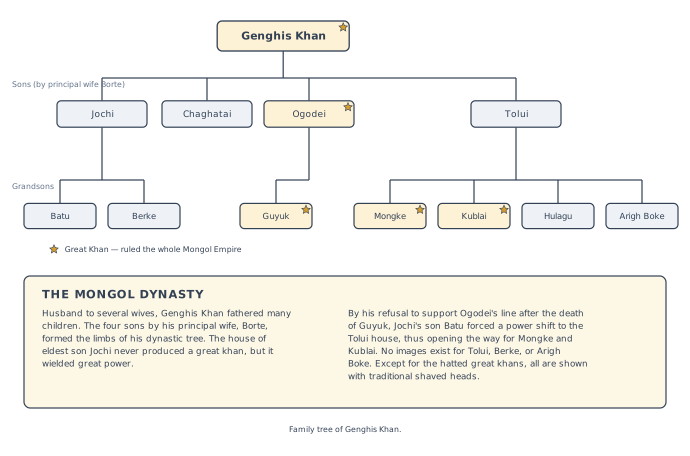
Drawn by us to help you understand the concept clearly, and verified to make sure it's accurate. For exams, practice from your NCERT textbook's own diagram.
The figure is a genealogical tree, not a map or a scene of battle. Its trunk is Genghis Khan himself, and branching upward from him are his descendants, each shown in a portrait medallion. The tree is a visual statement of the central Mongol idea that the empire was a family possession, a shared patrimony to be ruled collectively by the khan’s heirs.
The four sons of Genghis Khan by his principal wife Borte form the main limbs: Jochi, Chaghatai, Ogodei and Tolui. Above them sit the grandsons — Batu and Berke (sons of Jochi), Guyuk (son of Ogodei) and Arigh Boke (son of Tolui) — and above them the great-grandsons Mongke, Kublai and Hulagu, all sons of Tolui. The diagram’s own explanatory panel, titled “The Mongol Dynasty,” draws out the political logic of this family tree. It notes that the house of Jochi, the eldest son, never produced a great khan, yet wielded great power. The decisive moment came when Batu, Jochi’s son, refused to support Ogodei’s line after the death of Guyuk; that refusal shifted power to the Tolui house and opened the way for Mongke and Kublai to become great khans.
Two details in the figure are worth pausing on. The panel tells us that no images exist for Tolui, Berke or Arigh Boke — so their medallions are necessarily inventions or placeholders. And except for the hatted great khans, all the figures are shown with traditional shaved heads, a visual marker of Mongol custom. The tree thus does double duty: it maps descent, and it silently records which branches actually rose to supreme power. …
Genghis Khan envisaged his sons ruling the empire collectively. To underline this, military contingents (tama) of the individual princes were placed in each ulus. The sense of a dominion shared by the family was reinforced at the assembly of chieftains, the quriltai, where all decisions relating to the family or state for the coming season — campaigns, distribution of plunder, pasture lands and succession — were taken collectively.
The Yam: Communication and the Qubcur Tax
Genghis Khan fashioned a rapid courier system connecting the distant areas of his regime. Fresh mounts and despatch riders were placed in outposts at regularly spaced distances. For its maintenance, the Mongol nomads contributed a tenth of their herd — horses or livestock — as provisions. This was the qubcur tax, a levy the nomads paid willingly for the multiple benefits it brought.
The courier system (yam) was further refined after Genghis Khan's death. Its speed and reliability surprised travellers. It enabled the Great Khans to keep a check on developments at the farthest end of their regime across the continental landmass.
The Cost of Conquest: Devastation and Ecological Collapse
The conquered people hardly felt a sense of affinity with their new nomadic masters. During the campaigns of the first half of the thirteenth century:
- Cities were destroyed
- Agricultural lands laid waste
- Trade and handicraft production disrupted
- Tens of thousands killed — the exact figures lost in the exaggerated reports of the time
- Even more people enslaved
All classes, from elites to peasantry, suffered. In the resulting instability, the underground canals called qanats in the arid Iranian plateau could no longer receive periodic maintenance. As they fell into disrepair, the desert crept in. This led to an ecological devastation from which parts of Khurasan never recovered.
Pax Mongolica and the Silk Route
Once the dust from the campaigns settled, Europe and China were territorially linked. In the peace ushered in by Mongol conquest — the Pax Mongolica — trade connections matured. Commerce and travel along the Silk Route reached its peak under the Mongols. But unlike before, the trade routes did not terminate in China. They continued north into Mongolia and to Karakorum, the heart of the new empire.
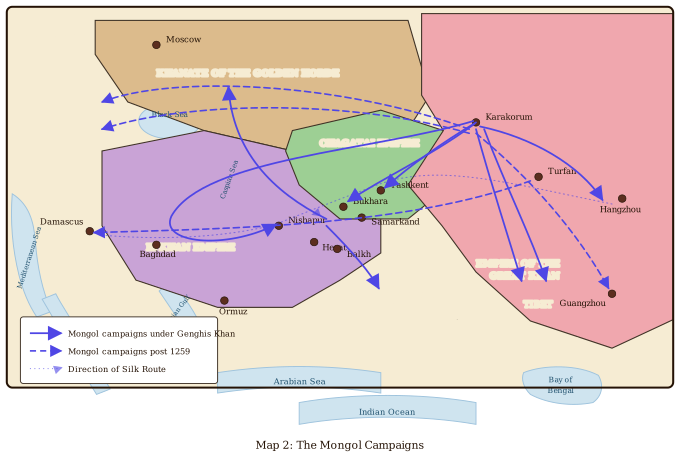
The map is a two-part visualisation of the Mongol world after Genghis Khan’s death, built around the theme of movement — of armies, of trade, and of power. The first layer shows campaign routes in two colours: red for Genghis Khan’s own campaigns, blue for those after 1259. This colour coding is the map’s central device, letting you read at a glance how Mongol military expansion shifted from the founder’s personal conquests to the later operations of his successors. The second layer is the Silk Route, drawn as a directional line that threads through the same space, reminding you that the same corridors used for war were also the arteries of commerce.
Overlaid on these routes are the four successor territories, each labelled: the Khanate of the Golden Horde in the west, the Chaghatai Empire in Central Asia, the Il Khan Empire in Iran and the Middle East, and the Empire of the Great Khan in China and Mongolia. These four boxes are not just geography — they are the political outcome of the campaigns. The map thus shows cause and effect together: the arrows of conquest and the boundaries they eventually produced. The red and blue routes cross these territories, so you can see which branch of the family inherited which zone of expansion.
What the map teaches is the transformation of a nomadic war machine into a settled imperial order. Genghis Khan’s red routes belong to the age of fluid frontiers, when the ulus of his sons were still indeterminate — Jochi’s lands extended “as far west as his horses could roam.” The blue routes, post-1259, belong to the era of fixed territorial dominions described in the chapter, when the sense of a shared patrimony had given way to separate dynasties. The Silk Route’s presence is equally instructive: it did not terminate in China but continued north into Mongolia and to Karakorum, the new imperial heart. The map therefore ties together the military, the political and the economic — conquest created the peace (Pax Mongolica) that made the Silk Route flourish, and the route in turn helped hold the vast realm together through the yam courier system and the movement of goods and travellers. …
Communication and ease of travel were vital to retain the coherence of the Mongol regime. Travellers were given a pass (paiza in Persian; gerege in Mongolian) for safe conduct. Traders paid the baj tax for the same purpose. All thereby acknowledged the authority of the Mongol Khan.
The Shift Towards Sedentary Life
The contradictions between nomadic and sedentary elements within the Mongol empire eased through the thirteenth century. In the 1230s, during the successful war against the Chin dynasty in north China, a strong pressure group within the Mongol leadership advocated massacring all the peasantry and converting their fields into pasture. But by the 1270s, when south China was annexed after the defeat of the Sung dynasty, Genghis Khan's grandson Qubilai Khan (d. 1294) appeared as the protector of the peasants and the cities.
In the 1290s, the Mongol ruler of Iran, Ghazan Khan (d. 1304), a descendant of Toluy, warned family members and generals to avoid pillaging the peasantry. It would not lead to a stable, prosperous realm, he advised — in a speech whose sedentary overtones would have made Genghis Khan shudder.
Ghazan Khan's speech, probably drafted by his Persian wazir Rashiduddin, is a striking document. He tells his nomad commanders: "I am not on the side of the Persian peasantry. If there is a purpose in pillaging them all, there is no one with more power to do this than I. Let us rob them together. But if you wish to be certain of collecting grain and food for your tables in the future, I must be harsh with you. You must be taught reason. If you insult the peasantry, take their oxen and seed and trample their crops into the ground, what will you do in the future? … The obedient peasantry must be distinguished from the peasantry who are rebels.
Ghazan Khan (1295-1304) was the first Il-Khanid ruler to convert to Islam. He gave the following speech to the Mongol-Turkish nomad commanders, a speech that was probably drafted by his Persian wazir Rashiduddin and included in the minister's letters: 'I am not on the side of the Persian peasantry. If there is a purpose in pillaging them all, there is no one with more power to do this than I. Let us rob them together. But if you wish to be certain of collecting grain and food for your tables in the future, I must be harsh with you. You must be taught reason. If you insult the peasantry, take their oxen and seed and trample their crops into the groun …
"
Civil Administrators from Conquered Societies
From Genghis Khan's reign itself, the Mongols recruited civil administrators from the conquered societies. They were sometimes moved around — Chinese secretaries deployed in Iran, Persians in China. They helped integrate the distant dominions, and their backgrounds and training were always useful in blunting the harsher edges of nomadic predation on sedentary life.
The Mongol Khans trusted them as long as they continued to raise revenue. These administrators could command considerable influence:
- In the 1230s, the Chinese minister Yeh-lu Ch'u-ts'ai muted some of Ogodei's more rapacious instincts.
- The Juwaini family played a similar role in Iran through the latter half of the thirteenth century.
- At the end of the century, the wazir Rashiduddin drafted the speech Ghazan Khan delivered to his Mongol compatriots, asking them to protect rather than harass the peasantry.
The pressure to sedentarise was greater in the new areas of Mongol domicile — areas distant from the original steppe habitat of the nomads.
The Breakup of the Common Patrimony
By the middle of the thirteenth century, the sense of a common patrimony shared by all the brothers was gradually replaced by individual dynasties, each ruling its separate ulus — a term that now carried the sense of a territorial dominion. This was, in part, a result of succession struggles, where Genghis Khanid descendants competed for the office of Great Khan and prized pastoral lands.
The resulting dynasties:
| Dynasty | Descendants of | Territory |
|---|---|---|
| Yuan | Toluy | China |
| Il-Khanid | Toluy | Iran |
| Golden Horde | Jochi | Russian steppes |
| Chaghatai Khanate | Chaghatai | Steppes of Transoxiana and lands called Turkistan today |
Noticeably, nomadic traditions persisted longest among the steppe dwellers in Central Asia (descendants of Chaghatai) and Russia (the Golden Horde).
The Fashioning of Memory: The Yasa
The gradual separation of Genghis Khan's descendants into separate lineage groups implied that their connections with the memory and traditions of a past family concordance also altered. At an obvious level, this was the result of competition among the cousin clans. The Toluyid branch was more adept at presenting their version of the family disagreements in the histories produced under their patronage — a consequence of their control of China and Iran and the large number of literati they could recruit.
At a more sophisticated level, the disengagement with the past meant underlining the merits of the regnant rulers as a contrast to other past monarchs. This exercise in comparison did not exclude Genghis Khan himself. Persian chronicles produced in Il-Khanid Iran during the late thirteenth century detailed the gory killings of the Great Khan and greatly exaggerated the numbers killed. For example, an eyewitness report said 400 soldiers defended the citadel of Bukhara, but an Il-Khanid chronicle reported 30,000 soldiers killed in the attack. Although Il-Khanid reports still eulogised Genghis Khan, they also carried a statement of relief that times had changed and the great killings of the past were over. The Genghis Khanid legacy was important, but for his descendants to appear as convincing heroes to a sedentary audience, they could no longer appear in quite the same way as their ancestor.
Following the research of David Ayalon, recent work on the yasa — the code of law Genghis Khan was supposed to have promulgated at the quriltai of 1206 — has elaborated on the complex ways in which the memory of the Great Khan was fashioned by his successors. …
In 1221, after the conquest of Bukhara, Genghis Khan had assembled the rich Muslim residents at the festival ground and had admonished them. He called them sinners and warned them to compensate for their sins by parting with their hidden wealth. The episode was dramatic enough to be painted and for a long time afterwards people still remembered the incident. In the late sixteenth century, 'Abdullah Khan, a distant descendant of Jochi, Genghis Khan's eldest son, went to the same festival ground in Bukhara. Unlike Genghis Khan, however, 'Abdullah Khan went to perform his holiday prayers there. His chronicler, Hafiz-i Tanish, reported this performance …