History · Ch 3 — Nomadic Empires
The Career of Genghis Khan
The Career of Genghis Khan
The Career of Genghis Khan
Genghis Khan’s rise is the story of how a boy born into hardship on the Mongolian steppe unified warring tribes and built the largest contiguous land empire in history. His career matters not just for the conquests, but for how he transformed nomadic warfare into a disciplined, innovative military machine.
Early Life and Struggle
Born around 1162 near the Onon river in present-day northern Mongolia, he was named Temujin. His father, Yesugei, was chieftain of the Kiyat, a group of families related to the Borjigid clan. When Yesugei was murdered, Temujin was still young, and his mother, Oelun-eke, raised him, his brothers, and step-brothers in great hardship.
The following decade was full of reversals. Temujin was captured and enslaved. Soon after his marriage, his wife Borte was kidnapped, and he had to fight to recover her. Yet these years of hardship also brought important friendships. The young Boghurchu became his first ally and remained a trusted friend for life. Jamuqa, his blood-brother (anda), was another. Temujin also restored old alliances with Tughril, also called Ong Khan, the ruler of the Kereyits and his father’s old blood-brother.
Alliance and Consolidation
Through the 1180s and 1190s, Temujin remained an ally of Ong Khan, using the alliance to defeat powerful adversaries — including Jamuqa, his old friend who had turned into a hostile foe. Only after defeating Jamuqa did Temujin feel confident enough to move against other tribes: the powerful Tatars (his father’s assassins), the Kereyits, and Ong Khan himself in 1203.
The final defeat of the Naiman people and the powerful Jamuqa in 1206 left Temujin as the dominant personality in steppe politics. This position was recognised at an assembly of Mongol chieftains, the quriltai, where he was proclaimed the ‘Great Khan of the Mongols’ (Qa’an) with the title Genghis Khan — the ‘Oceanic Khan’ or ‘Universal Ruler’.
The quriltai of 1206 was the formal recognition of Temujin’s supremacy. Just before it, he had reorganised the Mongol people into a more effective, disciplined military force — a step that made his future campaigns possible.
Conquest of China
Genghis Khan’s first major concern was China, divided at the time into three realms:
- The Hsi Hsia, people of Tibetan origin, in the north-western provinces
- The Jurchen, whose Chin dynasty ruled north China from Peking
- The Sung dynasty, which controlled south China
By 1209 the Hsi Hsia were defeated. The Great Wall of China was breached in 1213, and Peking was sacked in 1215. Long-drawn-out battles against the Chin continued until 1234, but Genghis Khan was satisfied enough with progress to return to his Mongolian homeland in 1216, leaving military affairs in the region to his subordinates.
Campaigns in Central Asia and the Middle East
After the defeat in 1218 of the Qara Khita, who controlled the Tien Shan mountains north-west of China, Mongol dominions reached the Amu Darya, including the states of Transoxiana and Khwarazm. Sultan Muhammad, ruler of Khwarazm, provoked Genghis Khan’s fury by executing Mongol envoys.
In the campaigns between 1219 and 1221, the great cities — Otrar, Bukhara, Samarqand, Balkh, Gurganj, Merv, Nishapur and Herat — surrendered to the Mongol forces. Towns that resisted were devastated. At Nishapur, where a Mongol prince was killed during the siege, Genghis Khan commanded that the town be laid waste so completely that the site could be ploughed upon, and that in taking vengeance for the prince’s death, not even cats and dogs should be left alive.
The Scale of Destruction
All reports of Genghis Khan’s campaigns agree on the vast numbers killed following the capture of cities that defied his authority. The figures are staggering:
| City | Year | Reported Deaths |
|---|---|---|
| Nishapur | 1220 | 1,747,000 |
| Herat | 1222 | 1,600,000 |
| Baghdad | 1258 | 800,000 |
| Nasa | — | 70,000 |
| Baihaq district | — | 70,000 |
| Tun (Kuhistan province) | — | 12,000 |
How did medieval chroniclers arrive at such figures? Juwaini, the Persian chronicler of the Ilkhans, stated that 1,300,000 people were killed at Merv. He reached the figure because it took thirteen days to count the dead, and each day they counted 100,000 corpses.
These numbers come from medieval chroniclers and reflect the horror of the events, but they are not modern demographic estimates. Treat them as contemporary claims, not verified statistics.
All reports of Genghis Khan's campaigns agree at the vast number of people killed following the capture of cities that defied his authority. The numbers are staggering: at the capture of Nishapur in 1220, 1,747,000 people were massacred while the toll at Herat in 1222 was 1,600,000 people and at Baghdad in 1258, 800,000. Smaller towns suffered proportionately: Nasa, 70,000 dead; Baihaq district, 70,000; and at Tun in the Kuhistan province, 12,000 individuals were executed.
How did medieval chroniclers arrive at such figures? …
Later Campaigns and Death
Mongol forces pursuing Sultan Muhammad pushed into Azerbaijan, defeated Russian forces at the Crimea, and encircled the Caspian Sea.
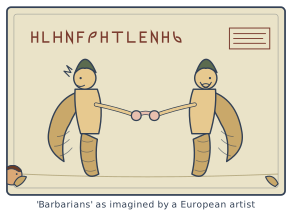
Drawn by us to help you understand the concept clearly, and verified to make sure it's accurate. For exams, practice from your NCERT textbook's own diagram.
The image is a medieval European manuscript illustration, not a Mongol or Chinese source. It shows two winged, bird-like humanoid figures — the artist’s fantasy of what a “Tartar” looked like — locked in a tug-of-war over a human captive. One figure pulls the captive by the arm, the other by the leg, as if tearing the person apart. Above them runs a line of Latin text, which references the belief that Tartars fed on human flesh. The whole scene is framed as an illuminated initial or marginal decoration typical of European chronicles of the period.
What matters here is not the accuracy of the drawing — there is none — but what it reveals about European perception. The Mongols had burst into European consciousness through their devastating campaigns in Russia, Hungary, Poland and Austria in the 1230s and 1240s, and terrified chroniclers had no reliable information about them. So they filled the gap with fantasy: cannibalism, monstrous bodies, demonic wings. The figure is a primary source for the history of representation, not for the Mongols themselves. It tells us how the “barbarian” was constructed in the European imagination — as the absolute opposite of civilised, Christian, settled life. …
Another wing followed the Sultan’s son, Jalaluddin, into Afghanistan and the Sindh province. At the banks of the Indus, Genghis Khan considered returning to Mongolia through North India and Assam, but the heat, the natural habitat, and ill portents reported by his Shaman soothsayer made him change his mind.
Genghis Khan died in 1227, having spent most of his life in military combat.
The Secret of Mongol Military Success
His military achievements were astounding, and they were largely a result of his ability to innovate and transform different aspects of steppe combat into extremely effective military strategies.
- The horse-riding skills of the Mongols and Turks provided speed and mobility to the army
- Their abilities as rapid-shooting archers from horseback were perfected during regular hunting expeditions, which doubled as field manoeuvres
- The steppe cavalry had always travelled light and moved quickly, but now it brought all its knowledge of terrain and weather to do the unimaginable: they carried out campaigns in the depths of winter, treating frozen rivers as highways to enemy cities and camps
- Nomads were conventionally at a loss against fortified encampments, but Genghis Khan quickly learnt the importance of siege engines and naphtha bombardment. His engineers prepared light, portable equipment, used against opponents with devastating effect
The genius of Genghis Khan lay in adaptation: he took the traditional strengths of nomadic warfare — mobility, archery, horsemanship — and added the siege technology of settled civilisations, creating an army that could fight anywhere, in any season.
The Succession and the Fate of the Empire
The period after Genghis Khan’s death saw continued Mongol unity under his successors:
| Period | Ruler | Notes |
|---|---|---|
| 1227–41 | Ogodei, son of Genghis Khan | Continued Mongol unity |
| 1236–42 | Batu, son of Jochi (eldest son) | Campaigns in Russia, Hungary, Poland and Austria |
| 1246–49 | Guyuk, son of Ogodei | Continued unity |
| 1251–60 | Mongke, son of Toluy (youngest son) | Fresh campaigns in Iran and China |
| 1253–55 | Under Mongke | Campaigns renewed in Iran and China |
| 1258 | Hulegu, younger brother of Mongke | Capture of Baghdad; end of the Abbasid caliphate; establishment of the Il-Khanid state of Iran; beginning of conflict between the Jochids and the Il-Khans |
| 1260 | Qubilai Khan | Accession as Grand Khan in Peking; conflict amongst descendants; fragmentation of the Mongol realm into independent lineages |
The fragmentation produced three major lineages:
- Toluyids: the Yuan dynasty in China and the Il-Khanid state in Iran
- Chaghataids: in the steppes north of Transoxiana and ‘Turkistan’
- Jochid lineages: in the Russian steppes, described as the ‘Golden Horde’ by observers
The Ogodei lineage was defeated and absorbed into the Toluyids.
Later Developments in the Mongol World …
The chapter's own chronology of the Mongols, from the birth of Temujin to the establishment of the Republic of Mongolia:
| Date | Event |
|---|---|
| c. 1167 | Birth of Temujin |
| 1160s-70s | Years spent in slavery and struggle |
| 1180s-90s | Period of alliance formation |
| 1203-27 | Expansion and triumph |
| 1206 | Temujin proclaimed Genghis Khan, 'Universal Ruler' of the Mongols |
| 1227 | Death of Genghis Khan |
| 1227-60 | Rule of the three Great Khans and continued Mongol unity |
| 1227-41 | Ogodei, son of Genghis Khan |
| 1246-49 | Guyuk, son of Ogodei |
| 1251-60 | Mongke, son of Genghis Khan's youngest son, Toluy |
| 1236-42 | Campaigns in Russia, Hungary, Poland and Austria under Batu, son of Jochi, Genghis Khan's eldest son |
| 1253-55 | Beginning of fresh campaigns in Iran and China under Mongke |
| 1258 | Capture of Baghdad and the end of the Abbasid caliphate. Establishment of the Il-Khanid state of Iran under Hulegu, younger brother of Mongke. Beginning of conflict between the Jochids and the Il-Khans |
| 1260 | Accession of Qubilai Khan as Grand Khan in Peking; conflict amongst descendants of Genghis Khan; fragmentation of Mongol realm into independent lineages – Toluy, Chaghatai and Jochi (Ogodei's lineage defeated and absorbed into the Toluyid). Toluyids: Yuan dynasty in China and Il-Khanid state in Iran; Chaghataids in steppes north of Transoxiana and 'Turkistan'; Jochid lineages in the Russian steppes, described as the 'Golden Horde' by observers |
| 1257-67 | Reign of Berke, son of Batu; reorientation of the Golden Horde from Nestorian Christianity towards Islam. Definitive conversion takes place only in the 1350s. Start of the alliance between the Golden Horde and Egypt against the Il-Khans |
| 1295-1304 | Reign of Il-Khanid ruler Ghazan Khan in Iran. His conversion from Buddhism to Islam is followed gradually by other Il-Khanid chieftains |
| 1368 | End of Yuan dynasty in China |
| 1370-1405 | Rule of Timur, a Barlas Turk who claimed Genghis Khanid descent through the lineage of Chaghatai. Establishes a steppe empire that assimilates part of the dominions of Toluy (excluding China), Chaghatai and Jochi. Proclaims himself 'Guregen' – 'royal son-in-law' – and marries a princess of the Genghis Khanid lineage |