History · Ch 1 — Writing and City Life
Life in the City
Life in the City
Life in the City
The enormous wealth buried with some kings and queens at Ur — gold vessels, jewellery, ceremonial daggers of gold, wooden musical instruments inlaid with white shell and lapis lazuli — makes one thing unmistakably clear: a small ruling elite had come to control a major share of society's riches. But what do we know about the ordinary people of these cities?
From legal texts dealing with disputes and inheritance, we learn that the nuclear family — a man, his wife and children — was the norm in Mesopotamian society, though a married son and his family often lived with his parents. The father was the head of the family. The procedures for marriage are partly known: a declaration was made about the willingness to marry, and the bride's parents gave their consent. The groom's people then presented a gift to the bride's people. At the wedding itself, both parties exchanged gifts, ate together, and made offerings in a temple. When the mother-in-law came to fetch the bride, the bride received her share of the inheritance from her father. The father's house, herds, fields and other property were inherited by the sons.
In India, early stone seals were stamped. In Mesopotamia until the end of the first millennium BCE, cylindrical stone seals, pierced down the centre, were fitted with a stick and rolled over wet clay so that a continuous picture was created. They were carved by very skilled craftsmen, and sometimes carry writing: the name of the owner, his god, his official position, etc. A seal could be rolled on clay covering the string knot of a cloth package or the mouth of a pot, keeping the contents safe. When rolled on a letter written on a clay tablet, i …
In India, early stone seals were stamped. In Mesopotamia, until the end of the first millennium BCE, cylindrical stone seals were pierced down the centre, fitted with a stick, and rolled over wet clay so that a continuous picture was created. They were carved by very skilled craftsmen and sometimes carried writing: the name of the owner, his god, his official position, and so on.
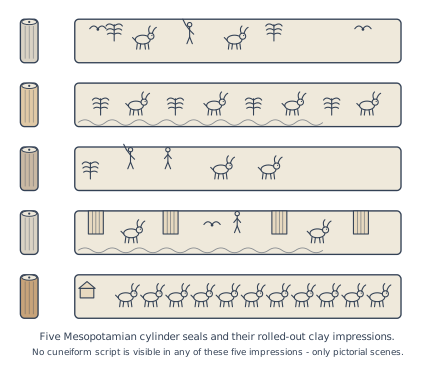
Drawn by us to help you understand the concept clearly, and verified to make sure it's accurate. For exams, practice from your NCERT textbook's own diagram.
The figure shows five early Mesopotamian cylinder seals, each displayed twice: once as the carved stone object itself and once as the continuous picture it rolls out onto wet clay. A cylinder seal is a small stone cylinder, usually pierced lengthwise so it could be worn on a cord or pin, with a design carved in reverse on its curved surface. When rolled across soft clay, the raised parts of the carving leave a repeating band of imagery — the impression. The figure pairs each seal with its rolled-out imprint, so you can see both the original object and the picture it produces.
The five seals are not identical. Each carries a different scene, and the impressions show the variety of subjects Mesopotamian seal carvers chose: animals, human figures, ritual scenes, and patterns of daily life. The caption notes that these seals were carved by skilled craftsmen, and that a seal might carry the owner's name, the name of a god, or the owner's office. That detail matters — a seal was not just decoration. It was a personal signature pressed into wet clay to mark goods, packages, and letters as authentic. Because clay hardens and survives, these impressions have come down to us as some of the most direct evidence of how Mesopotamians identified themselves and their property. …
A seal had practical uses. It could be rolled on clay covering the string knot of a cloth package or the mouth of a pot, keeping the contents safe. When rolled on a letter written on a clay tablet, it became a mark of authenticity. The seal was, in short, the mark of a city dweller's role in public life.
The ordinary houses of Ur
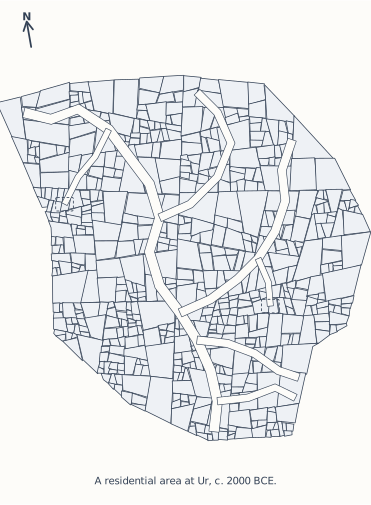
Ur, one of the earliest cities to be excavated, had its ordinary houses systematically dug up in the 1930s. The narrow, winding streets tell us that wheeled carts could not have reached many of the houses — sacks of grain and firewood would have arrived on donkey-back.
Drawn by us to help you understand the concept clearly, and verified to make sure it's accurate. For exams, practice from your NCERT textbook's own diagram.
The figure is a site plan of a residential quarter at Ur, drawn to show how ordinary people lived in one of Mesopotamia’s earliest cities. It is not a picture of grand palaces or temples, but a ground-level map of a neighbourhood as it stood around 2000 BCE. The plan is dominated by closely packed houses of irregular shape, squeezed together with little regard for order. Running between them are narrow, winding streets, and the caption asks you to locate two or three blind alleys — dead-end lanes that lead nowhere. These are easy to spot once you know what to look for: a street that terminates against a house wall instead of connecting to another lane.
What the plan makes visible is the absence of town planning. The streets are not straight, the house plots are not uniform, and there is no grid. This matches the textual description of Ur: wheeled carts could not have reached many houses, so goods like sacks of grain and firewood would have been carried in on donkey-back. The winding lanes and irregular plots are direct evidence that no authority laid out the city in advance — it grew organically, house by house, over generations. …
These winding streets and the irregular shapes of house plots point to an absence of town planning. There were no street drains of the kind found in contemporary Mohenjo-daro. Instead, drains and clay pipes were located in the inner courtyards of Ur houses. It is thought that house roofs sloped inwards, so rainwater was channelled through the drainpipes into sumps — covered basins in the ground into which water and sewage flowed — in the inner courtyards. This was a way of preventing the unpaved streets from becoming excessively slushy after a downpour. …