History · Ch 1 — Writing and City Life
The Significance of Urbanism
The Significance of Urbanism
The shift from hunting and gathering to city life is often described as a revolution, because it transformed human existence beyond recognition. But before you accept that label, pause. A revolution implies a sudden, complete break. What the archaeological record actually shows is a long, uneven process, full of continuities as well as changes. Not everyone became a city dweller. Farming communities, pastoral peoples, and hunter-gatherers all continued to exist alongside the new urban centres. The examples chosen for detailed study in this chapter are only a selection — a window into a few early societies, not the whole picture of early human history.
What makes a city a city
A city is not simply a place with a large population. The real marker of urban life is economic: people cluster in towns when the economy develops beyond food production. Urban economies rest on four pillars — food production, trade, manufactures, and services. Because of this, city dwellers are never self-sufficient. They depend on the products and services of other people, both in the city and in the surrounding villages, and there is constant interaction among all these groups.
This interdependence is the heart of urbanism. Consider a stone seal carver. He is a specialist in fine carving, but he cannot make the bronze tools he needs for his work, nor does he know where to obtain the coloured stones he carves. The bronze tool maker, in turn, does not go out himself to fetch copper and tin, and he needs regular supplies of charcoal for fuel. No one in the city produces everything they need; everyone relies on someone else.
Division of labour and the need for organisation
The division of labour is a defining mark of urban life. But specialisation alone is not enough — it creates a demand for coordination. Fuel, metal, various stones, wood, and many other materials come to city manufacturers from many different places. This requires organised trade and storage. Grain and other food items are delivered from villages to the city, and these food supplies must be stored and distributed. Many different activities have to be synchronised: seal cutters need not only stones but also bronze tools and pots to be available when they work.
Such a system cannot run on goodwill. Some people must give commands that others obey. And because the scale of activity is large and complex, urban economies almost always require the keeping of written records. Writing, in other words, is not an accident of city life — it is a practical necessity of managing it.
The Warka Head and the chain of specialists
Drawn by us to help you understand the concept clearly, and verified to make sure it's accurate. For exams, practice from your NCERT textbook's own diagram.
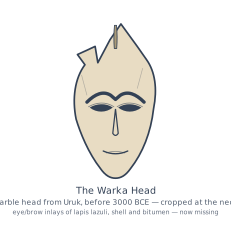
The Warka Head is one of the most celebrated surviving artworks from ancient Mesopotamia, and it comes from Uruk — the very city whose growth into a true urban centre this chapter traces. The sculpture is a woman's head carved from white marble, and it dates to before 3000 BCE, which places it right at the threshold of the period when writing and city life were emerging. That timing is not accidental: the head belongs to the same world that produced the earliest tablets and the monumental temples of Uruk.
What makes the piece remarkable is not just its age but its craftsmanship. The face is modelled with extraordinary delicacy — the mouth, chin and cheeks are rendered with a softness and naturalism that stand out against the more stylised art of the period. The eyes and eyebrows were originally inlaid, almost certainly with lapis lazuli, shell and bitumen, so the head would once have had a striking, vivid gaze. The marble itself was not local to Uruk; it was imported from a considerable distance, which tells you something important about the reach of Uruk's trade networks even at this early date. A raw material carried over hundreds of kilometres, shaped by a skilled sculptor, and finished with precious stones — this was an object of real value and significance. …
The Warka Head is a world-famous piece of sculpture from Uruk, carved in white marble before 3000 BCE. The eyes and eyebrows would probably have been inlaid with lapis lazuli (blue), shell (white), and bitumen (black). A groove runs along the top of the head, perhaps to hold an ornament. What makes it remarkable is not just the delicate modelling of the woman's mouth, chin, and cheeks, but the fact that it was carved from a hard stone imported from a great distance.
Think about the chain of specialists involved in producing such a piece.
This woman's head was sculpted in white marble at Uruk before 3000 BCE. The eyes and eyebrows would probably have taken lapis lazuli (blue) and shell (white) and bitumen (black) inlays, respectively. There is a groove along the top of the head, perhaps for an ornament. This is a world-famous piece of sculpture, admired for the delicate modelling of the woman's mouth, chin and cheeks. And it was modelled in a hard stone that would have been imported from a distance. …
It begins with the procurement of the stone — someone must travel to obtain it and bring it back. Then the stone must be transported, perhaps overland or by river. A sculptor must shape it, and for that, bronze tools are needed. Those tools require a bronze maker, who needs copper, tin, and charcoal — each obtained by yet other people. The inlays demand lapis lazuli, shell, and bitumen, each sourced from different places and worked by different craftsmen. Even the ornament that might have sat in the groove would have been made by someone else. Every stage of the process depends on a network of specialists, none of whom could produce the finished head alone.
The Bronze Age and the earliest cities
The earliest cities in Mesopotamia date back to the bronze age, c.3000 BCE. Bronze is an alloy of copper and tin. Using bronze meant procuring these metals, often from great distances. Metal tools were necessary for accurate carpentry, drilling beads, carving stone seals, cutting shell for inlaid furniture, etc. Mesopotamian weapons were also of bronze – for example, …
…