History · Ch 1 — Writing and City Life
The Development of Writing
The Development of Writing
The development of writing is not a single event but a slow, practical response to the needs of early urban life. In Mesopotamia, writing emerged around 3200 BCE, and its earliest purpose was far more mundane than recording poetry or prayers — it was bookkeeping. The first tablets were used to keep accounts of goods, grain, and livestock, and only later did writing expand to include royal inscriptions, letters, and literary works.
The system the Mesopotamians developed is called cuneiform, from the Latin word cuneus, meaning "wedge." Scribes pressed a reed stylus into soft clay tablets, and the wedge-shaped marks left behind gave the script its name. Once the clay dried or was baked, the tablet became a permanent record. Thousands of these tablets have survived, which is why we know so much about Mesopotamian society.
Cuneiform = wedge-shaped writing on clay tablets, developed in Mesopotamia around 3200 BCE. The word comes from Latin cuneus (wedge).
Writing in Mesopotamia passed through distinct stages. The earliest tablets were pictographic — each sign was a picture of the object it represented. A drawing of a head meant "head," a drawing of a fish meant "fish."
The figure shows four small clay tablets, each no more than 3.5 cm high, dating to around 3200 BCE. They are arranged together to display the earliest stage of writing in Mesopotamia, before the script evolved into the wedge-shaped marks we call cuneiform. Each tablet carries a picture-like sign scratched or pressed into the clay, and beside each picture are small notches or strokes that stand for numbers.
The signs themselves are simple and recognisable: an ox, a fish, a grain stalk and a boat. These are not abstract symbols — they are literal drawings of the objects they represent. The number marks next to them indicate quantities, so a tablet showing a fish with three strokes likely records three fish. This is the key point the figure makes: writing here begins as bookkeeping, a way of counting goods, not as literature or religious text.
What makes these tablets historically significant is their date and form. At 3200 BCE, this is the earliest known writing in the world, emerging in the city-states of southern Mesopotamia (the land between the Tigris and Euphrates, in modern Iraq). The signs are pictographic — each one is a picture of the thing it names. Only later, over centuries, did these pictures get simplified, rotated and pressed with a reed stylus to produce the angular wedge shapes of cuneiform. So the figure captures writing at its very birth, before it became the complex script that would later record laws, epics and royal annals. …
But pictographs could not express abstract ideas or grammatical relationships, so the system evolved. Signs came to stand for sounds as well as objects, allowing scribes to write words that had no simple picture. This shift from pictographic to phonetic writing was the crucial breakthrough that made the script flexible enough for full language.
The figure is a small, hand-drawn chart of four cuneiform signs, each paired with the syllable it represents. The signs are drawn in the characteristic wedge-shaped strokes of Mesopotamian writing, and beside each one is its phonetic value: še, kur, i, and ma. The layout is simple — a sign on one side, its syllable on the other — so the eye moves from the wedge marks to the sound they encode.
What the figure is really demonstrating is the logic of cuneiform itself. Each sign does not stand for a single letter, as in an alphabet, but for a whole syllable — a consonant-plus-vowel combination or a single vowel. So še is one sign, kur is another, and i and ma are yet others. The point is that the script works at the level of syllables, not individual sounds. This is why cuneiform needed hundreds of signs rather than a couple of dozen letters. …
The key evolution: from pictographic (picture = object) to phonetic (sign = sound). This is what allowed writing to express abstract ideas, names, and grammar.
The people who did the writing were scribes, a professional class trained in the complex script. Becoming a scribe required years of schooling, and scribal schools were attached to temples and palaces. Scribes were essential to the running of the state — they recorded tax payments, kept track of harvests, drew up contracts, and wrote letters between officials. Their skill gave them a privileged position in Mesopotamian society.
Think of the scribe as the accountant, clerk, and archivist of the ancient city rolled into one. Writing was a profession, not a common skill.
The uses of writing expanded steadily. Beyond accounts, scribes wrote legal documents — sale deeds, marriage contracts, and court judgments. They composed royal inscriptions proclaiming the deeds of kings, and letters exchanged between rulers and officials. Over time, the Mesopotamians also wrote down their literary works, the most famous being the Epic of Gilgamesh, and their scientific knowledge, including astronomical observations and mathematical tables.
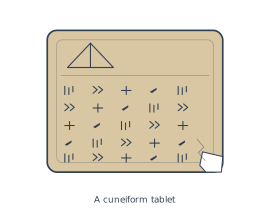
Drawn by us to help you understand the concept clearly, and verified to make sure it's accurate. For exams, practice from your NCERT textbook's own diagram.
The figure shows a clay tablet, the standard writing surface of ancient Mesopotamia, with cuneiform pressed into both faces. On the front, or obverse, the visible content is a geometric exercise: a triangle with lines drawn across it. The reverse carries more of the same wedge-shaped script. The tablet is not a royal inscription or a record of trade — it is a school exercise, a piece of working mathematics.
What matters here is what the tablet is, not just what it says. Cuneiform was not only used for laws, letters, and temple accounts; it was also the medium for science. Mesopotamian scribes used clay for calculations, and this tablet preserves one of those calculations. The triangle with lines across it suggests a problem about dividing a triangle — likely finding areas of the smaller parts, a type of exercise known from scribal schooling. The fact that both sides are written on shows the student or teacher using the full surface, working through the problem step by step.
The deeper lesson is about writing itself. Cuneiform began around 3200 BCE in Mesopotamia, and it was pressed into wet clay with a reed stylus, leaving wedge-shaped marks — hence the name, from the Latin cuneus, meaning wedge. This tablet shows that writing was not merely a tool for administration or religion; it was a technology for thinking. Mathematics, geometry, and calculation were written down, practised, and transmitted through this script. The tablet is evidence that abstract knowledge — not just goods and taxes — was being recorded and taught. …
Writing thus became the memory of the civilisation, preserving what would otherwise have been lost.
Do not assume writing began as literature or religion. It began as accounting — the need to record economic transactions in growing cities. Literature came much later.
The book also places Mesopotamian writing in a wider chronological frame. The table below summarises the key milestones in the development of writing and related technologies across regions, as given in the chapter's timeline.
| Region | Key development | Date |
|---|---|---|
| Mesopotamia | Writing (cuneiform) | c. 3200 BCE |
| Egypt | Hieroglyphic script, writing on papyrus | 3000–2000 BCE |
| Crete | Development of a script | 2000–1900 BCE |
| China | Cities, writing, kingdoms (Shang dynasty) | 1600–1500 BCE |
| South Asia | Harappan script | c. 2700 BCE |