Sociology · Ch 1 — Sociology, Society and its Relationship with other Social Sciences
Pluralities and Inequalities Among Societies
Pluralities and Inequalities Among Societies
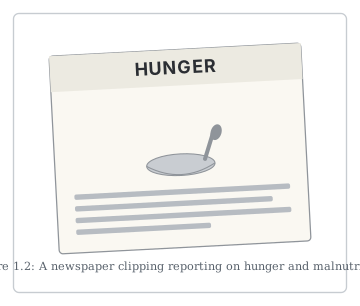
Drawn by us to help you understand the concept clearly, and verified to make sure it's accurate. For exams, practice from your NCERT textbook's own diagram.
A newspaper headline framing hunger as a global crisis illustrates one visible face of inequality among societies -- populations that lack sufficient food even as other populations, shown in the paired obesity clipping on the same page, struggle with the opposite problem of over-nutrition. Placed side by side, the two clippings make a single point: the SAME global economic and social structure produces starkly different material outcomes for different populations, which i …
Drawn by us to help you understand the concept clearly, and verified to make sure it's accurate. For exams, practice from your NCERT textbook's own diagram.
A well-fed child eating a generous meal stands in deliberate visual contrast to the hunger clipping on the same page. The pairing is not about individual eating habits -- it is about how unevenly food and resources are distributed across and within societies, so that hunger and over-nutrition can exist side by …
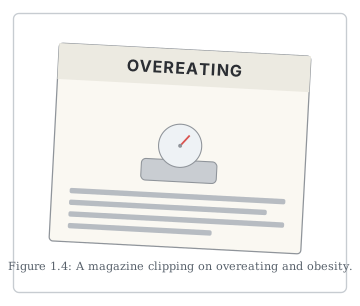
Drawn by us to help you understand the concept clearly, and verified to make sure it's accurate. For exams, practice from your NCERT textbook's own diagram.
A magazine clipping on rising obesity, noting India's place among countries with a growing over-nutrition problem, completes the hunger/obesity contrast the chapter opens with. Read together with the hunger clipping, it shows that a society's food problem is never just about total food supply -- it is about how food, income and access are distributed, which is a structural questi …
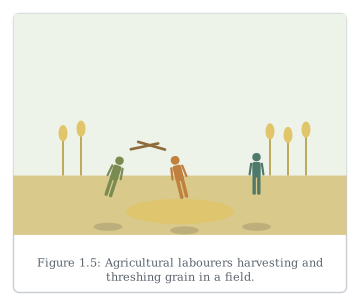
Drawn by us to help you understand the concept clearly, and verified to make sure it's accurate. For exams, practice from your NCERT textbook's own diagram.
Labourers harvesting and threshing grain by hand represent one of the many livelihoods whose conditions are shaped by land ownership, wages and access to technology -- structural factors, not individual choice. The chapter uses images like this to show that a person's material circumstances are patterned by th …
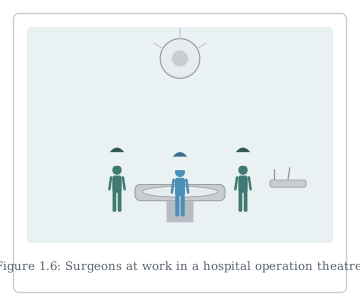
Drawn by us to help you understand the concept clearly, and verified to make sure it's accurate. For exams, practice from your NCERT textbook's own diagram.
An operating theatre with trained surgeons and modern equipment stands in sharp contrast to the manual, low-resource labour shown elsewhere on the same page. The juxtaposition illustrates how unevenly specialised knowledge, technology and institutional resources are distributed across a society -- another dimension of the …
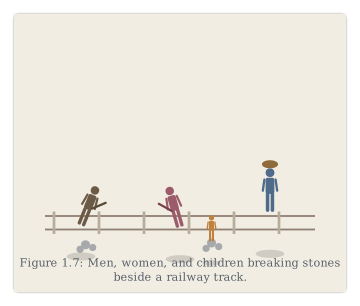
Drawn by us to help you understand the concept clearly, and verified to make sure it's accurate. For exams, practice from your NCERT textbook's own diagram.
Men, women and a child breaking stones by hand beside a railway track is one of the chapter's starkest images of manual labour and child labour -- work shaped by poverty and a lack of alternatives rather than by choice. It reinforces the point that where a person is born within the social structure has a great deal …
In the contemporary world, we belong, in a sense, to more than one society. When we are amidst foreigners, a reference to “our society” may mean Indian society. But when we are amongst fellow Indians, the same phrase can denote a linguistic or ethnic community, a religious, caste, or tribal society. This diversity makes deciding which “society” we are talking about genuinely difficult.
This difficulty of mapping society is not confined to sociologists alone. The great Indian filmmaker Satyajit Ray once reflected on what to focus on in his films, and his wondering captures the same problem. What should you put in your films? What can you leave out? Would you leave the city behind and go to the village where cows graze in the endless fields and the shepherd plays the flute? You could make a film there that would be pure and fresh, with the delicate rhythm of a boatman’s song. Or would you rather go back in time, way back to the Epics, where gods and demons took sides in a great battle where brothers killed brothers? Or would you stay where you are, right in the present, in the heart of this monstrous, teeming, bewildering city, and try to orchestrate its dizzying contrasts of sight and sound and milieu?
Ray’s dilemma shows that the plurality of Indian society is not an abstract academic problem. It is something every thinking person confronts. The same society contains the village and the metropolis, the ancient and the modern, the sacred and the chaotic. This is the plural character of society itself.
Along with plurality, there is inequality. Societies are not just different from one another; they are also marked by unequal access to resources, opportunities, and dignity. The textbook asks you to discuss the visuals and think about what kinds of pluralities and inequalities they show. This is a reminder that diversity and inequality often coexist — a society can be plural in its cultures and yet deeply unequal in its social structure.
Our everyday life is full of notions about our own society and about others’ societies. These are our everyday notions, our common sense, in terms of which we live our lives. But the observations and ideas that sociology as a discipline makes about society are different from both philosophical reflections and common sense.
Observations of philosophical and religious thinkers are often about what is moral or immoral in human behaviour, about the desirable way of living, and about a good society. Sociology too concerns itself with norms and values. But its focus is not on norms and values as they ought to be, as goals that people should pursue. Its concern is with the way they function in actual societies. In other words, the philosopher asks what a good society should look like; the sociologist asks how the norms and values of a real society actually operate in practice.
Empirical study of societies is an important part of what sociologists do. This does not mean that sociology is not concerned with values. It only means that when a sociologist studies a society, the sociologist is willing to observe and collect findings, even if they are not to her or his personal liking. Peter Berger makes an unusual but effective comparison to make this point — the sociologist, like a detective or a scientist, must report what is found, not what one wishes to find.
The key distinction: philosophy and religion prescribe how society ought to be; sociology studies how society actually functions. Both deal with norms and values, but sociology treats them as facts to be observed, not ideals to be endorsed.
To remember this, think of the sociologist as a mapmaker, not a tour guide. The mapmaker records the terrain as it is — including the slums and the polluted rivers — while the tour guide only points out the beautiful sights. …