Sociology · Ch 1 — Sociology, Society and its Relationship with other Social Sciences
The Material Issues That Went into the Making of Sociology
The Material Issues That Went into the Making of Sociology
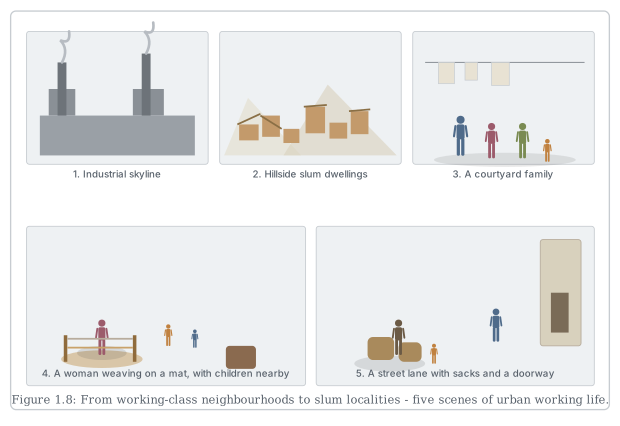
Drawn by us to help you understand the concept clearly, and verified to make sure it's accurate. For exams, practice from your NCERT textbook's own diagram.
This composite scene -- an industrial skyline, a hillside slum, a courtyard family, a woman weaving on a mat, and a street lane with sacks by a doorway -- traces the everyday texture of working-class and slum life in a city shaped by industrialisation. It grounds the chapter's discussion of the material conditions (housing, informal work, crowded settlement) that industrial capitalism pr …
The Material Issues That Went into the Making of Sociology
Sociology did not emerge in a vacuum. It was born out of the need to understand one of the most disruptive transformations in human history — the Industrial Revolution. To grasp why sociology arose when it did, you have to see what changed on the ground: the economy, the city, the factory, the clock, and the very meaning of work.
Capitalism and the New Economy
The Industrial Revolution rested on a new, dynamic form of economic activity — capitalism. This system became the driving force behind the growth of industrial manufacturing. Capitalism was not just a way of making money; it brought with it new attitudes and institutions.
- Entrepreneurs now engaged in the sustained, systematic pursuit of profit — profit was no longer incidental but the central goal.
- Markets became the key instrument of productive life. Production was organised around what could be sold, not what a community needed.
- Goods, services and labour all became commodities — things whose use was determined by rational calculation, not by tradition or personal ties.
The new economy was completely different from what it replaced. To appreciate how far-reaching this change was, consider what life in pre-industrial England looked like.
Life in Pre-Industrial England
Before industrialisation, agriculture and textiles were the chief occupations of the British. Most people lived in villages. The social landscape was familiar — much like our own Indian villages, there were:
- peasants and landlords
- the blacksmith and leather worker
- the weaver and the potter
- the shepherd and the brewer
Society was small. It was hierarchical — the status and class positions of different people were clearly defined. And like all traditional societies, it was characterised by close interaction among its members.
With industrialisation, each of these features changed.
The Degradation of Labour
One of the most fundamental aspects of the new order was the degradation of labour — the wrenching of work from the protective contexts of guild, village, and family. Work that had once been embedded in community life was now torn out and placed in the factory.
Both radical and conservative thinkers were appalled at the decline in the status of the common labourer, not to mention the skilled craftsman. The artisan who had once commanded respect for his craft was now reduced to a cog in a machine.
The Rise of the Industrial City
Urban centres expanded and grew. Cities had existed before, but their character prior to industrialisation was different. The industrial cities gave birth to a completely new kind of urban world, marked by:
- the soot and grime of factories
- overcrowded slums of the new industrial working class
- bad sanitation and general squalor
But it was also marked by new kinds of social interactions. The Hindi film song from C.I.D. (1956) captures both the material and experiential aspects of city life. The song speaks of Bombay as a place where you find buildings, trams, motors and mills — but no human heart. It describes a world of power, money, theft and cheating, where the rich mock the homeless as vagabonds, yet when they cut each other's throats, it is called "business." The same action is given various names in this place. The song captures the anonymity, the moral confusion, and the harshness of urban industrial life.
The Factory and Its Critics
The factory and its mechanical division of labour were often seen as a deliberate attempt to destroy the peasant, the artisan, as well as family and local community. The factory was perceived as an archetype of an economic regimentation hitherto known only in barracks and prisons.
According to Karl Marx, the factory was oppressive — yet potentially liberating. Here workers learnt both:
- collective functioning — working together as a coordinated mass
- concerted efforts for better conditions — organising to improve their lot
So the same institution that crushed the worker also created the conditions for worker solidarity and collective action.
The New Significance of Clock-Time
Another indicator of the emergence of modern societies was the new significance of clock-time as a basis of social organisation. In the 18th and 19th centuries, the tempo of agricultural and manufacturing labour increasingly came to be set by the clock and calendar — very different from pre-modern forms of work.
Prior to industrial capitalism, work-rhythms were set by:
- the period of daylight
- the break between tasks
- the constraints of deadlines or other social duties
Factory production implied the synchronisation of labour — work began punctually, had a steady pace, and took place for set hours on particular days of the week. The clock also injected a new urgency into work. For both employer and employee, "time is now money: it is not passed but spent." …