Sociology · Ch 1 — Sociology, Society and its Relationship with other Social Sciences
The Scope of Sociology and Its Relationship to Other Social Science Disciplines
The Scope of Sociology and Its Relationship to Other Social Science Disciplines
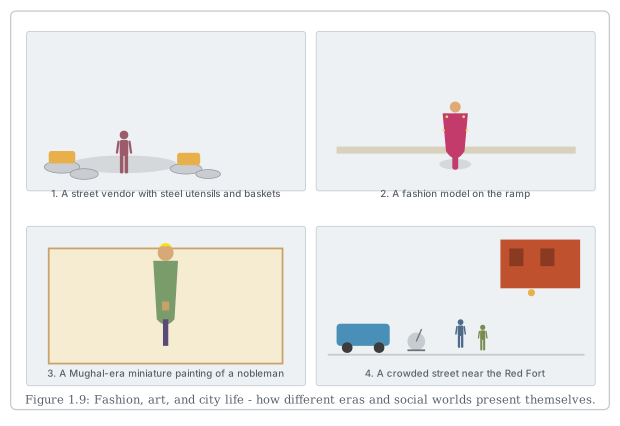
Drawn by us to help you understand the concept clearly, and verified to make sure it's accurate. For exams, practice from your NCERT textbook's own diagram.
A street vendor, a fashion show, a Mughal-style painting and a crowded historic street together capture the range of social life a single Indian city can contain -- economic activity, cultural change, historical memory and public life all at once. The chapter uses this variety to make its closing point: no single social science discipline can capture all of this on its own, which is why sociology studies its relationship to economics, political …
The scope of sociological study is extremely wide. It can focus its analysis on meaningful interactions between individuals — a shopkeeper with a customer, teachers and students, two friends, or family members. It can likewise focus on national issues such as unemployment, caste conflict, the effect of state policies on the forest rights of tribal populations, or rural indebtedness. Or it can examine global social processes: the impact of new flexible labour regulations on the working class, the effect of electronic media on the young, or the entry of foreign universities into a country's education system.
What defines the discipline of sociology is therefore not just what it studies — family, trade unions, or villages — but how it studies a chosen field. Sociology is one of a group of social sciences, which also includes anthropology, economics, political science, and history. The divisions among these social sciences are not clear-cut; all share a certain range of common interests, concepts, and methods. It is therefore very important to understand that the distinctions between disciplines are to some extent arbitrary and should not be seen in a straitjacket fashion. To differentiate the social sciences sharply would be to exaggerate the differences and gloss over the similarities. Furthermore, feminist theories have shown the greater need for an interdisciplinary approach. For instance, how would a political scientist or economist study gender roles and their implications for politics or the economy without a sociology of the family or of the gender division of labour?
Sociology and Economics
Economics is the study of the production and distribution of goods and services. The classical economic approach dealt almost exclusively with the inter-relations of pure economic variables: the relations of price, demand and supply; money flows; output and input ratios; and the like. The focus of traditional economics has been on a narrow understanding of 'economic activity', namely the allocation of scarce goods and services within a society. Economists influenced by a political economy approach seek to understand economic activity in a broader framework of ownership of, and relationship to, the means of production. The objective of the dominant trend in economic analysis, however, was to formulate precise laws of economic behaviour.
The sociological approach looks at economic behaviour in a broader context of social norms, values, practices, and interests. The corporate sector managers are aware of this. The large investment in the advertisement industry is directly linked to the need to reshape lifestyles and consumption patterns. Trends within economics, such as feminist economics, seek to broaden the focus, drawing in gender as a central organising principle of society. For instance, they would look at how work in the home is linked to productivity outside.
The defined scope of economics has helped facilitate its development as a highly focused, coherent discipline. Sociologists often envy economists for the precision of their terminology, the exactness of their measures, and their ability to translate the results of theoretical work into practical suggestions having major implications for public policy. Yet economists' predictive abilities often suffer precisely because of their neglect of individual behaviour, cultural norms, and institutional resistance — which sociologists study.
Pierre Bourdieu wrote in 1998 that a true economic science would look at all the costs of the economy — not only at the costs that corporations are concerned with, but also at crimes, suicides, and so on. He argued for an economics of happiness, which would take note of all the profits, individual and collective, material and symbolic, associated with activity (such as security), and also the material and symbolic costs associated with inactivity or precarious employment (for example, the consumption of medicines — France holds the world record for the use of tranquilisers).
Sociology, unlike economics, usually does not provide technical solutions. But it encourages a questioning and critical perspective. This helps question basic assumptions, and thereby facilitates a discussion of not just the technical means towards a given goal, but also the social desirability of the goal itself. Recent trends have seen a resurgence of economic sociology, perhaps because of both this wider and critical perspective of sociology. Sociology provides a clearer or more adequate understanding of a social situation than existed before — either on the level of factual knowledge, or through gaining an improved grasp of why something is happening, that is, by means of theoretical understanding.
Sociology and Political Science
As in the case of economics, there is an increased interaction of methods and approaches between sociology and political science. Conventional political science was focused primarily on two elements: political theory and government administration. Neither branch involves extensive contact with political behaviour. The theory part usually focuses on ideas about government from Plato to Marx, while courses on administration generally deal with the formal structure of government rather than its actual operation.
Sociology is devoted to the study of all aspects of society, whereas conventional political science restricted itself mainly to the study of power as embodied in formal organisation. Sociology stresses the interrelationships between sets of institutions, including government, whereas political science tends to turn attention towards the processes within the government. However, sociology long shared similar interests of research with political science. Sociologists like Max Weber worked in what can be termed political sociology. The focus of political sociology has been increasingly on the actual study of political behaviour. Even in recent Indian elections one has seen the extensive study of political patterns of voting. Studies have also been conducted on membership of political organisations, the process of decision-making in organisations, sociological reasons for support of political parties, the role of gender in politics, and so on.
Sociology and History
Historians almost as a rule study the past; sociologists are more interested in the contemporary or recent past. Historians earlier were content to delineate the actual events, to establish how things actually happened, while in sociology the focus was to seek to establish causal relationships. History studies concrete details, while the sociologist is more likely to abstract from concrete reality, categorise, and generalise. Historians today are equally involved in using sociological methods and concepts in their analysis.
Conventional history has been about the history of kings and war. The history of less glamorous or exciting events — such as changes in land relations or gender relations within the family — has traditionally been less studied by historians, but formed the core area of the sociologist's interest. Today, however, history is far more sociological, and social history is the stuff of history. It looks at social patterns, gender relations, mores, customs, and important institutions other than the acts of rulers, wars, and monarchy.
Sociology and Psychology
Psychology is often defined as the science of behaviour. It involves itself primarily with the individual. It is interested in her or his intelligence and learning, motivations and memory, nervous system and reaction time, hopes and fears. Social psychology, which serves as a bridge between psychology and sociology, maintains a primary interest in the individual but concerns itself with the way in which the individual behaves in social groups, collectively with other individuals.
Sociology attempts to understand behaviour as it is organised in society — that is, the way in which personality is shaped by different aspects of society: the economic and political system, family and kinship structure, culture, norms, and values. It is interesting to recall that Durkheim, who sought to establish a clear scope and method for sociology in his well-known study of suicide, left out the individual intentions of those who commit or try to commit suicide in favour of statistics concerning various social characteristics of these individuals.
Sociology and Social Anthropology
Anthropology in most countries incorporates archaeology, physical anthropology, cultural history, many branches of linguistics, and the study of all aspects of life in 'simple societies'. The concern here is with social anthropology and cultural anthropology, for it is these that are close to the study of sociology. Sociology is deemed to be the study of modern, complex societies, while social anthropology was deemed to be the study of simple societies.
Each discipline has its own history or biography. Social anthropology developed in the west at a time when it meant that western-trained social anthropologists studied non-European societies, often thought of as exotic, barbaric, and uncivilised. This unequal relationship between those who studied and those who were studied was not remarked upon too often earlier. But times have changed, and we have the erstwhile 'natives' — be they Indians or Sudanese, Nagas or Santhals — who now speak and write about their own societies. The anthropologists of the past documented the details of simple societies, apparently in a neutral scientific fashion. In practice, they were constantly comparing those societies with the model of western modern societies as a benchmark.
Other changes have also redefined the nature of sociology and social anthropology. Modernity led to a process whereby the smallest village was impacted by global processes. The most obvious example is colonialism. The most remote village of India under British colonialism saw its land laws and administration change, its revenue extraction alter, and its manufacturing industries collapse. Contemporary global processes have further accentuated this 'shrinking of the globe'. The assumption of studying a simple society was that it was bounded — we know this is not so today. …