Sociology · Ch 1 — Sociology, Society and its Relationship with other Social Sciences
Sociology and Economics
Sociology and Economics
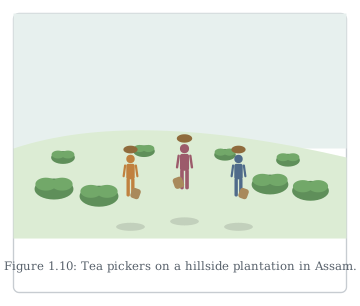
Drawn by us to help you understand the concept clearly, and verified to make sure it's accurate. For exams, practice from your NCERT textbook's own diagram.
Women picking tea leaves on a hillside plantation illustrate labour organised around a specific commercial crop and export economy -- exactly the kind of production and livelihood question that sociology studies in dialogue with economics. The image grounds the sub-section's discussion of how sociology and economics overlap: both are interested in work and production, but sociology asks about the social relationships and …
Sociology and Economics
Economics, at its core, studies how societies produce and distribute goods and services. But the way economists have traditionally gone about this has been very specific. Classical economics focused almost entirely on the relationships between pure economic variables — price, demand, supply, money flows, output and input ratios. The world of the traditional economist was a world of these measurable, interlocking quantities.
The focus of this traditional economics was a narrow understanding of "economic activity": the allocation of scarce goods and services within a society. The dominant objective was to formulate precise laws of economic behaviour — laws that could predict how markets would move and how people would respond to changes in price or supply. This precision is exactly what made economics such a powerful and coherent discipline. Sociologists often envy economists for the exactness of their terminology, the precision of their measures, and their ability to translate theoretical work into practical suggestions with major implications for public policy.
But this narrowness came at a cost. Economists' predictive abilities often fail precisely because they neglect the things sociologists study: individual behaviour, cultural norms, and institutional resistance. People do not always behave as rational economic actors; they are shaped by their values, their social practices, and their interests.
The sociological approach, in contrast, looks at economic behaviour in a broader context of social norms, values, practices and interests. The corporate sector is well aware of this. The huge investment in the advertisement industry is directly linked to the need to reshape lifestyles and consumption patterns — to change what people value and desire, not just to inform them about products.
There are also trends within economics itself that seek to broaden its focus. Feminist economics, for instance, treats gender as a central organising principle of society. Feminist economists would look at how work in the home — unpaid, invisible, traditionally women's work — is linked to productivity outside the home. The economy, in this view, cannot be understood without understanding the social relations that sustain it.
Some economists have gone further. Pierre Bourdieu wrote in 1998 that a true economic science would look at all the costs of the economy — not only the costs corporations are concerned with, but also crimes, suicides, and so on. He called for an "economics of happiness" that would take note of all the profits, individual and collective, material and symbolic, associated with activity (such as security), and also the material and symbolic costs associated with inactivity or precarious employment. He pointed out, for example, that France holds the world record for the use of tranquilisers — a cost of economic insecurity that never appears in standard economic accounting.
Sociology, unlike economics, usually does not provide technical solutions. But it encourages a questioning and critical perspective. This helps question basic assumptions — not just the technical means towards a given goal, but also the social desirability of the goal itself. Is economic growth always good? Is efficiency always worth it? Sociology opens up these questions. …