Sociology · Ch 1 — Sociology, Society and its Relationship with other Social Sciences
The Sociological Imagination: The Personal Problem and the Public Issue
The Sociological Imagination: The Personal Problem and the Public Issue
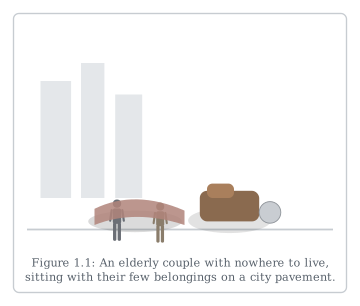
Drawn by us to help you understand the concept clearly, and verified to make sure it's accurate. For exams, practice from your NCERT textbook's own diagram.
The image captures an elderly couple sitting beside their few belongings on a pavement -- a private, personal circumstance. A purely individual reading would treat this as one family's misfortune. But the sociological imagination asks us to connect this private trouble to a public issue: patterns of old-age poverty, weak family or state support systems, and the structural conditions that leave elderly people without shelter are not one family's failing but a feature of how society is organised. This is exactly the …
The sociological imagination is not a method or a tool you pick up; it is a way of seeing. It asks you to hold two things in your mind at once — the individual and the society — and to refuse to explain one without the other. C. Wright Mills, the American sociologist who coined the term, built his entire vision of sociology on this single move: unravelling how the personal and the public are related. For Mills, the promise of sociology lies precisely here — in grasping history and biography and the relations between the two within society.
To do this work, Mills offers what he calls the most fruitful distinction the sociological imagination works with: the difference between personal troubles of the milieu and public issues of social structure.
Personal troubles occur within the character of the individual and within the range of his immediate relations with others. They have to do with his self, and with those limited areas of social life of which he is directly and personally aware. A trouble is private — it belongs to one person's life and the small circle around him.
Public issues, by contrast, transcend these local environments of the individual and the range of his inner life. An issue is not about one person's character or circumstances; it is about the structure of society itself, and it affects many people at once, often in ways they cannot see from where they stand.
The key insight is that the two are not separate. The facts of contemporary history are also facts about the success and failure of individual men and women. Mills drives this home with a series of examples:
- When a society is industrialised, a peasant becomes a worker; a feudal lord is liquidated or becomes a businessman.
- When classes rise or fall, a man is employed or unemployed.
- When the rate of investment goes up or down, a man takes new heart or goes broke.
- When wars happen, an insurance salesman becomes a rocket launcher; a store clerk, a radar man; a wife lives alone; a child grows up without a father.
In each case, what looks like a personal fate — a job lost, a family broken — is actually a public issue working itself out through individual lives. Mills concludes: neither the life of an individual nor the history of a society can be understood without understanding both.
The sociological imagination is the capacity to see the connection between personal troubles and public issues — to understand that biography and history are always intertwined within society.
The textbook applies this lens to a concrete case: homelessness. A photograph shows a poor and homeless couple. At first glance, homelessness might seem like a personal trouble — a failure of the individual. But the sociological imagination reveals it as a public issue. The causes are structural: employment possibilities, rural to urban migration, and other social forces that push people out of homes. The state itself treats homelessness as a public issue requiring concrete measures. The Pradhan Mantri Awas Yojna–Gramin, operationalised from 2016, is a major scheme by the Ministry of Rural Development that provides financial and labour support to houseless families and those living in dilapidated kutcha houses, helping them build pucca houses. The very existence of such a scheme shows that homelessness is understood not as a private failing but as a social problem demanding a public response.
To test whether something is a personal trouble or a public issue, ask: if one person faces it, it may be a trouble; if millions face it because of how society is organised, it is an issue.
The chapter then widens the discussion. The question of what to focus on in society is central to sociology. The textbook raises the example of Satyajit Ray's depiction of a village and asks whether it is romantic — and contrasts this with a sociologist's account of a Dalit in the village. The account describes Muli, a gaunt forty-year-old with betel-blackened teeth and long hair swept back, sitting on the dusty road in front of a thatch-roofed tea shop, his glass and saucer placed conspicuously beside him — a silent signal to the shopkeeper that an Untouchable wanted to buy tea. The contrast is stark: one vision of village life is aesthetic and nostalgic; the other is a record of caste-based exclusion enacted in the smallest daily gestures.
Finally, the textbook turns to inequality, quoting Amartya Sen to show how inequality is central to differences among societies: …