Computer Science · Ch 3 — Emerging Trends
Blockchains
Blockchains
Traditionally, digital transactions are performed against a centralised database: transactions are updated on it one by one. This is how ticket-booking websites and banks operate today. The weakness is obvious — with all the data stored in one central location, there is a real chance of the data being hacked or lost.
The blockchain idea: decentralise the database
Blockchain technology works on the opposite concept: a decentralised and shared database, where each computer holds a copy of the database. There is no single point to attack or lose.
Blocks
- A block can be thought of as a secured chunk of data or a valid transaction.
- Each block carries some data called its header, which is visible to every other node — while only the owner has access to the private data of the block.
- These blocks link together to form a chain — the blockchain (Figure 3.14).
The ledger
A blockchain can be defined as a system that allows a group of connected computers to maintain a single, updated and secure ledger. Its working rules:
- Every computer (node) participating in the blockchain receives a full copy of the database.
- The ledger is 'append only' — entries can be added, never rewritten.
- The open ledger is updated only after all the nodes within the network authenticate the transaction.
Why it is safe
Because every member of the network keeps a copy of the blockchain, it is not possible for any single member to make changes or alter the data. Tampering by one node is immediately contradicted by everyone else's copies — security comes from the structure itself, not from guarding one central vault.
Applications
- Digital currency — the most popular application of blockchain technology today.
- Thanks to its decentralised nature, openness and security, blockchain is also seen as a way to bring transparency, accountability and efficiency to business and governance systems:
- Healthcare — better data sharing between healthcare providers would raise the probability of accurate diagnosis, enable more effective treatments, and increase healthcare organisations' overall ability to deliver cost-effective care. …
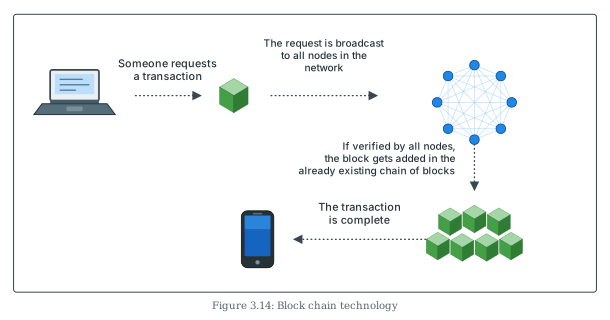
Drawn by us to help you understand the concept clearly, and verified to make sure it's accurate. For exams, practice from your NCERT textbook's own diagram.
This figure walks through the life of a single blockchain transaction as a four-step flow diagram, the steps connected by dotted arrows inside a rectangular frame:
- "Someone requests a transaction" — shown as a laptop. A user initiates a transaction from their device.
- "The request is broadcast to all nodes in the network" — a single green cube (a block, the secured chunk of data representing the transaction) points to a mesh network of interconnected blue dots. The dots are the participating computers (nodes); the mesh shows that the request goes to every node, not to one central server.
- "If verified by all nodes, the block gets added in the already existing chain of blocks" — the mesh points to a cluster of stacked green cubes: the growing blockchain. This is the crucial rule the section states — the ledger is updated only after all the nodes within the network authenticate the transaction.
- "The transaction is complete" — an arrow leads to a smartphone, the confirmation reaching the user. …